









 Ha Giang
 Hanoi
Hanoi Ho Chi Minh City
 Ha Long
 Sapa
Sapa Mekong Delta
 Da Nang
 Hue
Hue Hoi An
 Ninh Binh
 Da Lat
 Nha Trang
 Phan Thiet
 Phu Quoc
 Quang Binh
 Quy Nhon
 Vung Tau
 Thai Nguyen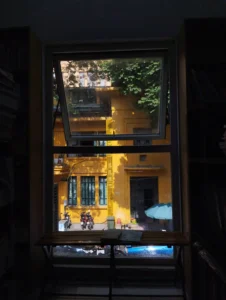
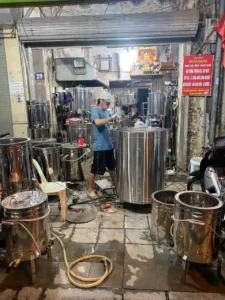
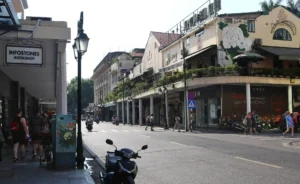
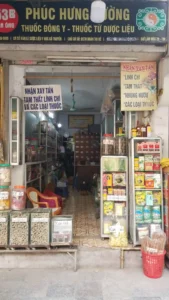


Hanoi is an incredibly dense city, which means most of the important historical sites, architecture, and older neighborhoods are physically compressed into just a few square kilometers.
If you look up things to do in the city center, a Hanoi walking tour will show up on almost every list. Many companies offer 3-hour guided walks that take you past the lake, point at a few buildings, and then bring you back to your hotel.
You can pay for that if you prefer to have the navigation handled for you. But honestly, if you have a smartphone with a reliable GPS signal and a comfortable pair of shoes, you can do this completely on your own and save your money.
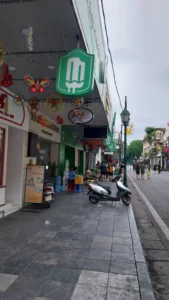
The biggest mistake people make when attempting a Hanoi walking tour self guided is walking without intent. The Old Quarter is a maze. If you just leave your hotel and turn down random streets, everything quickly starts looking the same. You will end up walking past convenience stores, travel agencies, and identical souvenir shops without seeing the actual bones of the city.
To get anything out of walking here, you need to understand that the center is geographically split by history.
I have mapped out two very distinct, straightforward routes below. The first one takes you deep into the original commercial heart of the city to see how people have worked and traded for centuries. The second one walks you through the shift into French colonial architecture with its massive avenues.
Load these into your map, pace yourself based on the weather, and start walking.
- Quick Answer: You can easily do a Hanoi walking tour self-guided if you have a reliable map. Instead of wandering randomly, break your walking down into two structured routes. Route 1 focuses on the original 36 guild streets (starting at the Old City Gate, passing the medicine and tin streets, and ending at Dong Xuan market). Route 2 covers the French colonial architecture (starting at St. Joseph’s Cathedral and walking down the wide, tree-lined boulevards to the Opera House).
- How to pace yourself: Do not combine both routes into a single day if you are visiting in the summer. Split them up. Walk the Old Quarter in the morning when the markets open, and walk the French Quarter in the late afternoon.
- Route 1: The Old Quarter Trades
- Starts at O Quan Chuong, the last remaining gate of the ancient citadel.
- Walk down Hang Chieu (Mat street) and turn into Hang Thiec (Tin street) and Thuoc Bac (Medicine street). The attraction here isn’t museums, it is observing how specific trades have stayed on the same streets for decades.
- Finish near Phung Hung, the stone railway arches painted with artwork of historical city scenes.
- Route 2: The French Colonial Transition
- Starts at St. Joseph’s Cathedral.
- Walks down Trang Tien street, where the chaotic alleys disappear and turn into wide pavements, bookstores, and government buildings.
- Finishes at the Hanoi Opera House and the surrounding cafes.
- When a guided tour makes sense: Seeing buildings is easy to do on your own for free. Navigating the street food scene and figuring out what exactly goes into the cooking pots requires a local. Booking a food-focused walking tour is where spending money is actually highly beneficial.
Understanding the Layout of the Streets
Before stepping off the curb, it helps to understand why the Old Quarter is laid out the way it is. The area is historically known as “36 Phố Phường” (the 36 guild streets). Each street was originally dedicated to a specific craft or trade.
In the 15th century, craftsmen from rural provinces around the Red River Delta began moving to the capital. They grouped themselves by trade on specific streets to organize production, share resources, and pay taxes to the imperial court. The streets are almost all named “Hàng” followed by the product they sold, Hàng Bạc (Silver Street), Hàng Tre (Bamboo Street), Hàng Gai (Silk Street).
While some streets now sell modern plastic goods, several still retain their original trades. Walking these streets isn’t about looking at static monuments; it’s about watching an active, centuries-old commercial ecosystem function around you.
The French Quarter, situated to the south and east of Hoan Kiem Lake, represents a completely different phase of the city’s history. When the French took control in the late 19th century, they wanted to rebuild Hanoi in the image of Paris. They filled in historical lakes, tore down large portions of the ancient imperial citadel, and laid down wide, straight avenues lined with leafy trees and colonial administrative villas.
By taking both routes, you will walk through the physical transition between these two contrasting eras.
Route 1: The Guilds and Trades (Old Quarter Route)
- Total Walking Distance: About 2.5 kilometers.
- Time needed: 1.5 to 2 hours at a slow pace.
- Best time to go: Start around 8:00 AM. The weather is cooler, the street vendors are setting up their produce, and the streets are actively functioning before the midday slowdown.
This route ignores the commercialized tourist areas entirely. You are going into the traditional streets where specific industries dominate. It is sensory-heavy. There is no air-conditioning on this route, and the pavements are narrow.
Stop A: Start at O Quan Chuong (The Old City Gate)
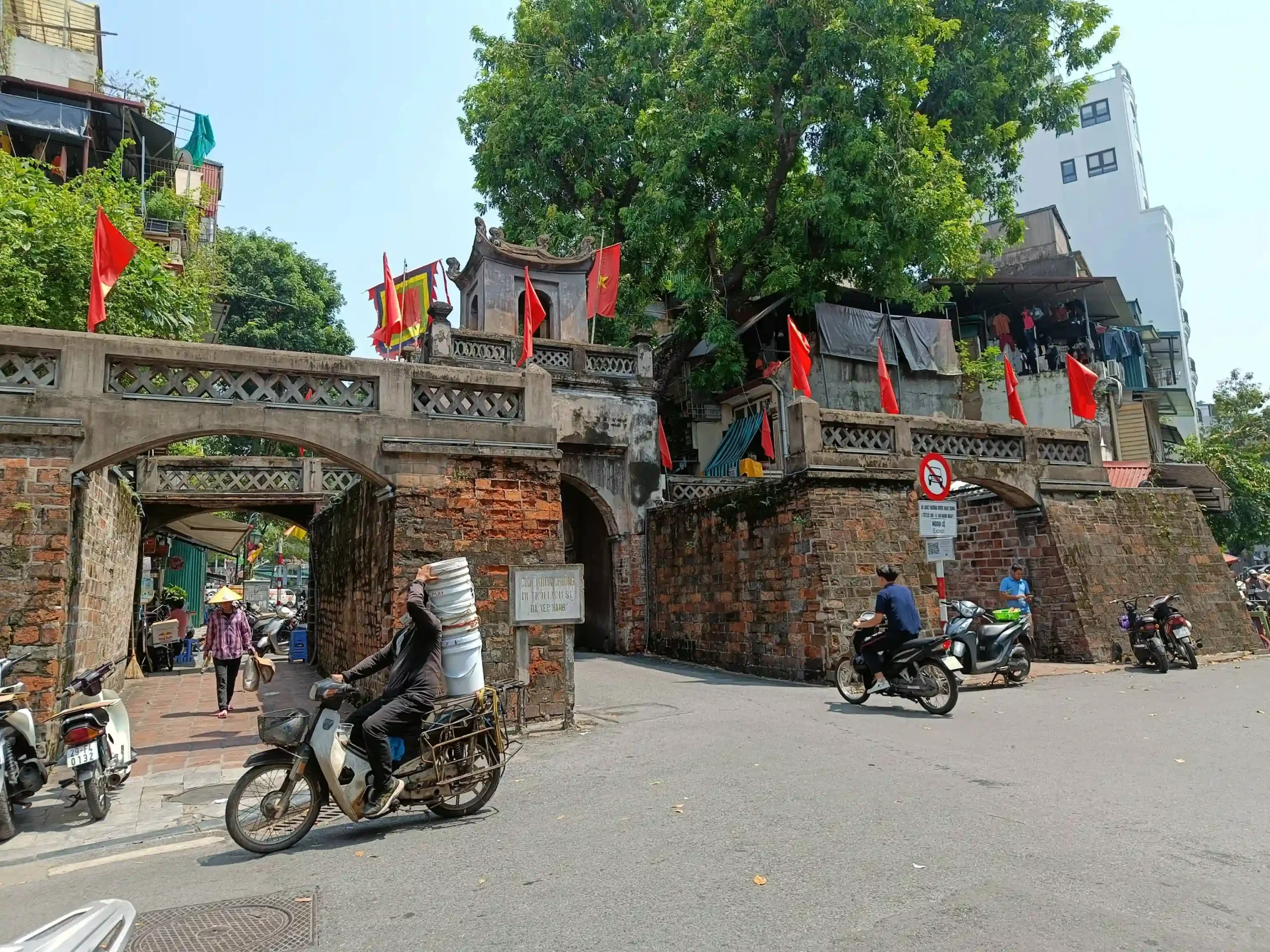
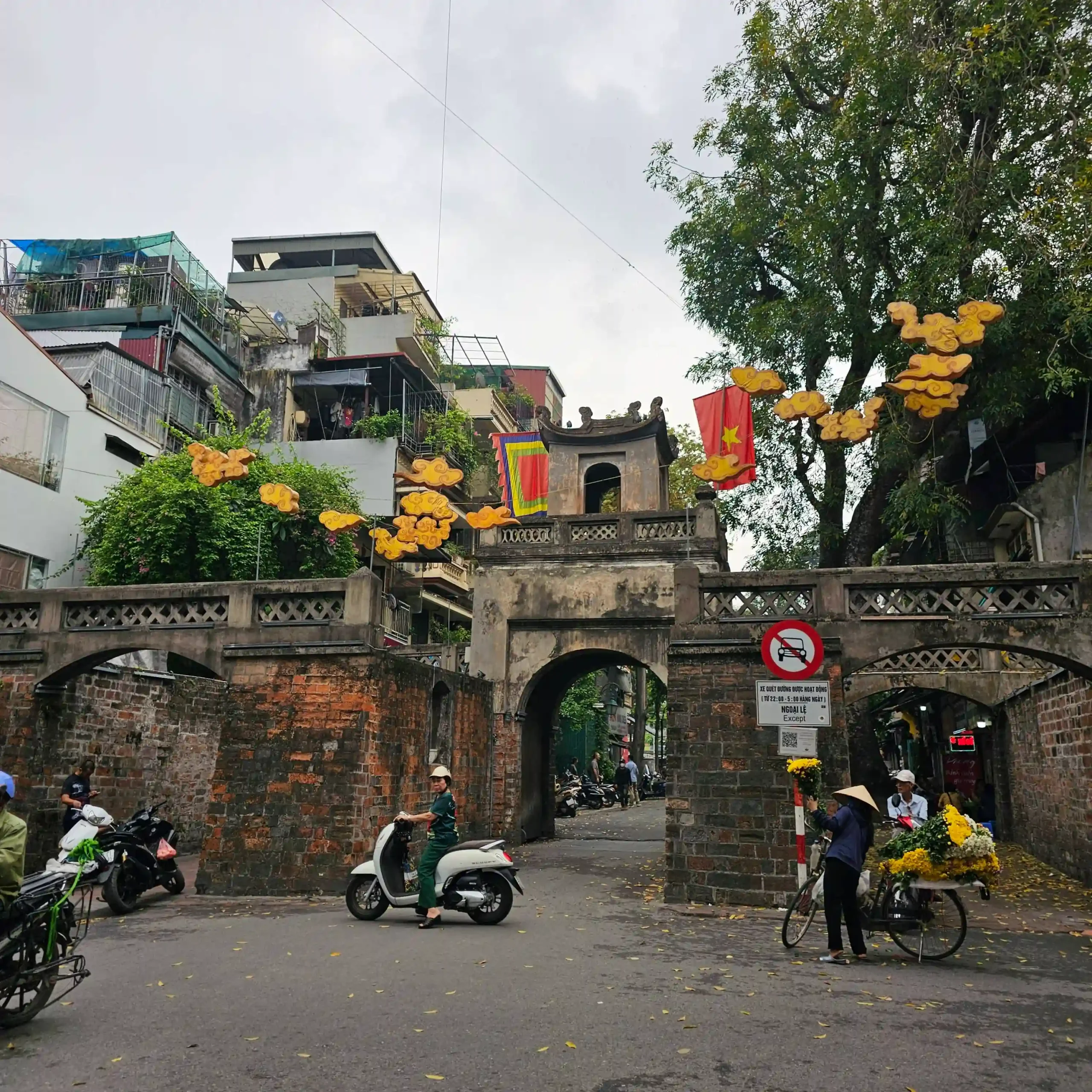
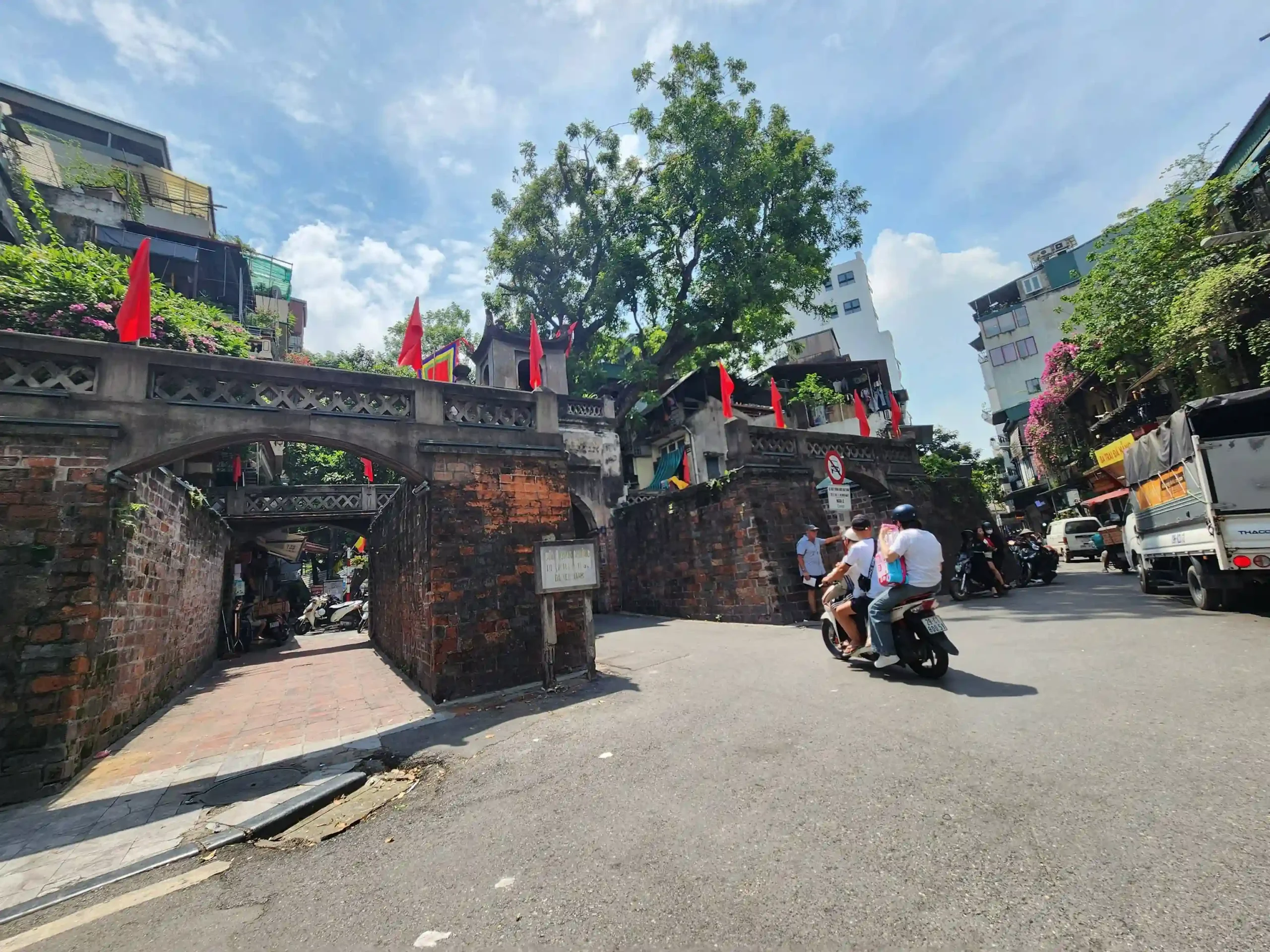
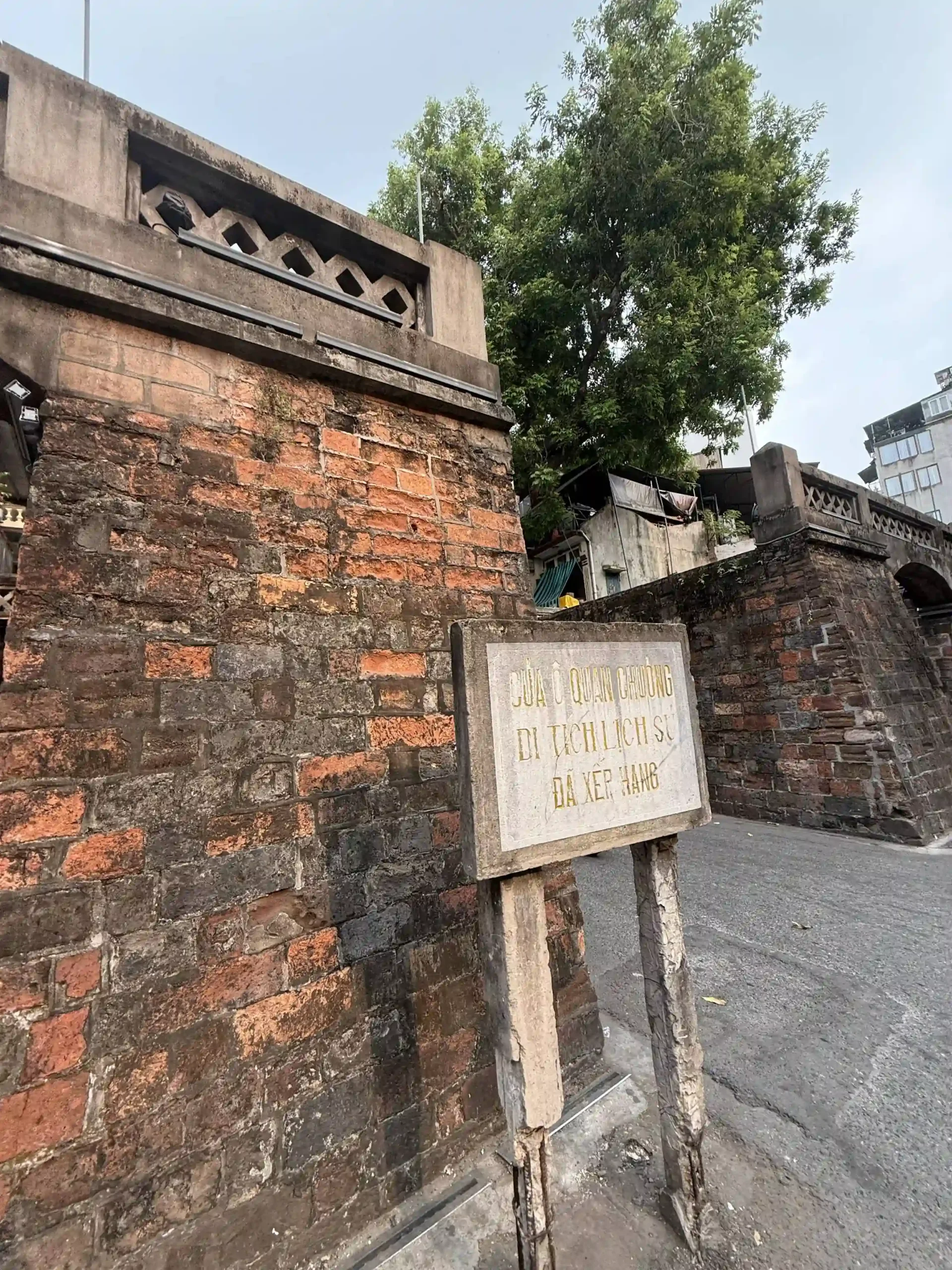
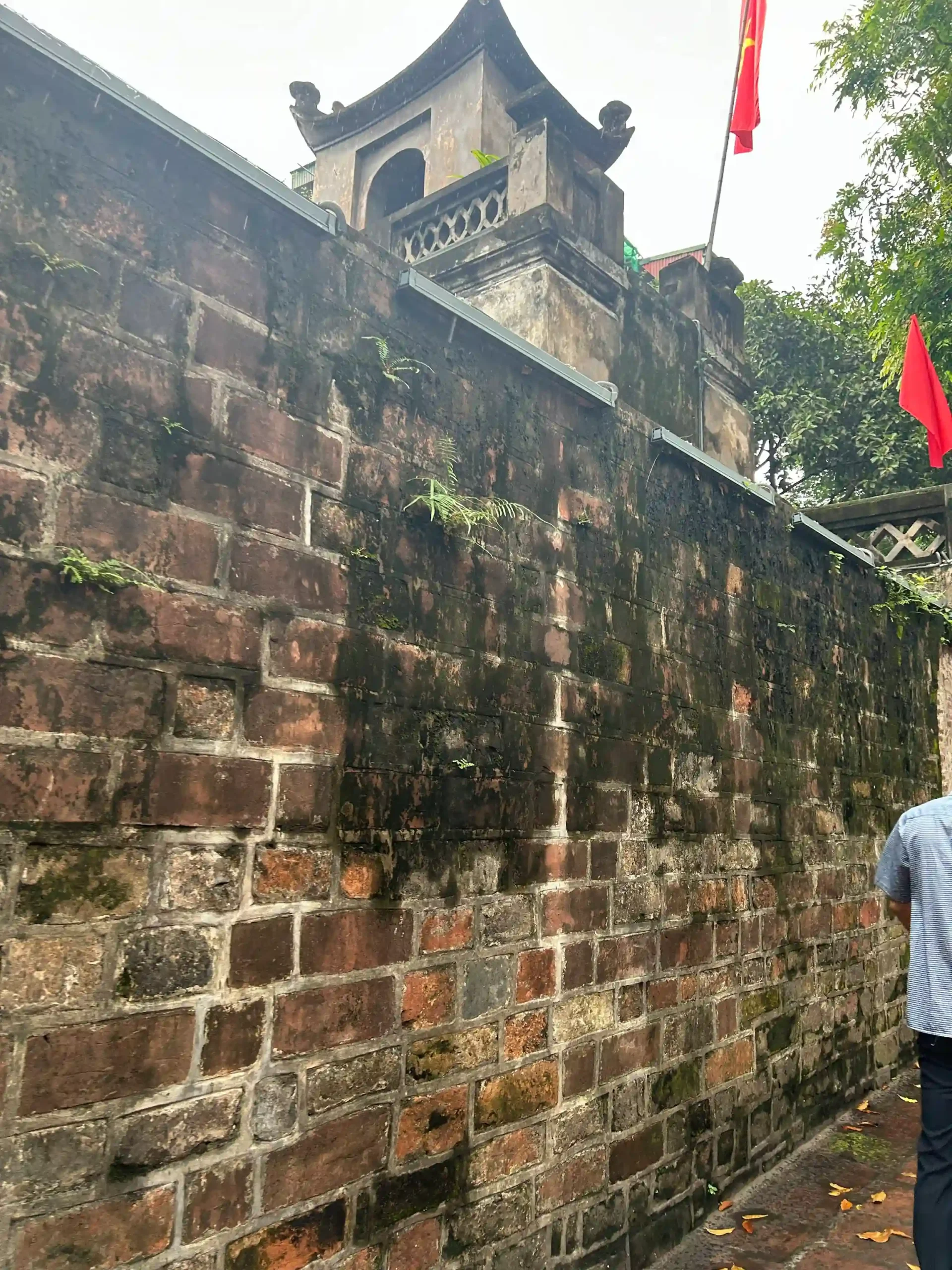
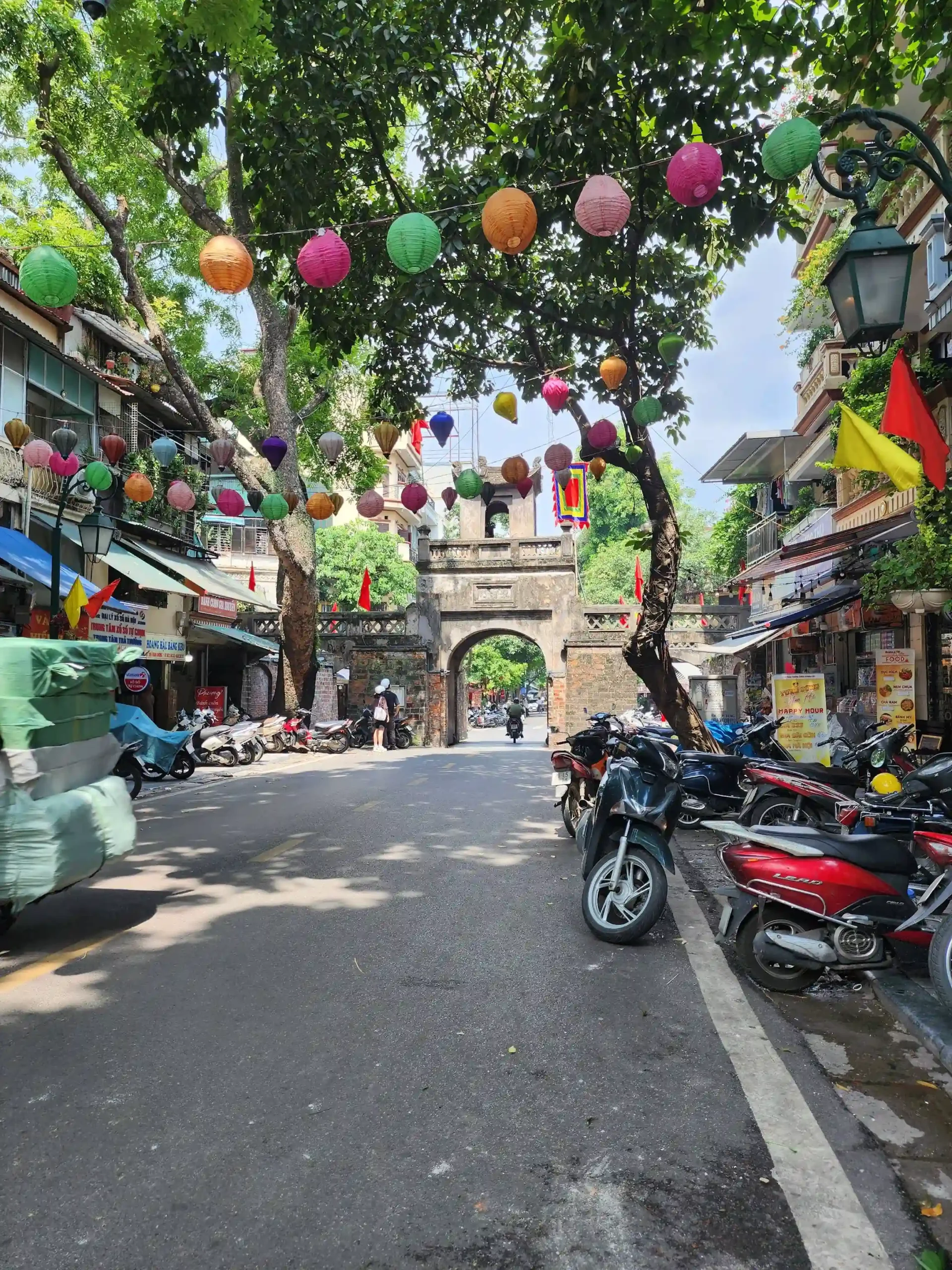
Start your walk at the intersection of Hang Chieu and Thanh Ha streets.
Sitting in the middle of a modern traffic intersection is the Quan Chuong City Gate. Out of the original sixteen gates that once guarded the brick walls of the ancient Thang Long Citadel, this is the only one left standing today.
Built in 1749 under the reign of Emperor Le Hien Tong, the gate survived French artillery bombardments during the conquest of Tonkin because it served as a highly strategic military checkpoint. It is constructed from large, heavy red bricks and mortar, featuring a large central arched gateway designed for carts and horses, flanked by two smaller, lower pedestrian archways on either side.
Take a moment to stand near the side of the gate. You will see locals hauling towering stacks of fresh herbs, pineapples, or cardboard boxes on the backs of old Honda motorbikes, riding directly through the 270-year-old central archway. There are no velvet ropes or glass barriers. History is simply built into the daily commute.
On the brick wall above the central arch, look for a small stone tablet. This is a real imperial decree issued in 1881, written in Han-Nom characters, strictly forbidding soldiers from harassing or extorting the local merchants passing through the gate. Today, the space right under the arches is usually occupied by elderly ladies selling betel leaves, lime paste, and small packets of salt.
Stop B: Down Hang Chieu (Mat Street)
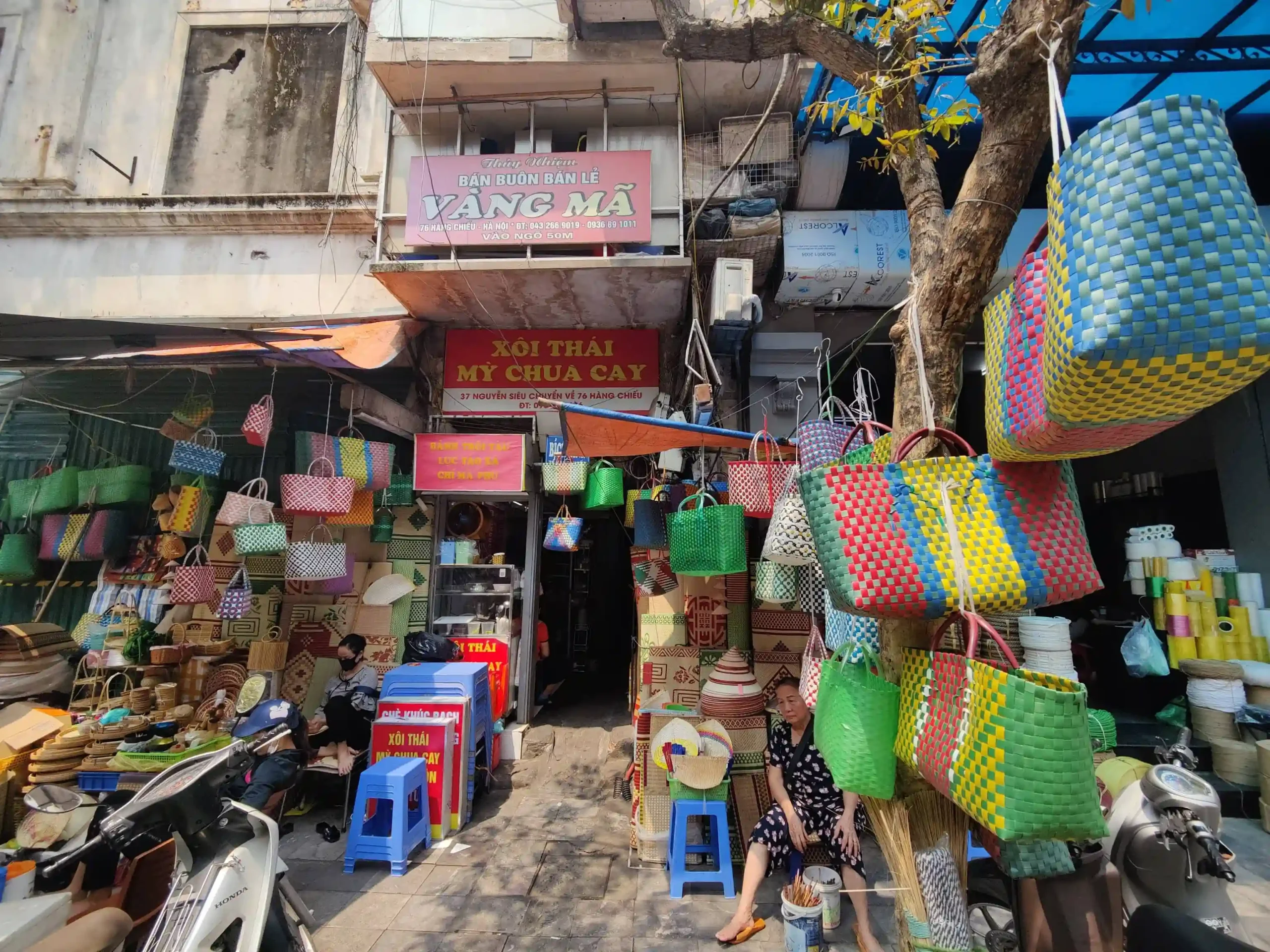
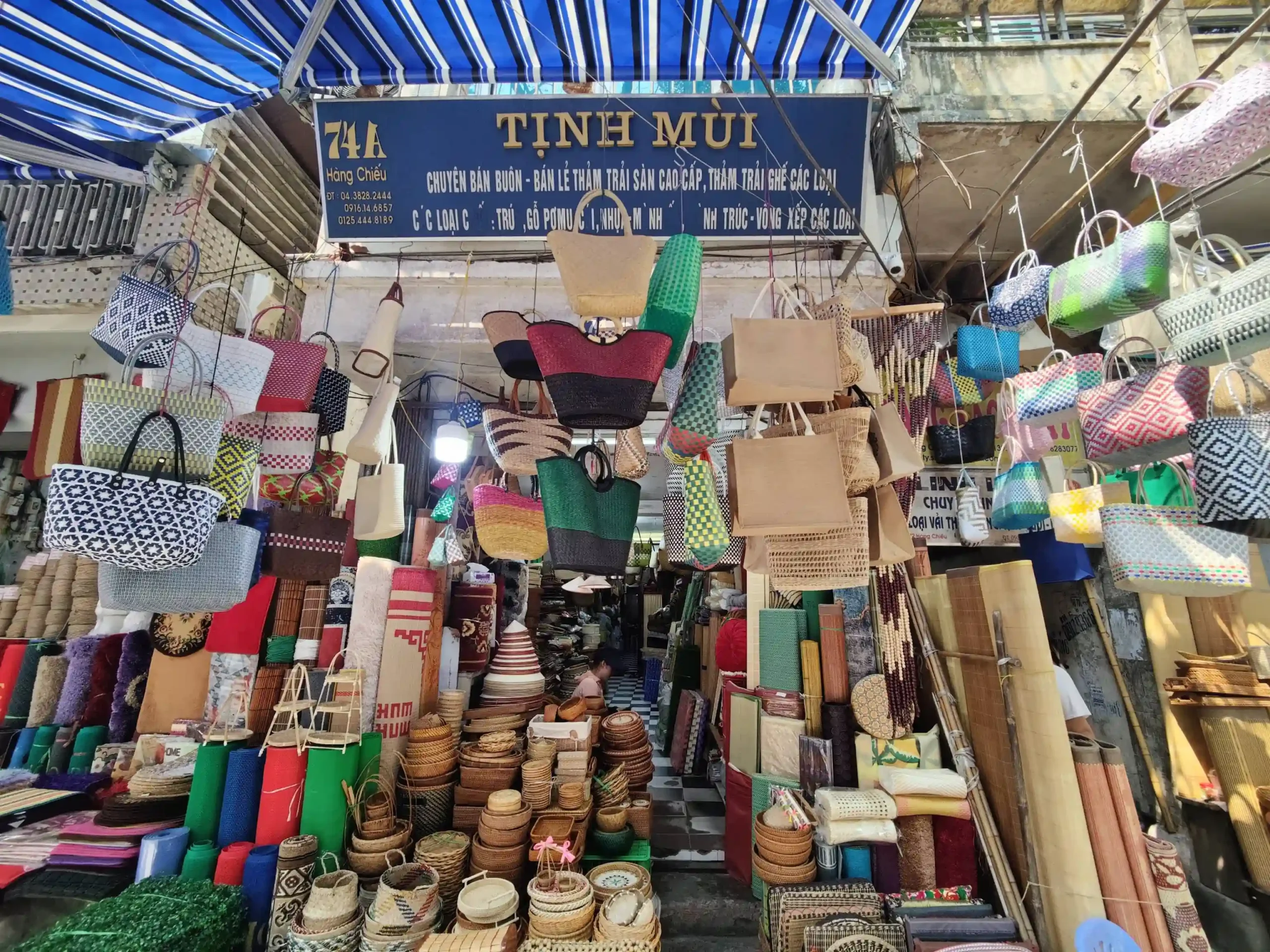
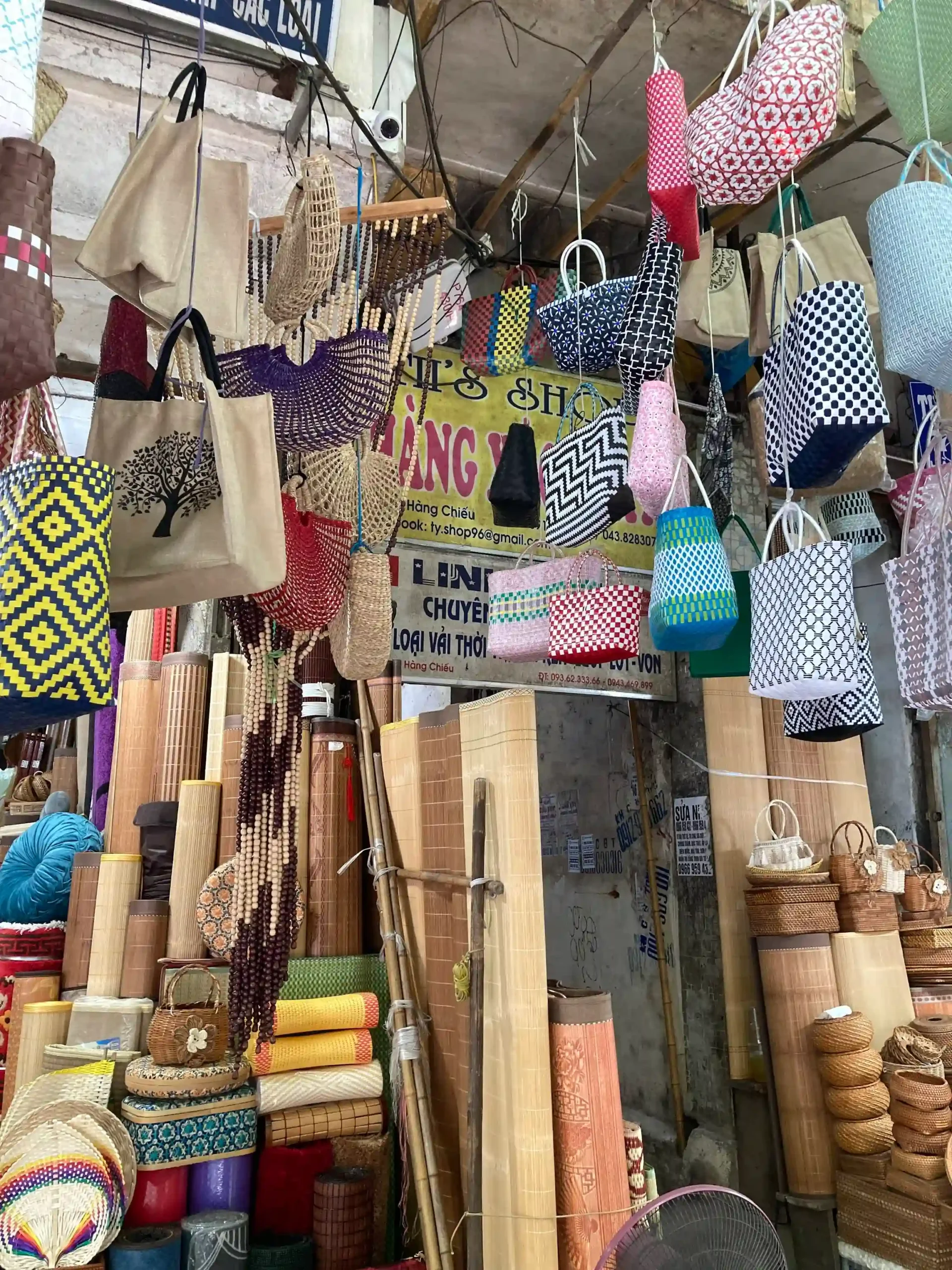
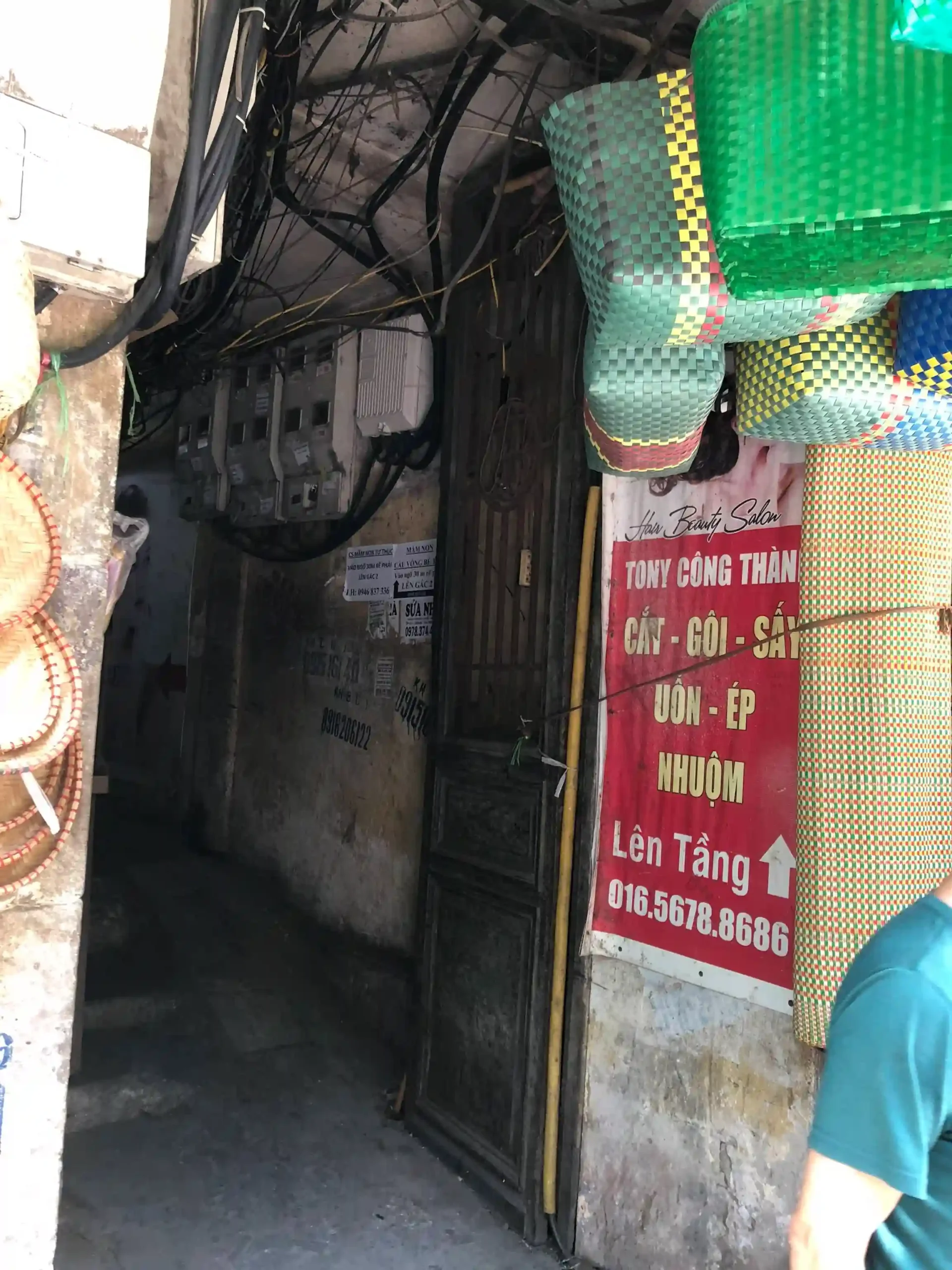
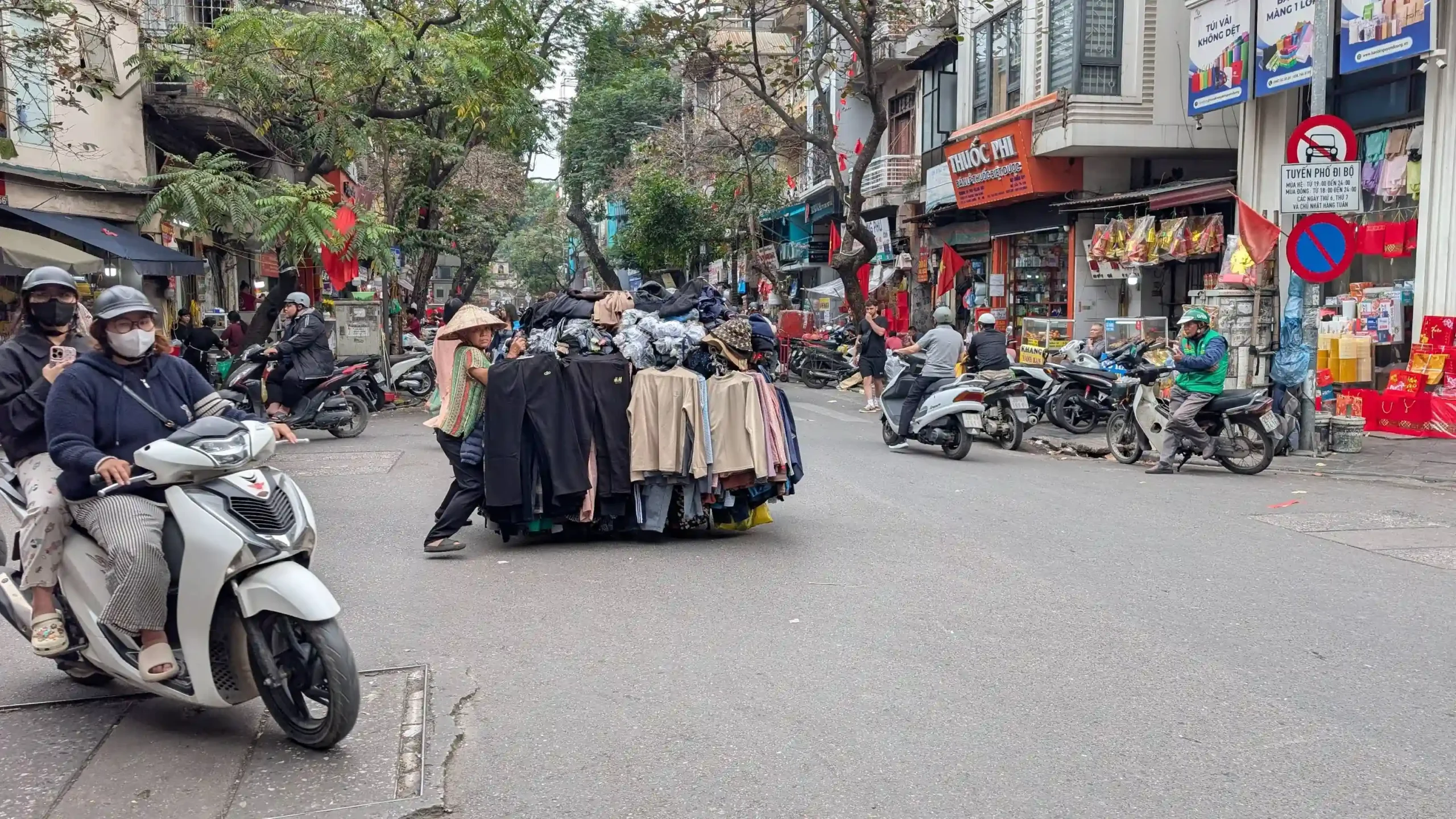
Walk through the central arch of the gate and continue straight down Hang Chieu.
This is the original “Mat Street.” Historically, the proximity of the Red River docks made this street the drop-off point for raw bamboo, sedge, and reeds imported from the coastal provinces. Local families wove these raw materials into mats (chiếu) and bags on the sidewalks.
As you walk down the street, you can still see stacks of rolled bamboo mats, synthetic plastic carpets, and heavy rolls of canvas packing material piled high in front of the narrow shops. Squeeze past the delivery motorbikes loading up these rolls.
Look up at the second floors of the buildings. You will notice the narrow facades typical of the traditional “tube house” design. These houses are often only three meters wide but can extend thirty meters deep into the block, punctuated by interior courtyards that let in light and air.
Stop C: Hang Luoc (The Old River Bed)
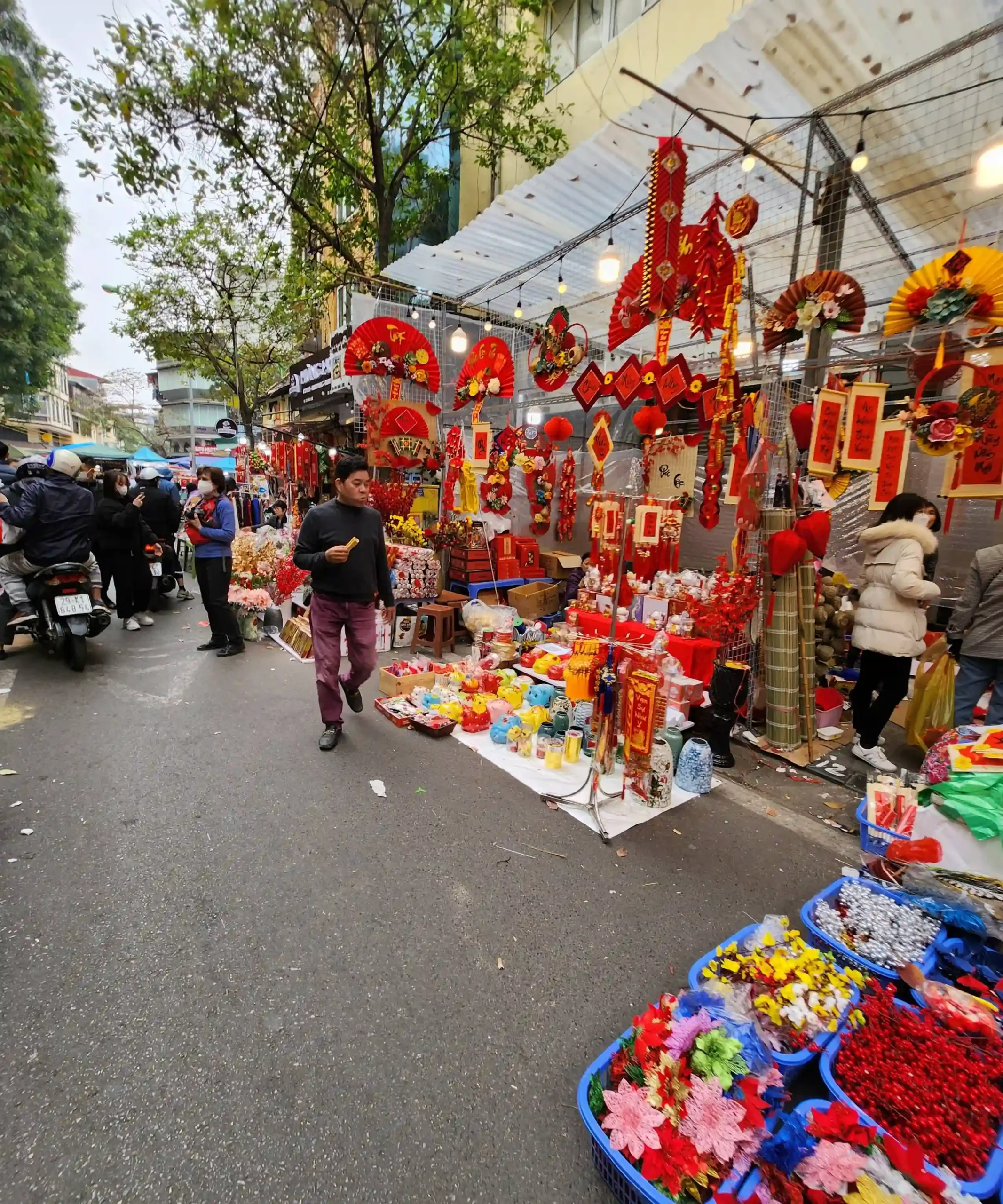
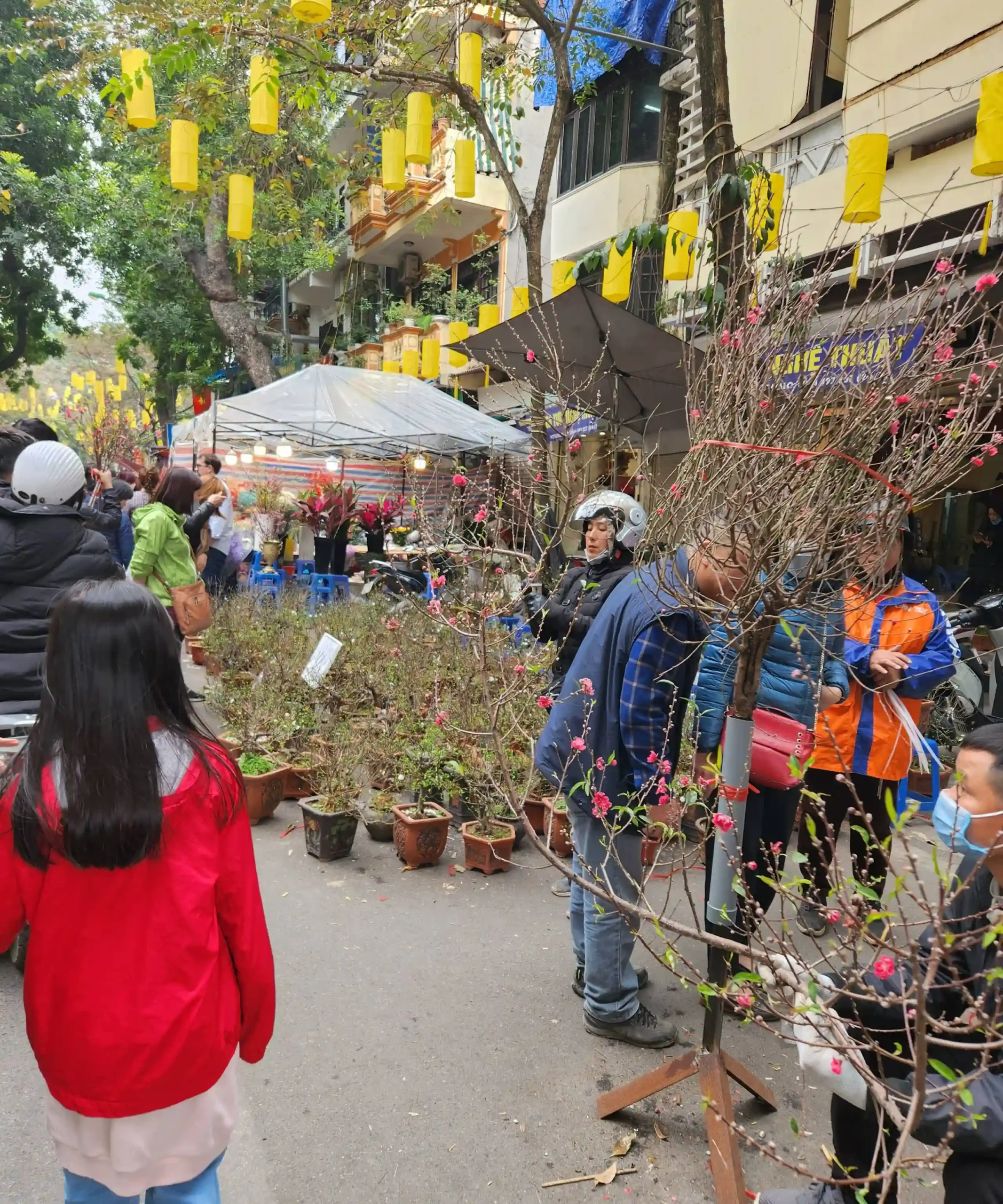
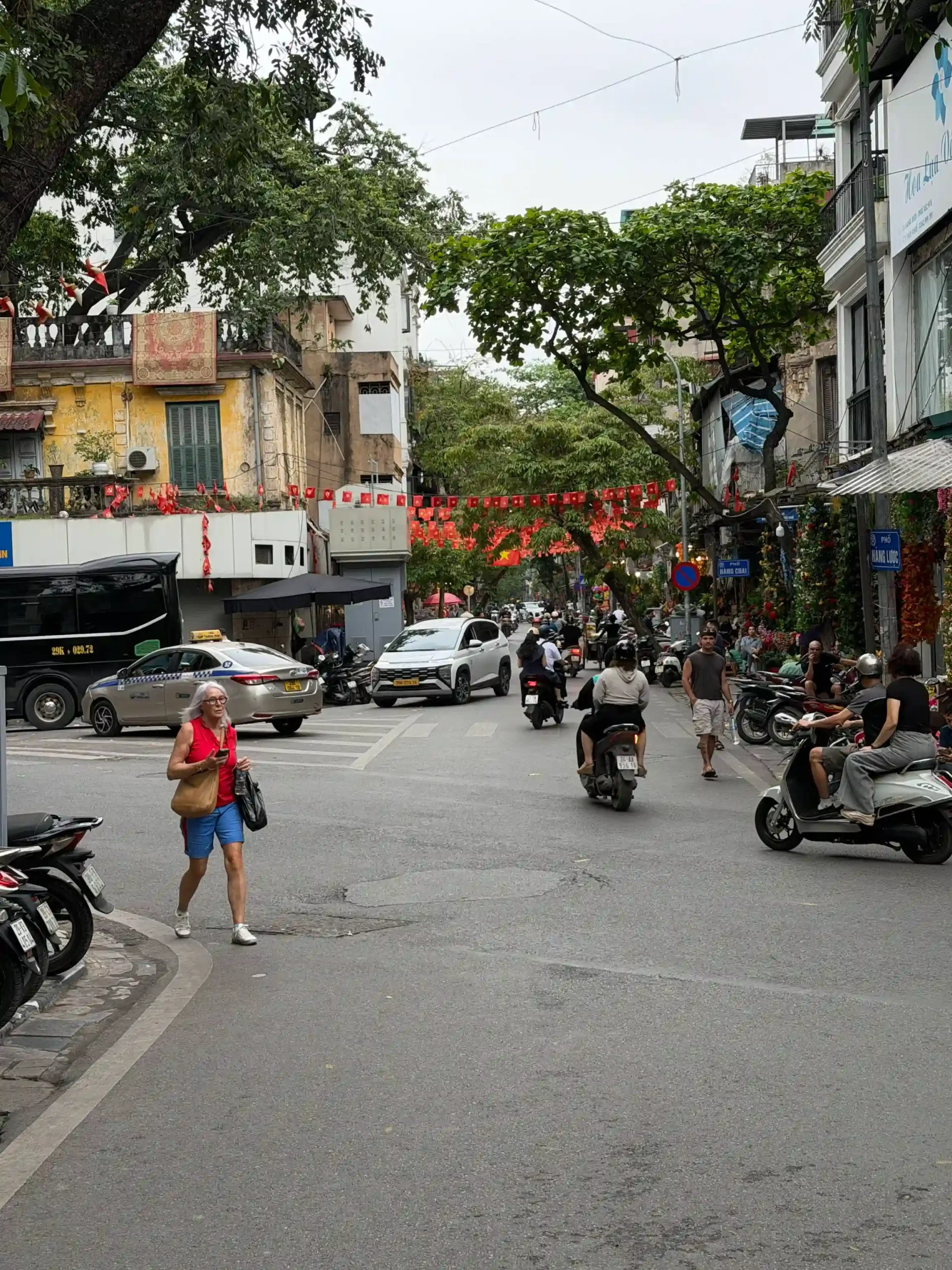
At the end of Hang Chieu, cross the busy intersection and find Hang Luoc street, heading north.
The curved path of Hang Luoc street exists because it follows the original banks of the To Lich River, which once flowed through the city center before the French colonial government filled it in during the late 19th century to build a modern sewage system.
Historically, this was the market for brass combs (lược), though today the street is famous for selling high-quality artificial flowers made of silk and plastic.
During the weeks leading up to the Lunar New Year (Tet), Hang Luoc turns into the oldest flower market in Hanoi, where locals buy peach blossom branches and kumquat trees to decorate their homes. On a normal day, it is a relatively quiet street with older, narrow houses featuring wooden louvers on the upper floors.
Stop D: The Sensory Overload of Thuoc Bac (Medicine Street)
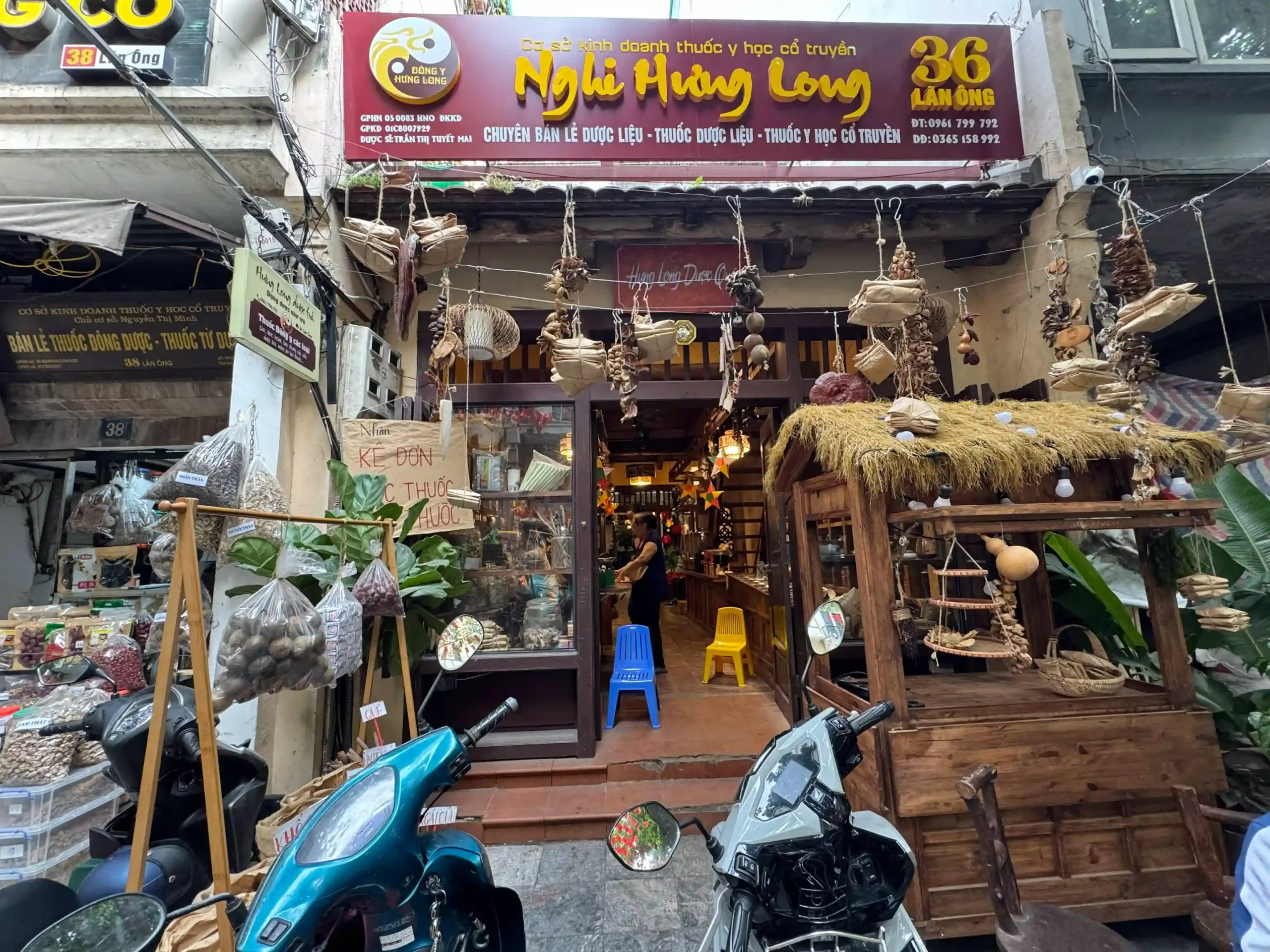
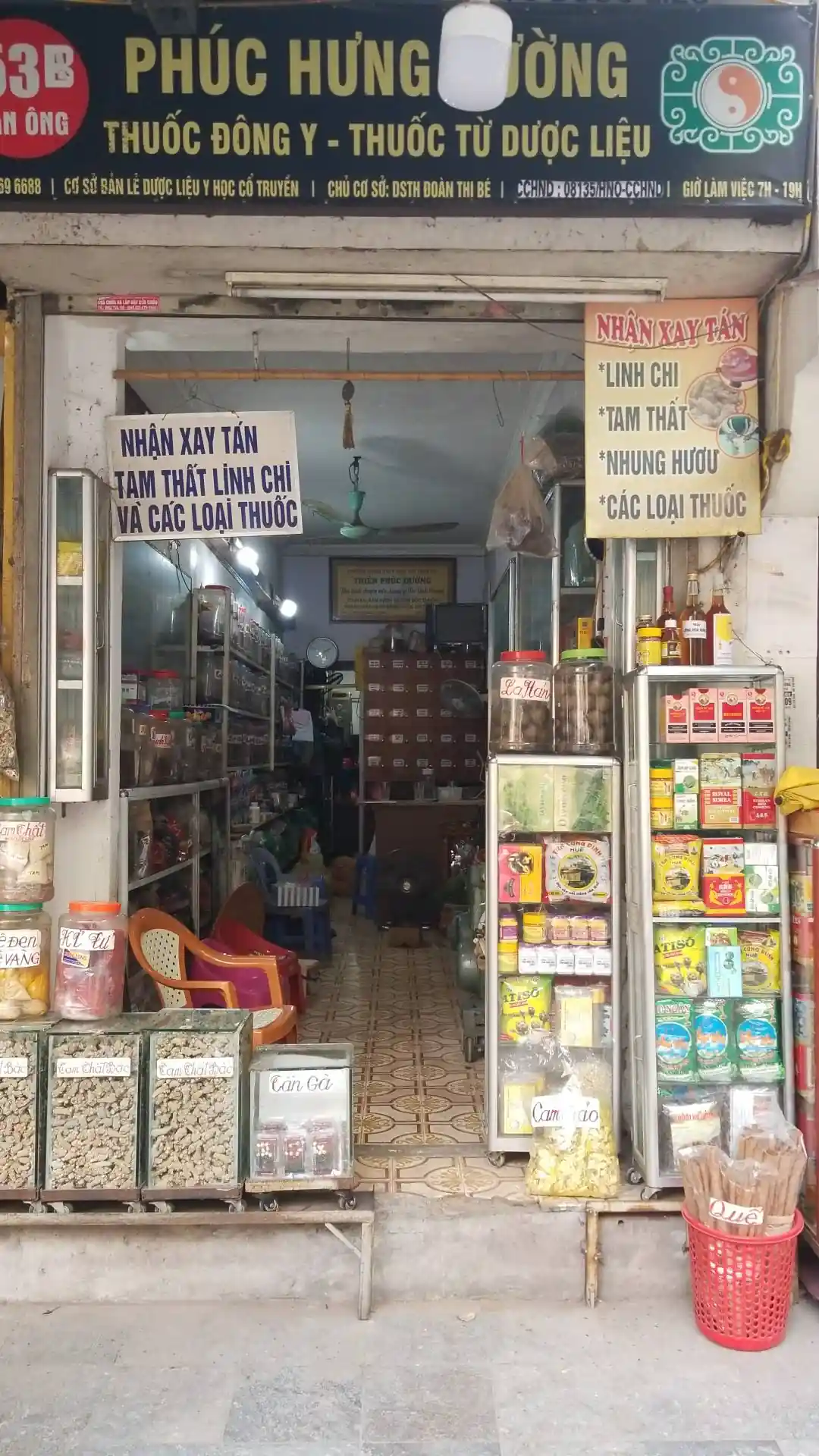
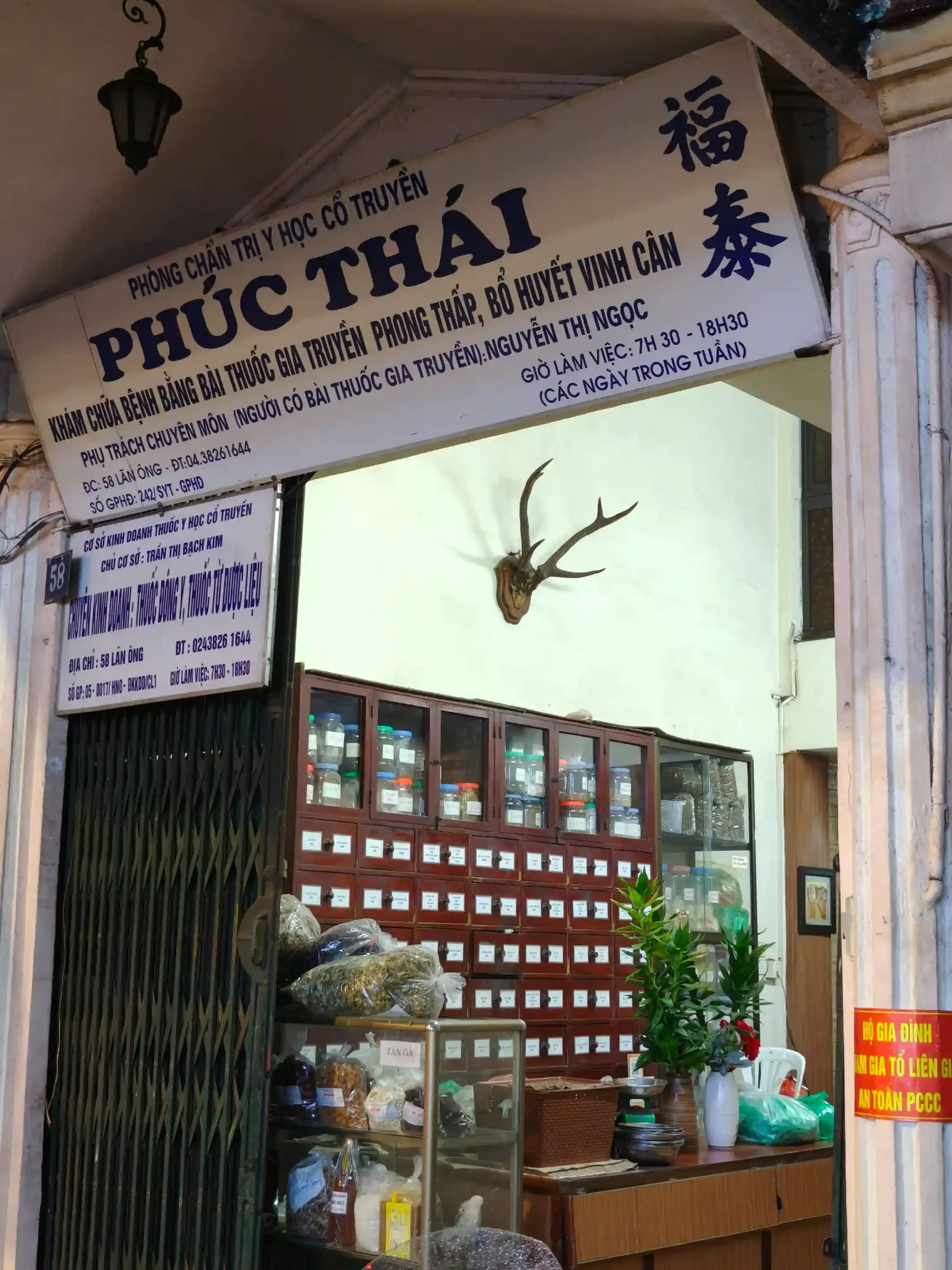
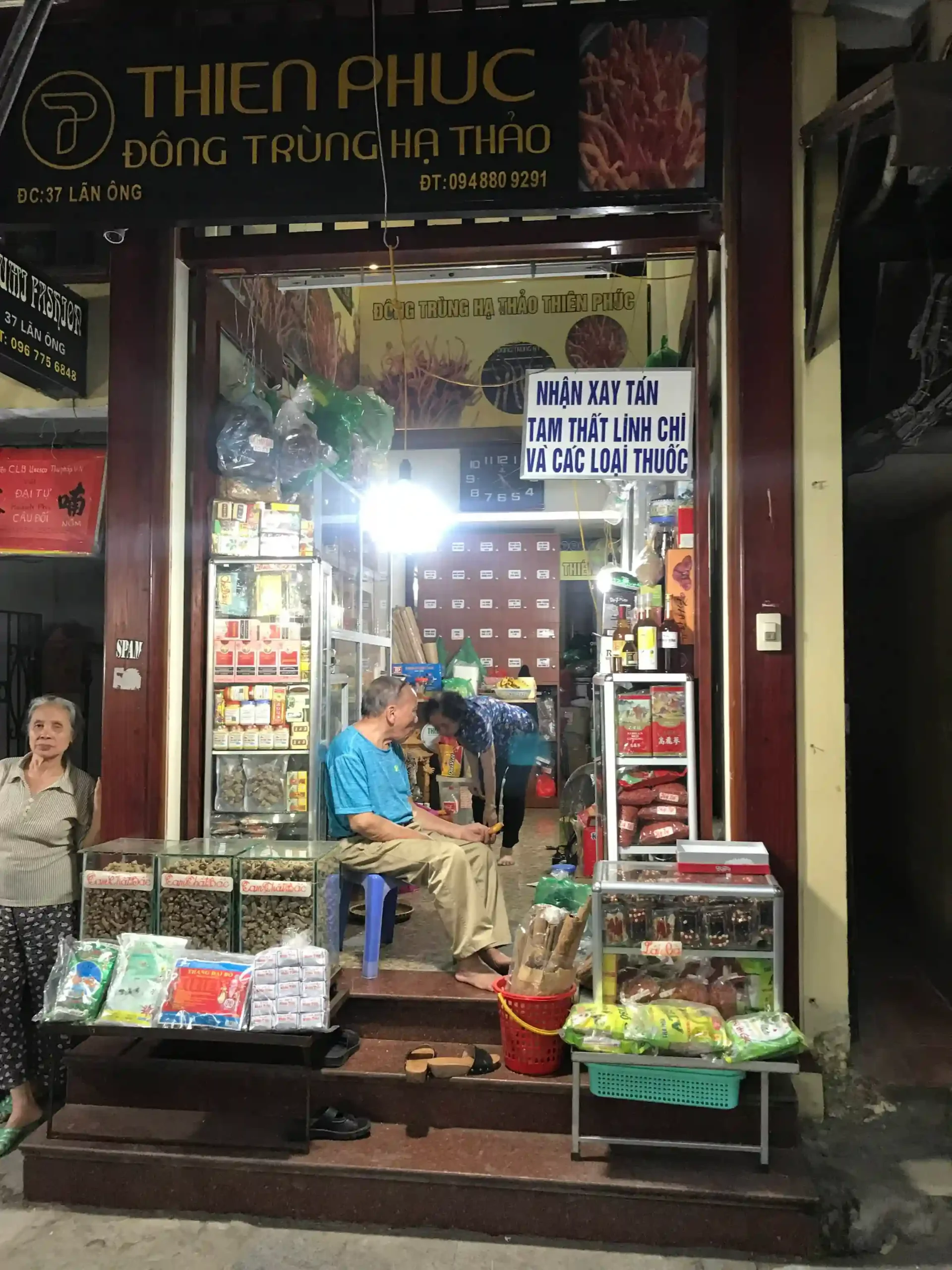
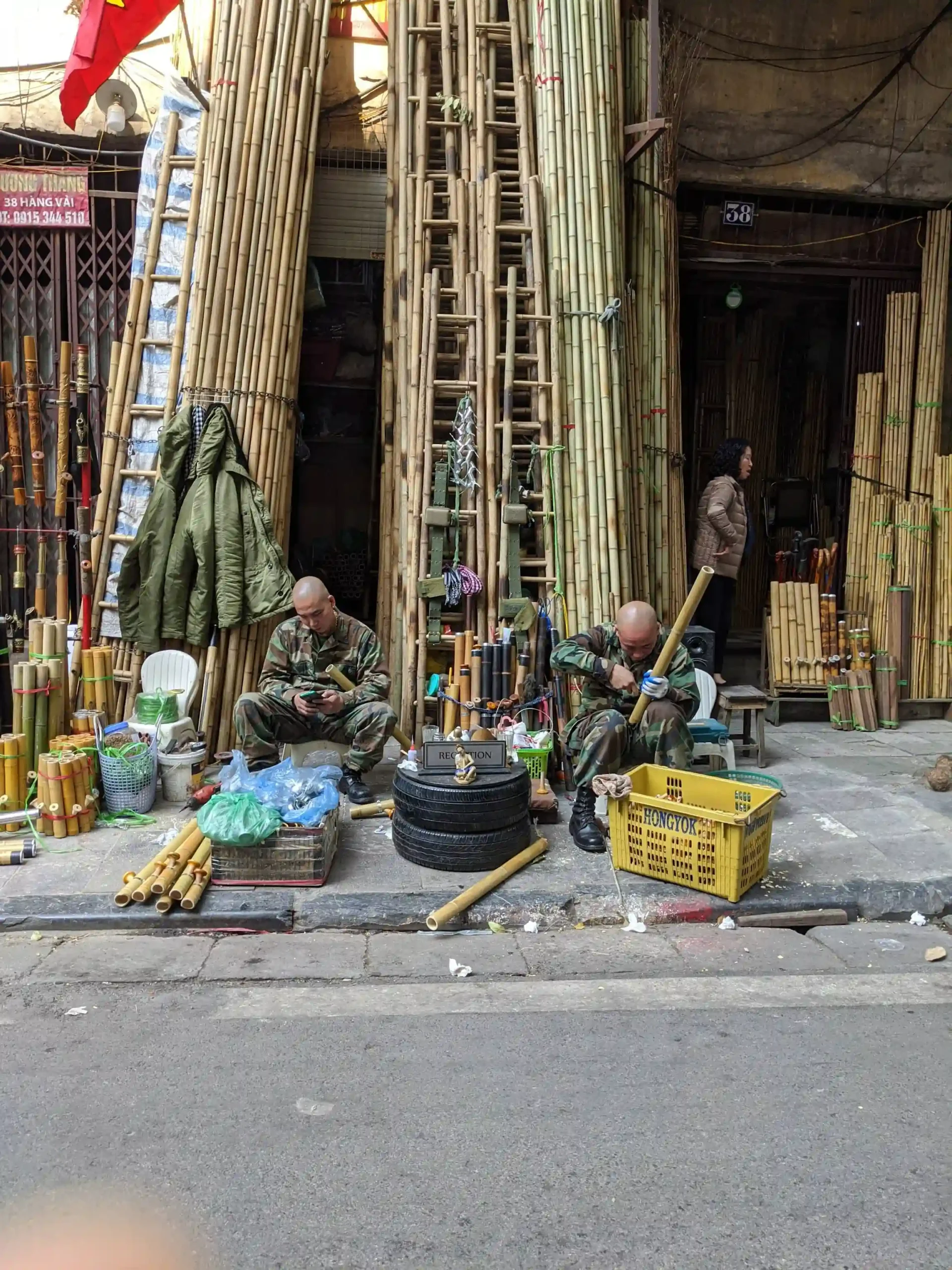
Turn left off Hang Luoc onto Thuoc Bac (Medicine Street).
You will smell this street long before you reach the corner. For generations, this road has been the center for traditional medicine (Thuốc Bắc translates to “Northern Medicine,” referring to Chinese herbal remedies).
The shops here are filled with massive wooden herbalist cabinets. These cabinets contain dozens of small drawers, each labeled in Han-Nom characters with the names of dried roots, star anise, ginseng, licorice bark, dried mushrooms, and cinnamon.
Walk past the open storefronts. You will see shopkeepers sitting on low stools, using large metal blades fixed to wooden blocks to slice tough, woody roots into thin shavings. They weigh out precise combinations of herbs using small brass hand-held scales, wrapping the mixtures in brown paper packages for customers. The air is thick with a heavy, aromatic scent of licorice, wood smoke, and dried spices.
Stop E: The Metalwork of Hang Thiec (Tin Street)
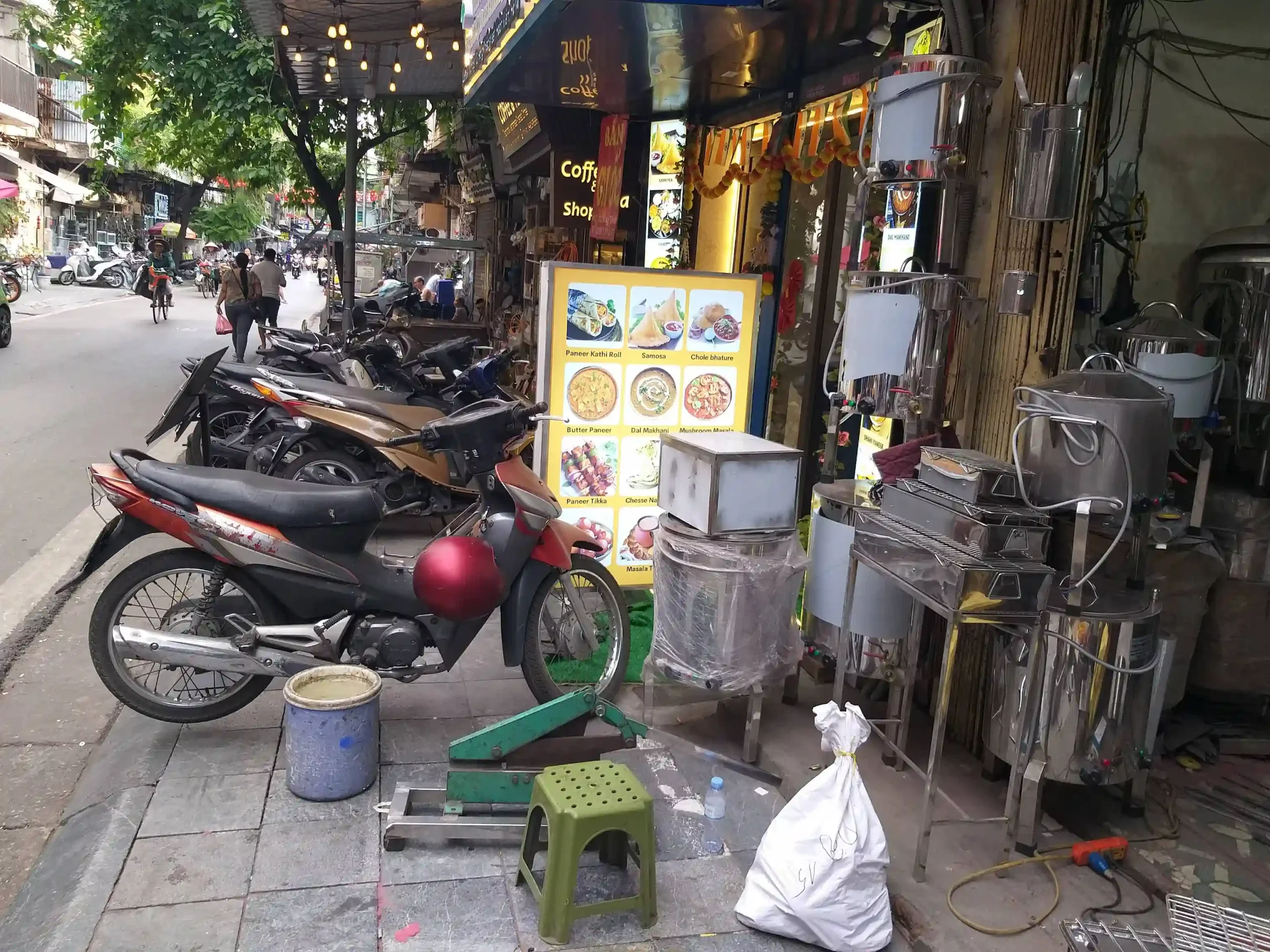
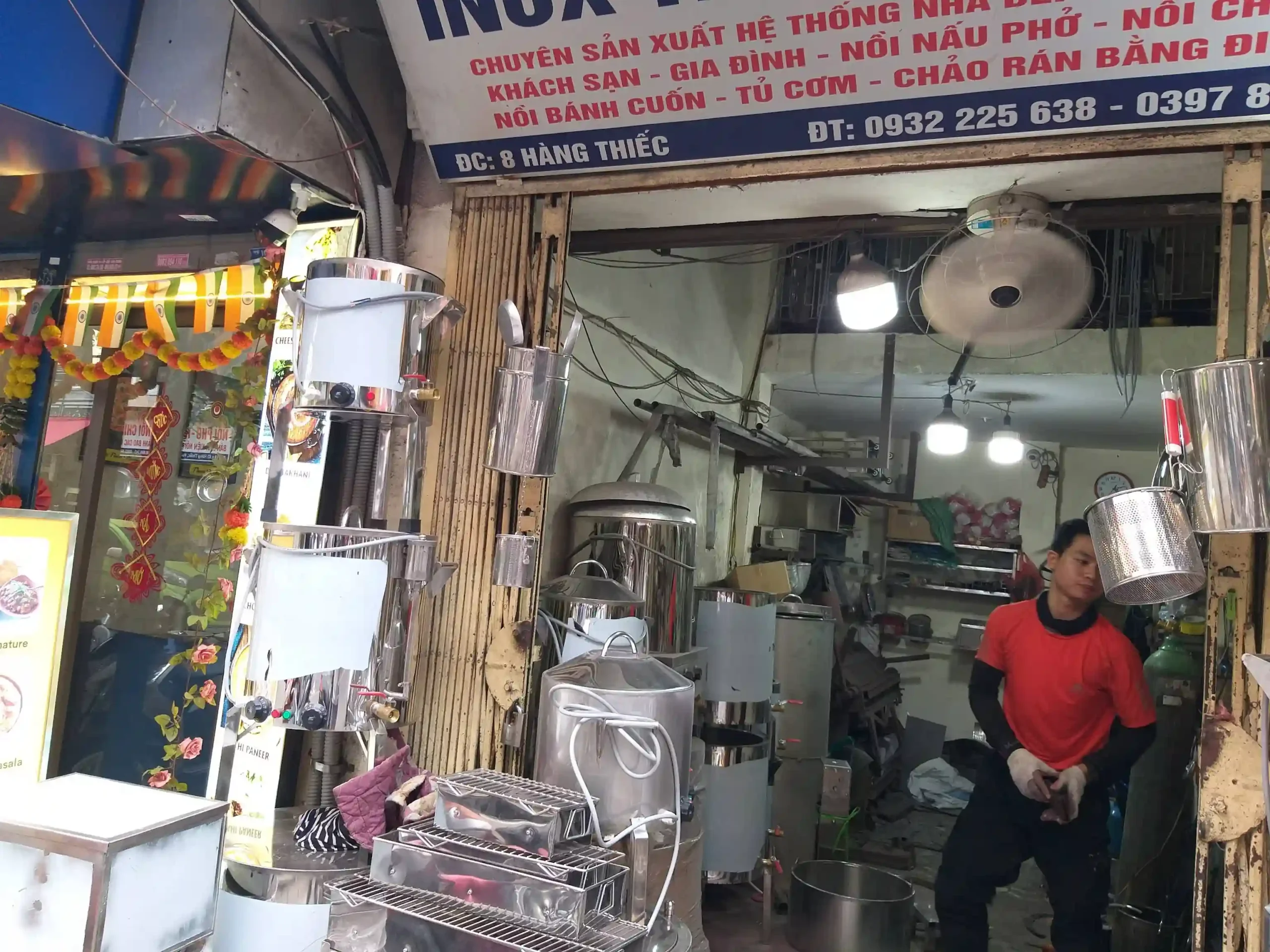
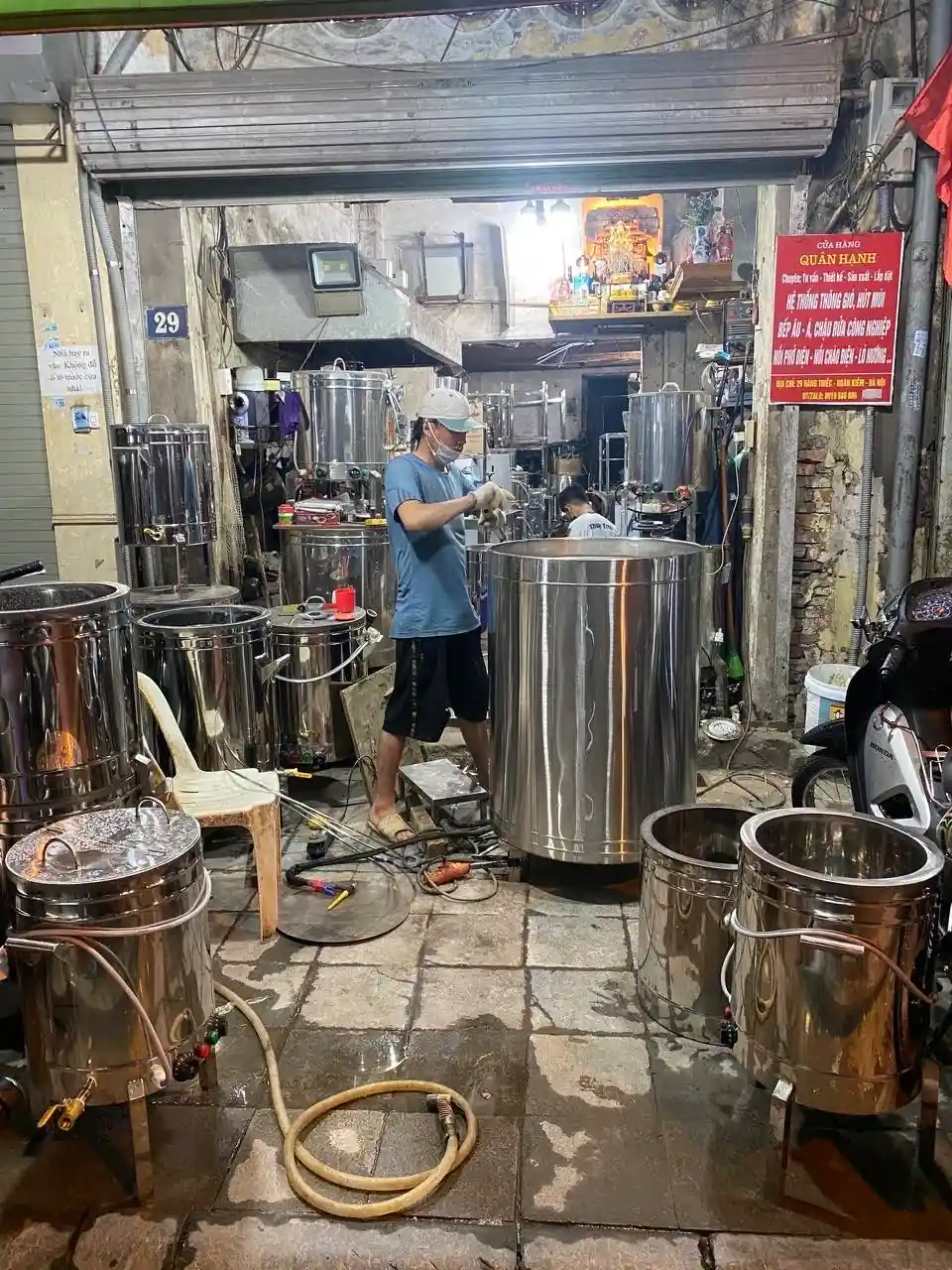
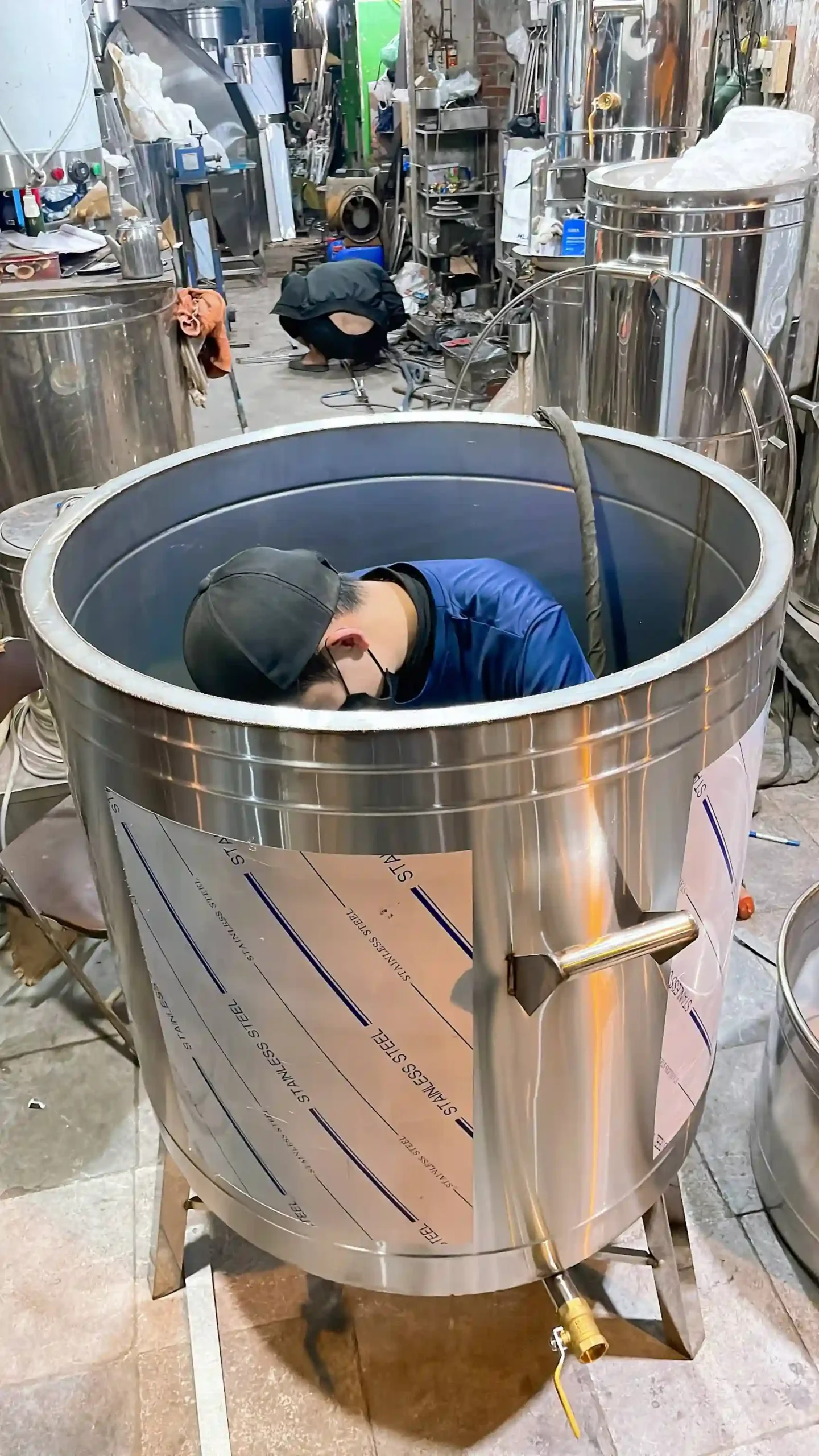
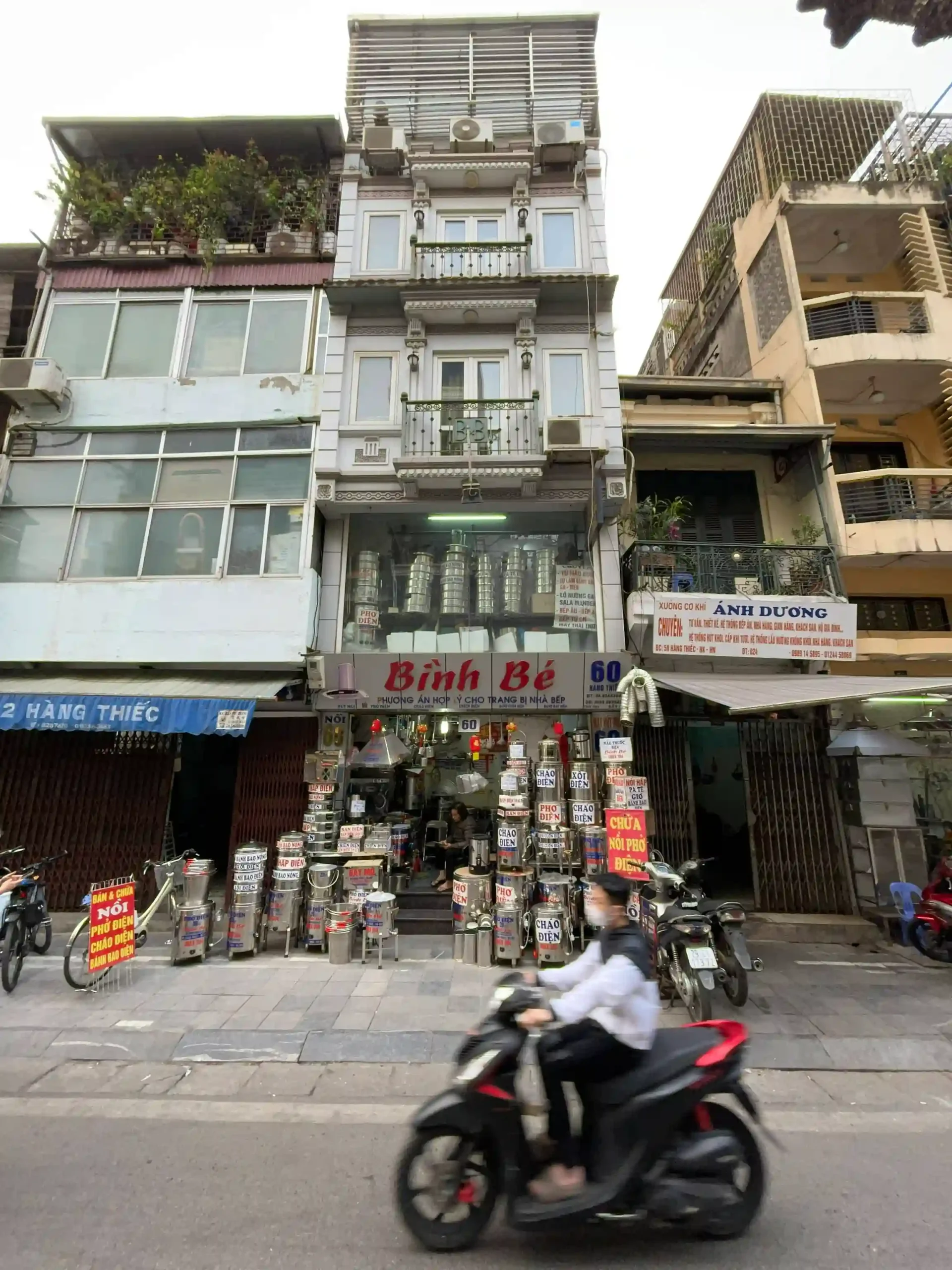
Keep walking down Thuoc Bac until you intersect with Hang Thiec (Tin Street), and turn right.
The transition here is completely abrupt. The earthy, quiet smell of Thuoc Bac is replaced by the loud sound of metalwork.
Every storefront on Hang Thiec is a metal fabrication workshop. Historically, the guild here hammered out tin sheets to make storage boxes, oil lamps, and temple ornaments. Today, the trade has modernized slightly, but the manual methods remain the same.
Men sit right on the curbs with heavy metal snips, hammers, and gas blowtorches. They cut and solder sheet metal, zinc, and tin to make steel mailboxes, industrial kitchen exhaust pipes, cake pans, and those iconic small metal coffee drip filters (Phin).
The air smells of heated metal, soldering flux, and gas. It is loud, sharp, and fascinating to watch how the manual labor just happens out in the open on the curb. Walk carefully through here; the sidewalks are often covered in sharp metal offcuts and finished steel boxes stacked three meters high.
Stop F: The Phung Hung Railway Arches
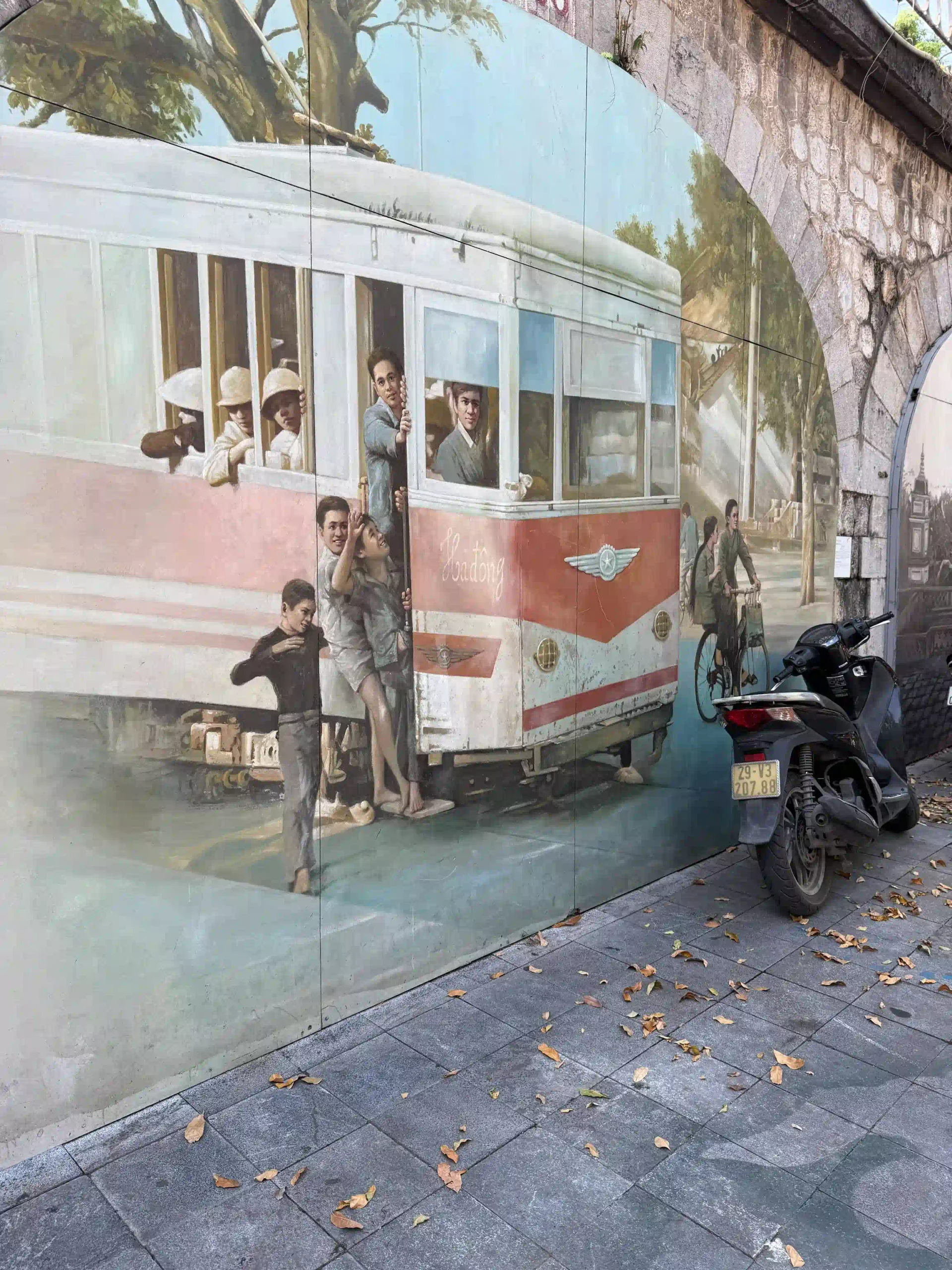
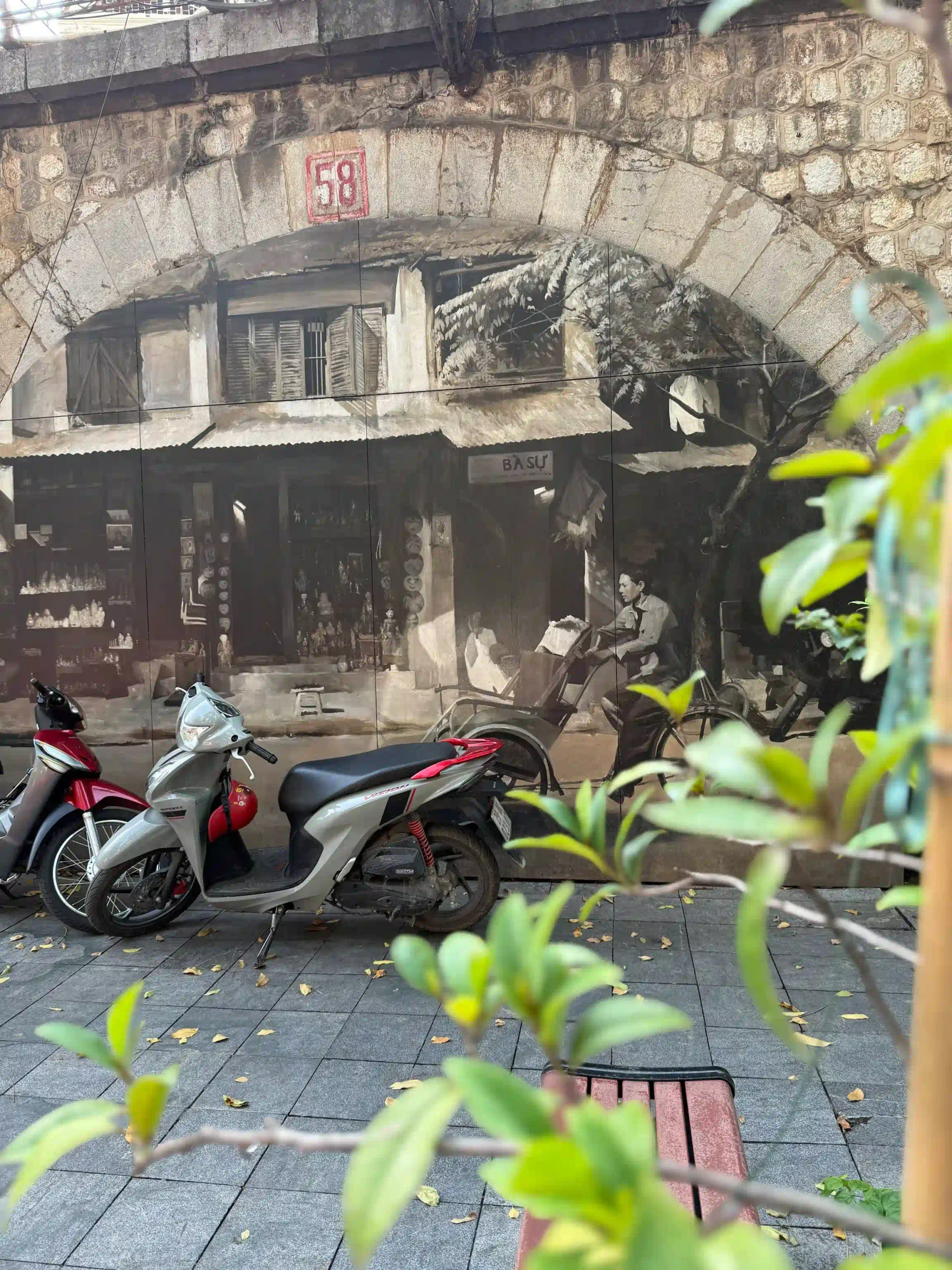
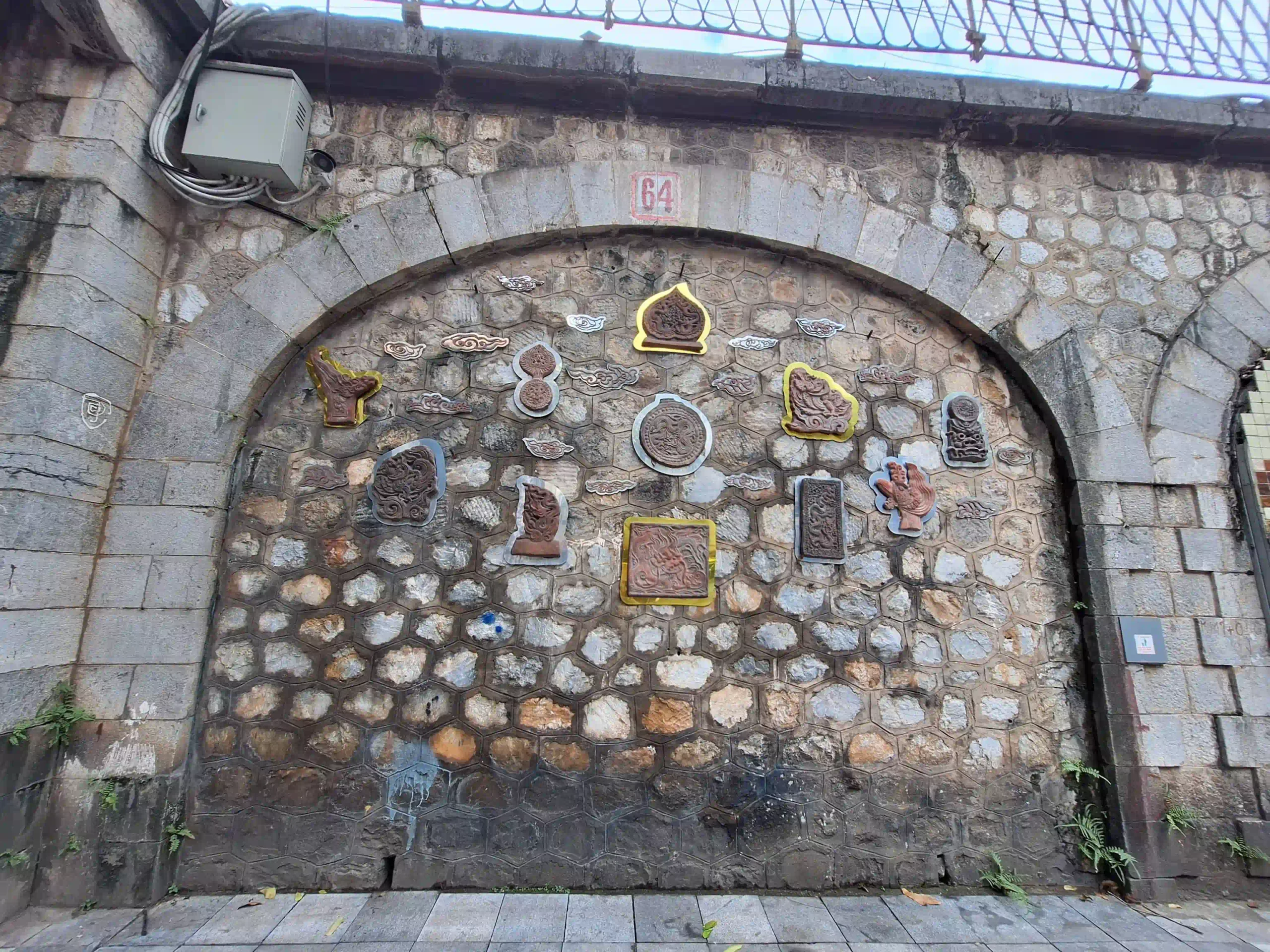
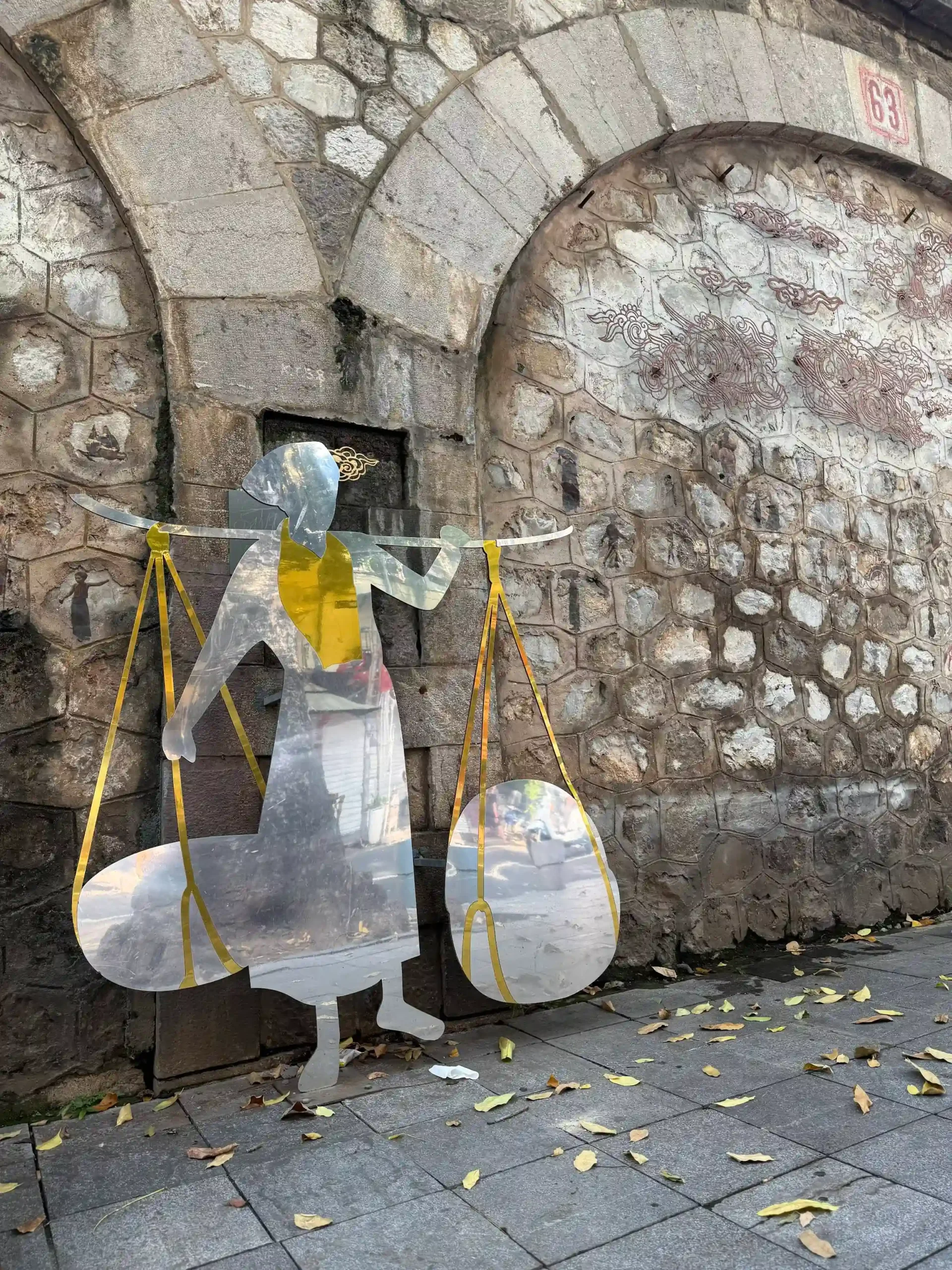
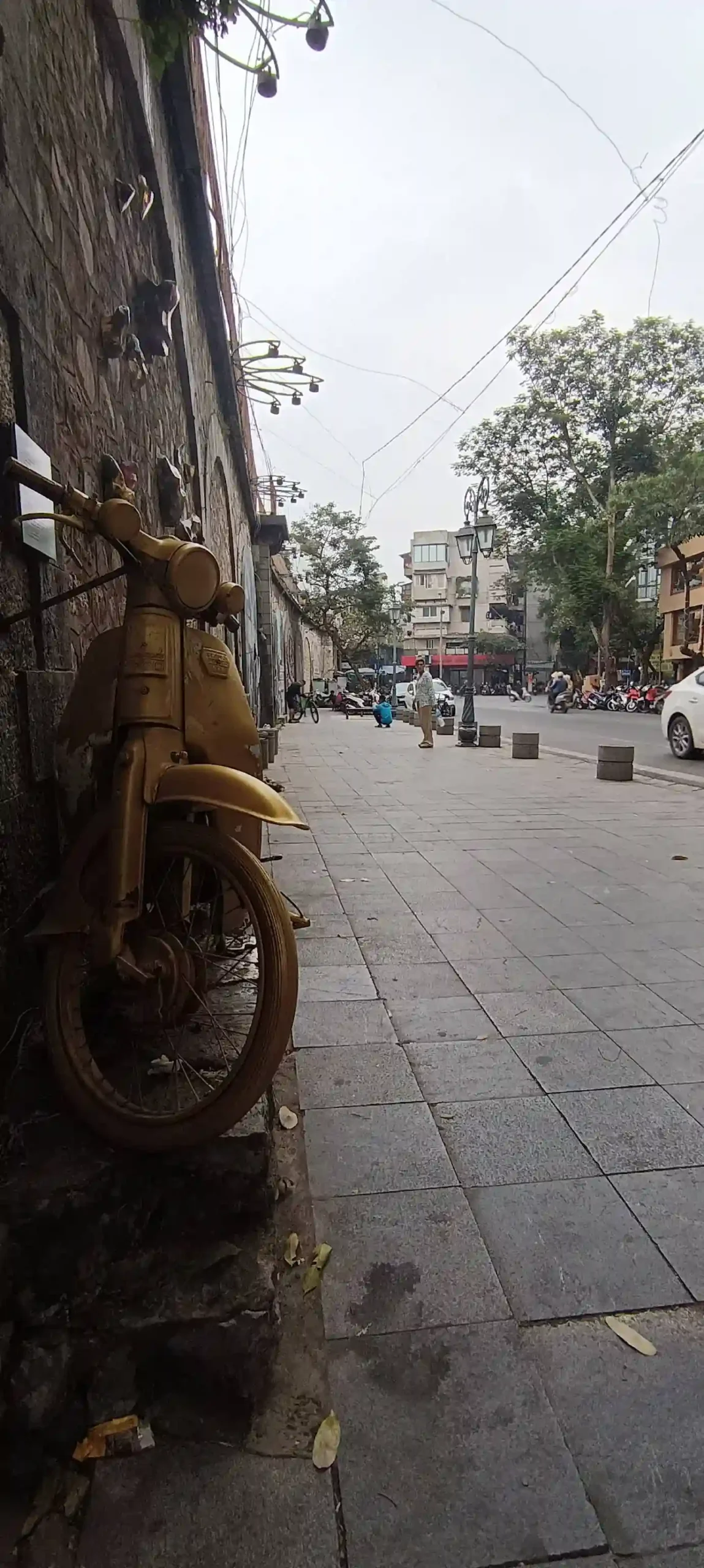
Leave the noise of Hang Thiec and weave west toward Phung Hung street.
This street runs parallel to a long, raised stone railway viaduct built by French engineers in 1902 using massive stone arches. A few years ago, a collaborative art project between Vietnamese and Korean artists transformed these sealed stone arches into a public art space.
They painted a series of 3D murals on the brickwork depicting historical scenes of Hanoi life: old street hawkers selling flowers, women carrying water using wooden yokes, vintage steam trains, and old department stores.
It is an easy, flat, open walkway running alongside the arches, allowing you to stretch your legs after navigating the cramped alleys of the inner guild streets. Walk down this street for a few blocks. Some of the paint is peeling now, and occasionally motorbikes park right in front of the artwork, but it’s still an excellent visual end to this specific route.
| Route 1 Checkpoint Summary | Intersection / Street | What you are looking for |
|---|---|---|
| Start | Ô Quan Chưởng | The 18th-century brick gate acting as a traffic circle. |
| Mat Street | Hàng Chiếu | Stacks of rolled bamboo mats and plastic carpets on the curb. |
| Flower/Combs | Hàng Lược | Wide curved street following the old river bed. |
| Medicine Street | Thuốc Bắc | Wooden herbalist drawers and the strong smell of star anise and cinnamon. |
| Tin Street | Hàng Thiếc | Intense din of hammers hitting zinc and tin sheets. |
| End | Phùng Hưng | The painted stone arches holding up the national railway line. |
Route 2: The French Transition (Colonial Architecture)
- Total Walking Distance: About 2 kilometers.
- Time needed: 1 hour.
- Best time to go: Mid-afternoon around 3:30 PM. The tree-lined streets provide better shade here than in the Old Quarter.
This Hanoi walking tour route physically leaves the tight, erratic layouts of the ancient trading streets. As the French took over the administration of Hanoi, they started planning areas on the southern side of Hoan Kiem Lake. They knocked down old structures, filled in small ponds, and built broad boulevards heavily influenced by Paris.
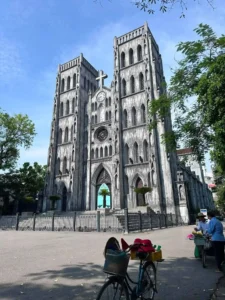
Stop A: Start at St. Joseph’s Cathedral
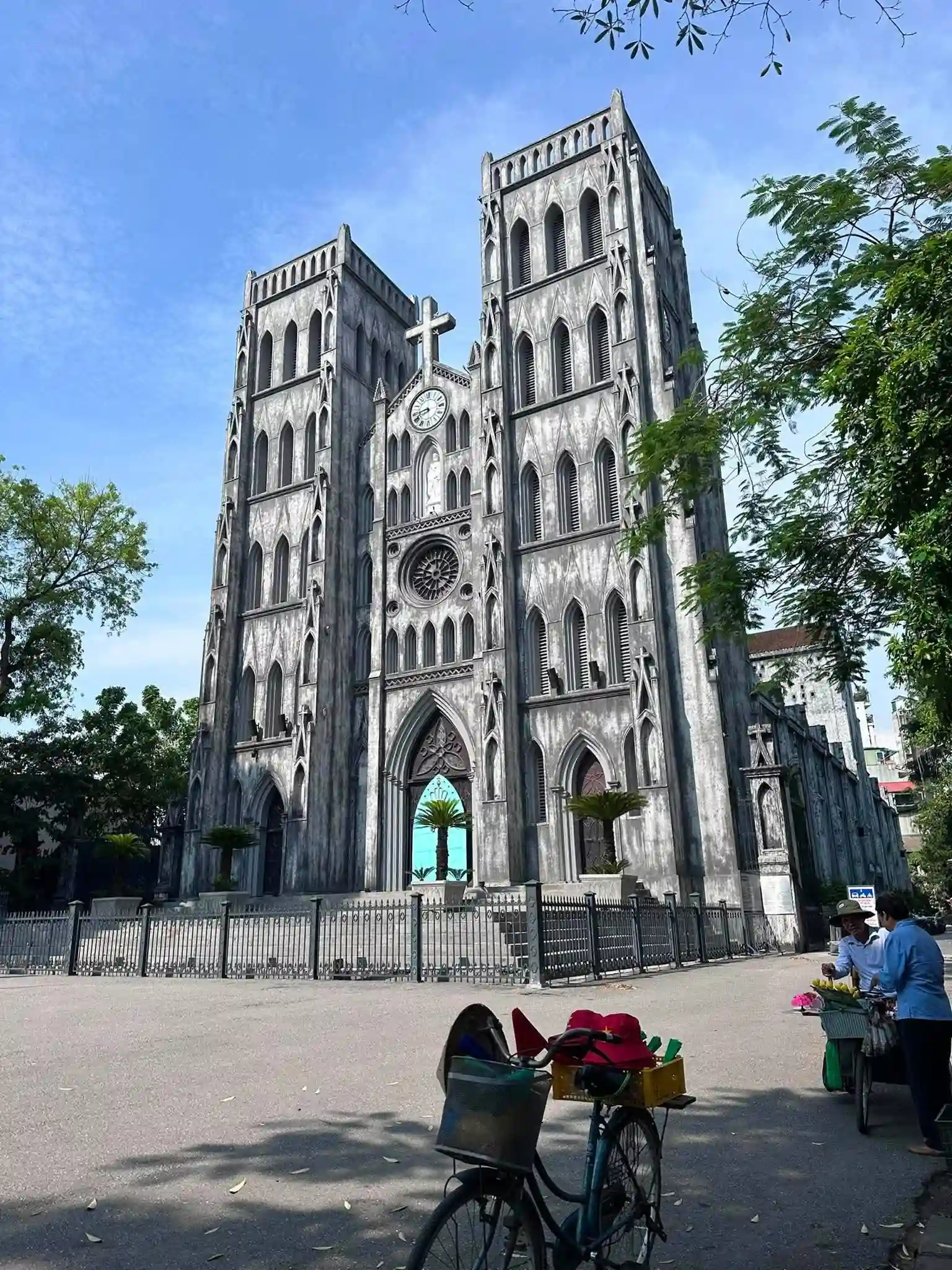
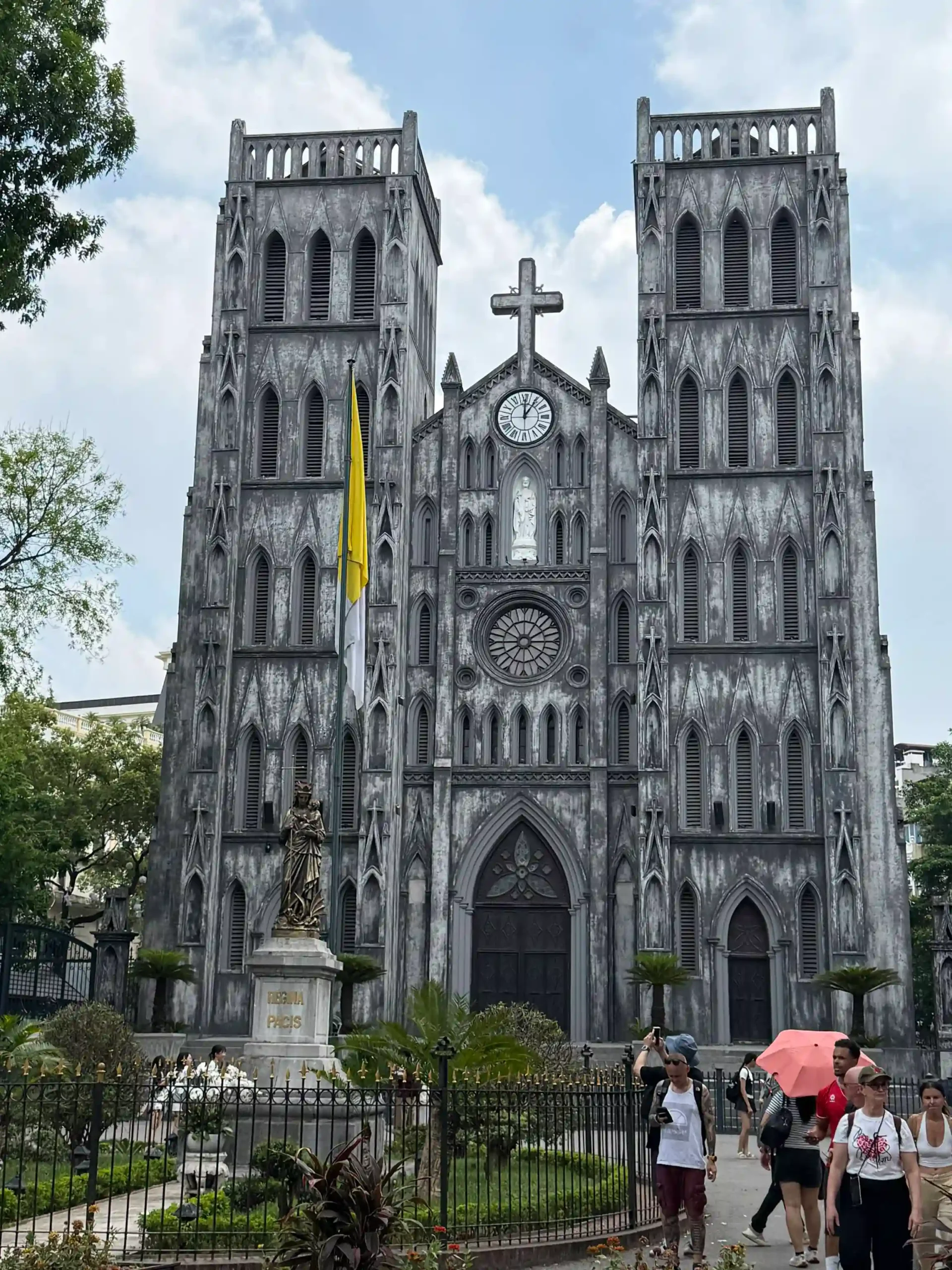
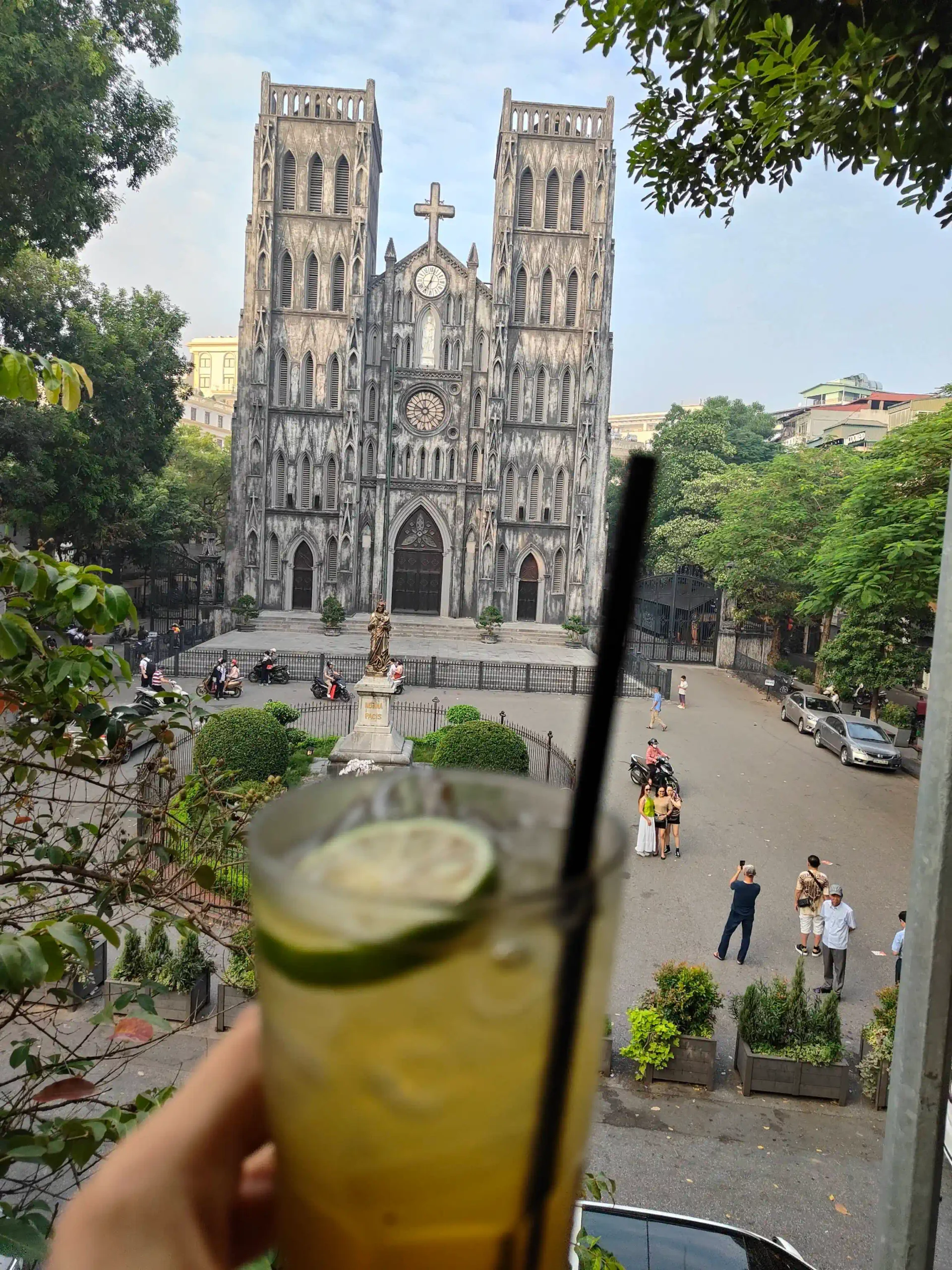
Begin your walk at the plaza on Nha Chung street in front of the cathedral.
Constructed in 1886, the neo-gothic facade of the church looks stark against the local climate. It was intentionally modeled after Notre-Dame de Paris, featuring two massive bell towers, a large rose window, and stone rib vaults.
The cathedral was built on the site of the ancient Bao Thien Pagoda, which had stood there since the Ly Dynasty but was demolished by the French administration to make way for the church. The gray stone exterior is heavily weathered, covered in black moss and stains from decades of tropical humidity.
Take some time to look at the statue of Mother Mary standing in the center of the small plaza. The area is flanked by cafes where locals sit on low stools drinking iced tea (Trà chanh) and cracking sunflower seeds.
It is a very natural transition point from the high-density alleys of the Old Quarter into the wider avenues of the French Quarter.
Stop B: Ly Thai To Boulevard
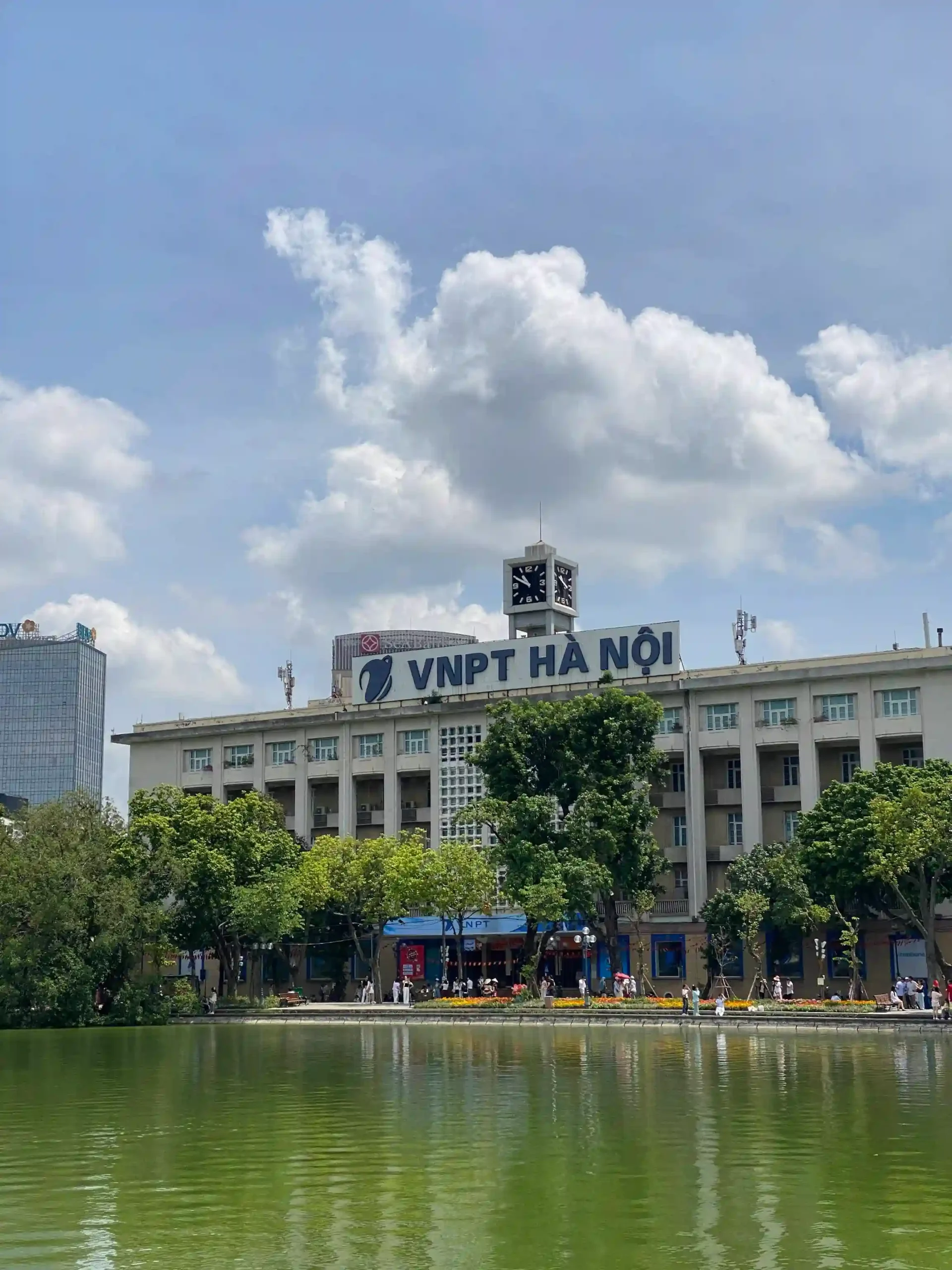
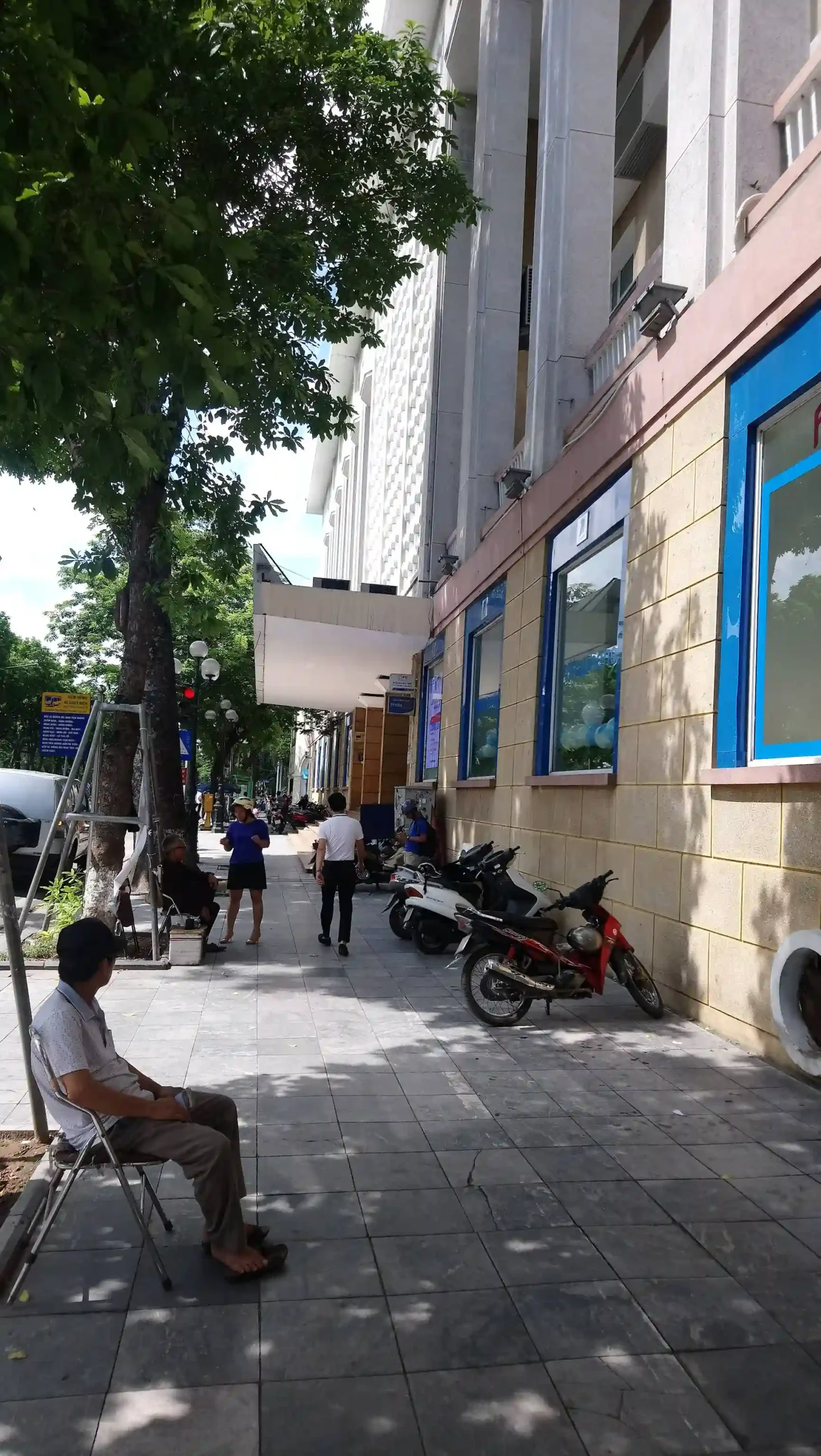
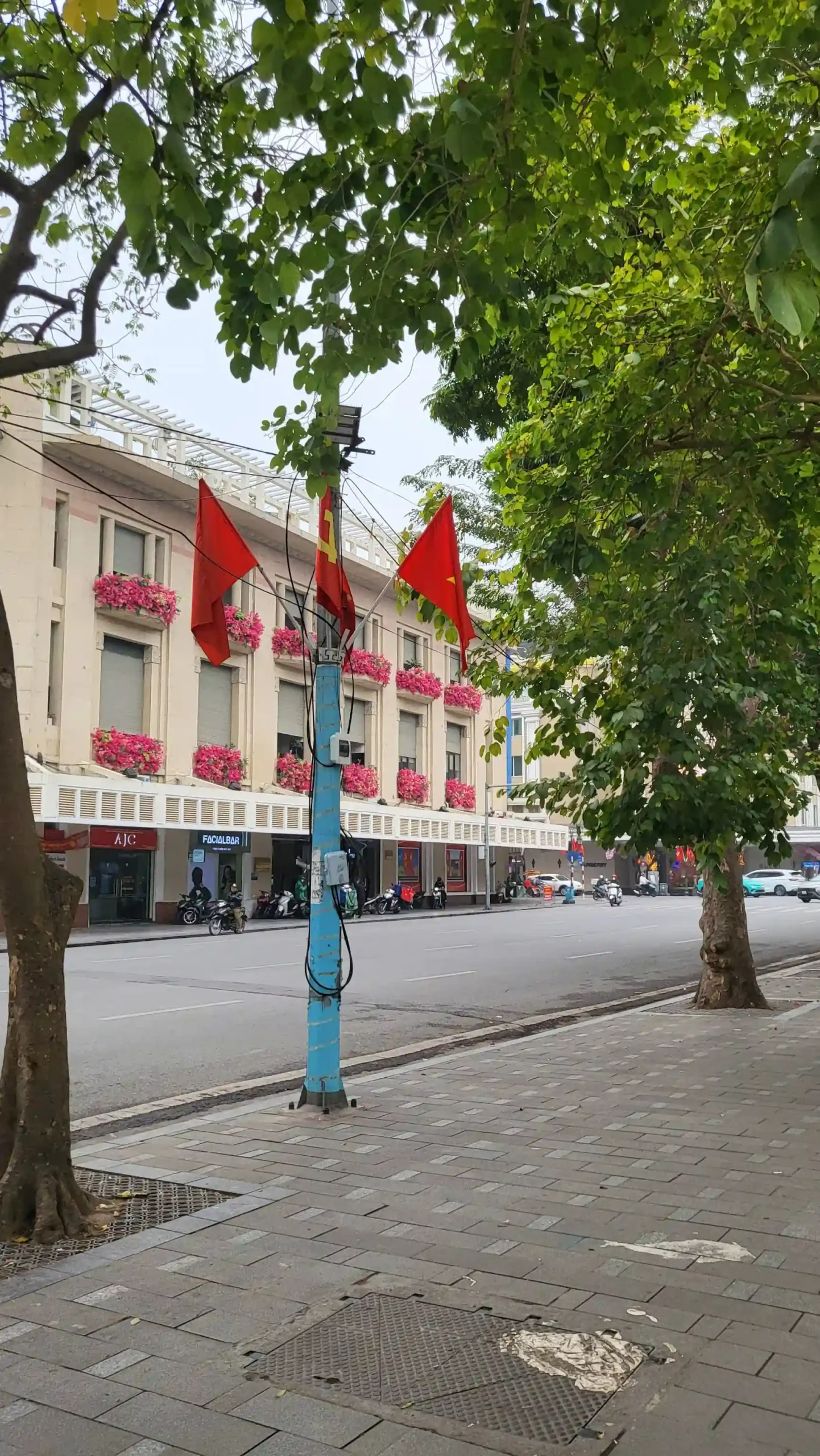
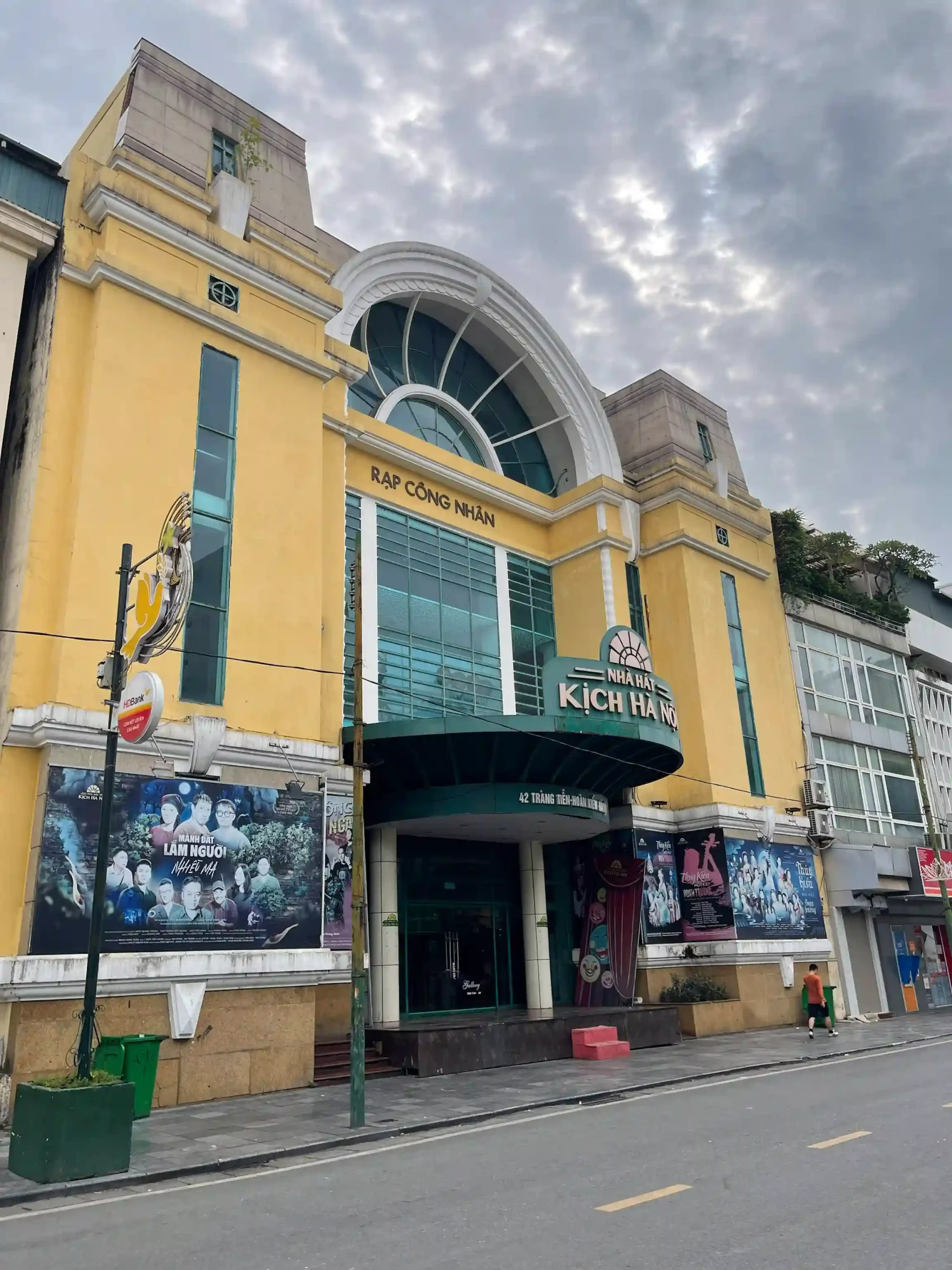
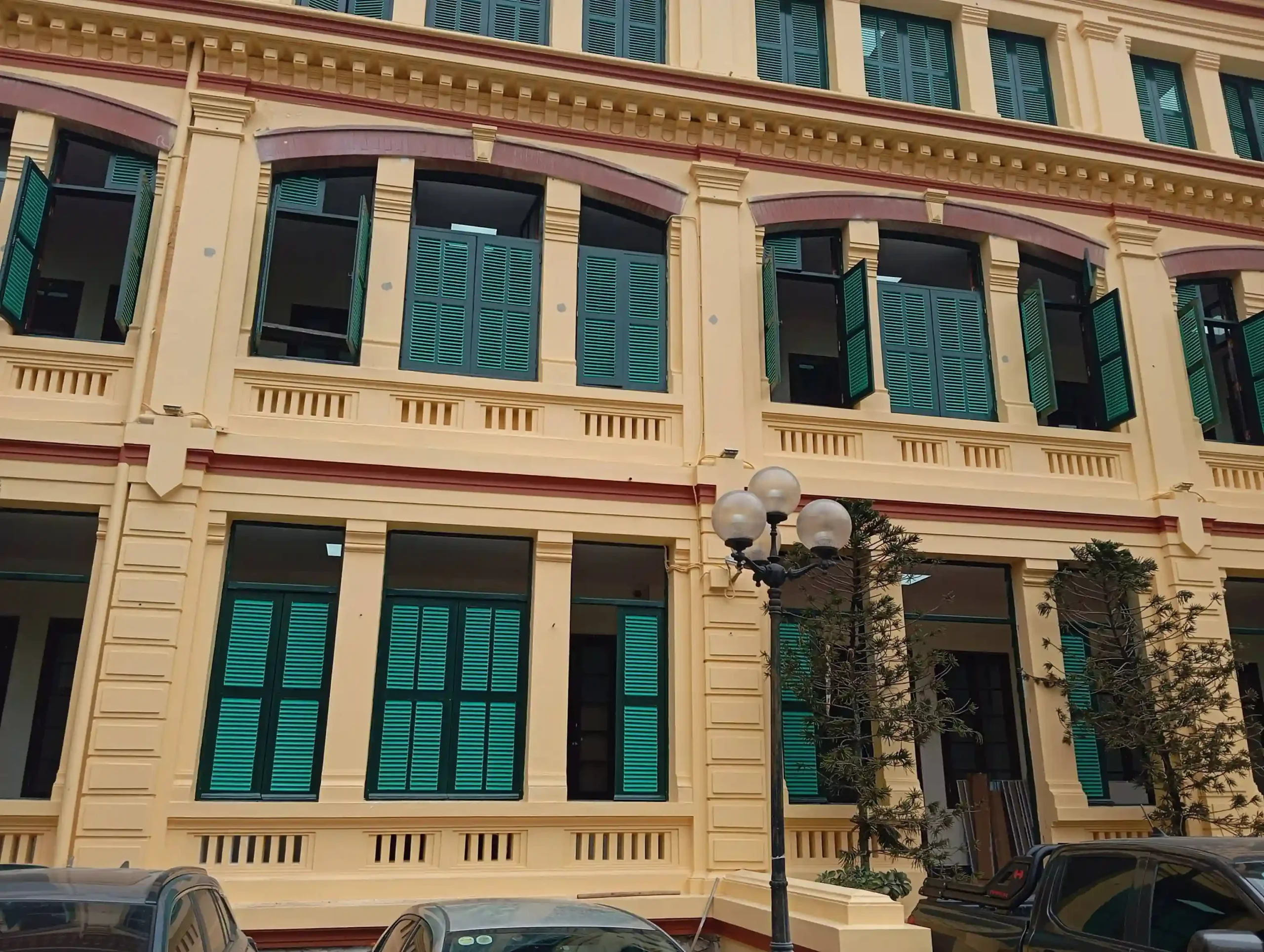
Walk east toward Hoan Kiem Lake, but bypass the water for now. Cut down toward the historic Post Office building and merge onto Ly Thai To street, walking south.
You will instantly notice the structural difference here compared to Route 1. The roads are built for large vehicles. There are actual pedestrian pavements that you can walk on without constantly dodging obstacles. Massive mahogany trees form a canopy over the street.
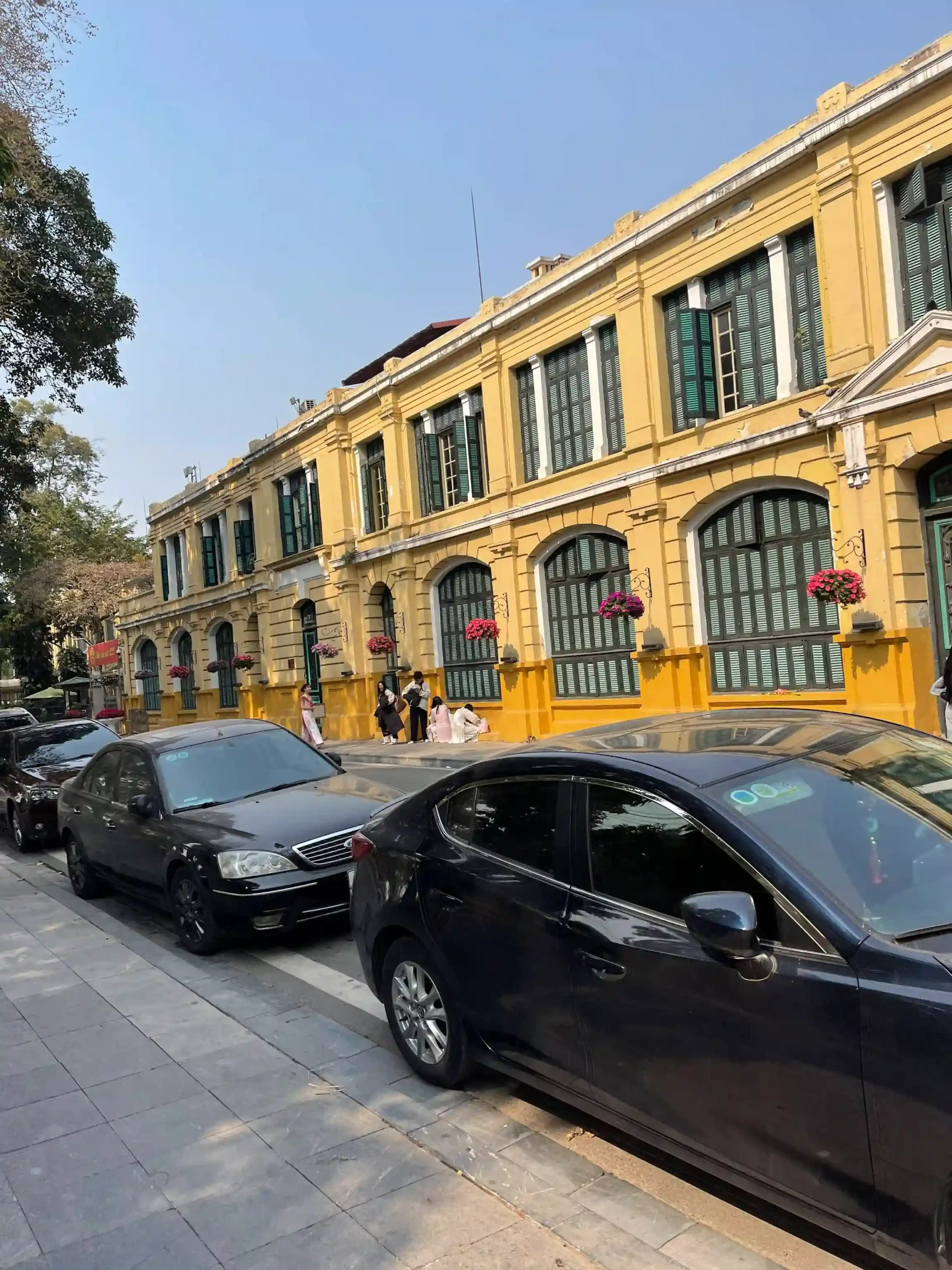
As you walk, look closely at the large, faded yellow villas hidden behind heavy iron gates. Many of these structures were built for French colonial officials.
Today, they have been repurposed. Some are foreign embassies with strict security, some house Vietnamese government ministries, and others have been bought by private investors and turned into high-end restaurants.
The faded yellow color (ochre), mixed with dark green wooden window shutters (louvers), is the signature color palette of this era. The green shutters were designed specifically for the humid climate, letting air flow through the building while keeping the heavy monsoon rains out.
Stop C: The Metropole and Dien Hong Garden
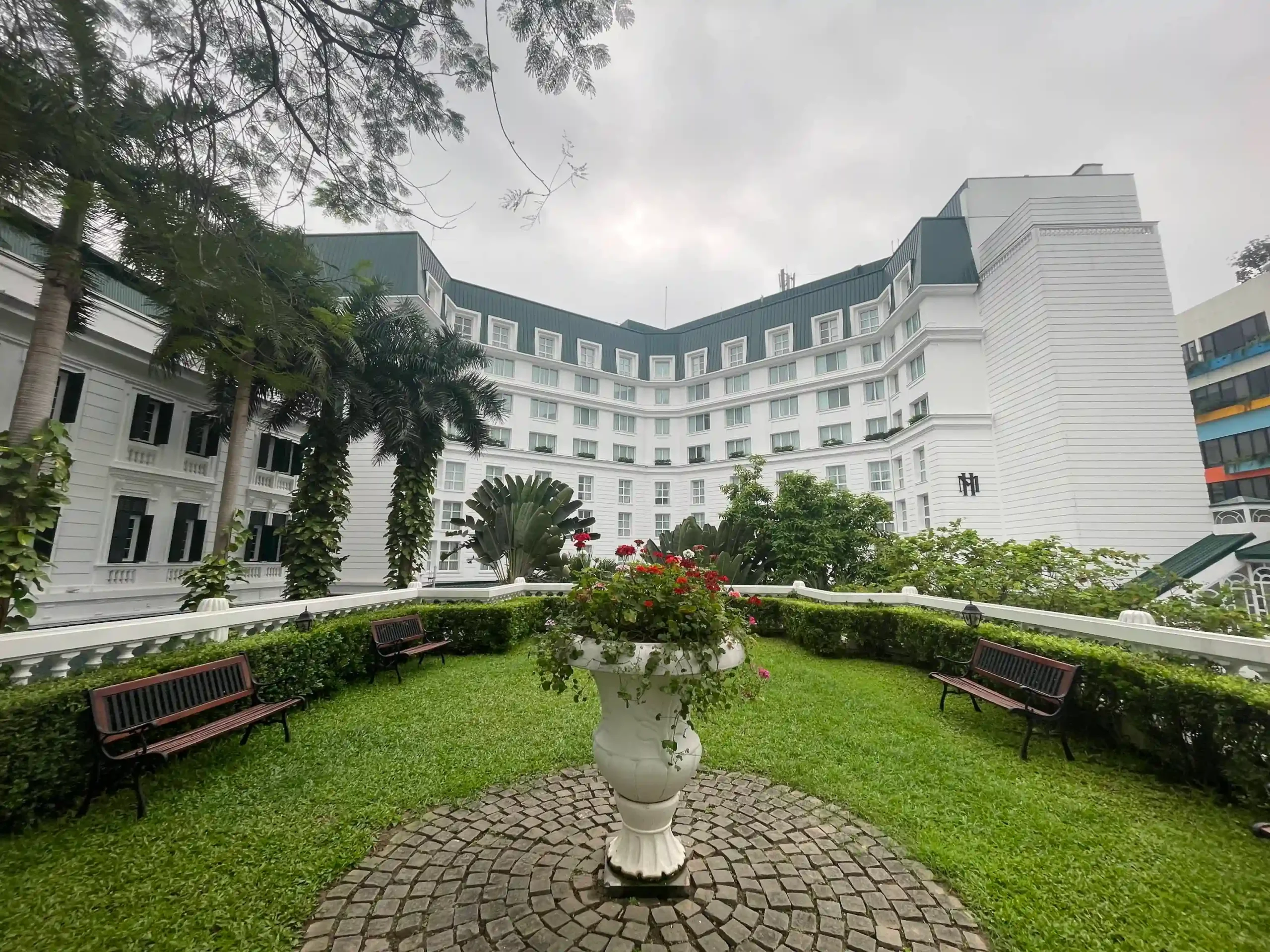
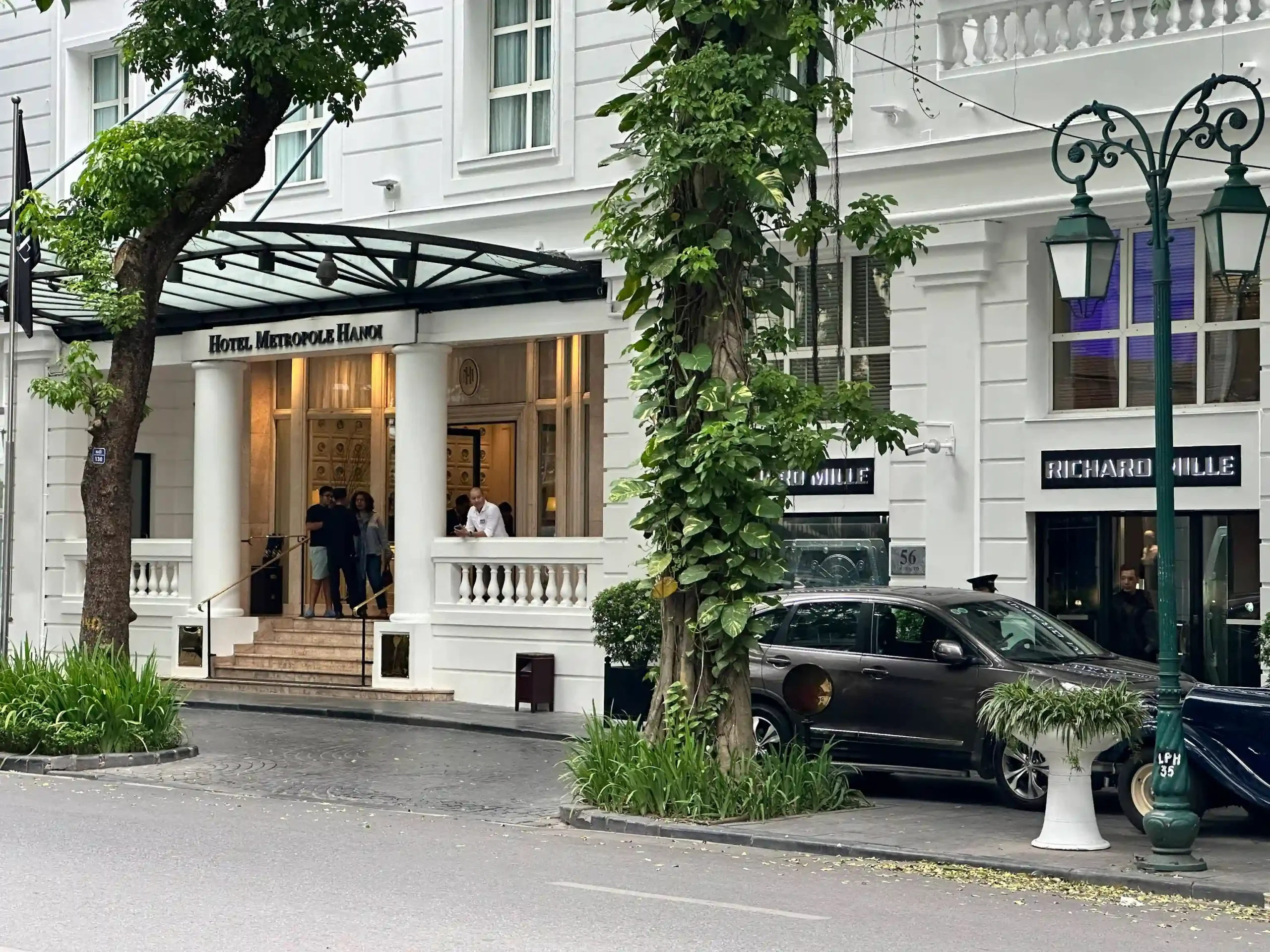
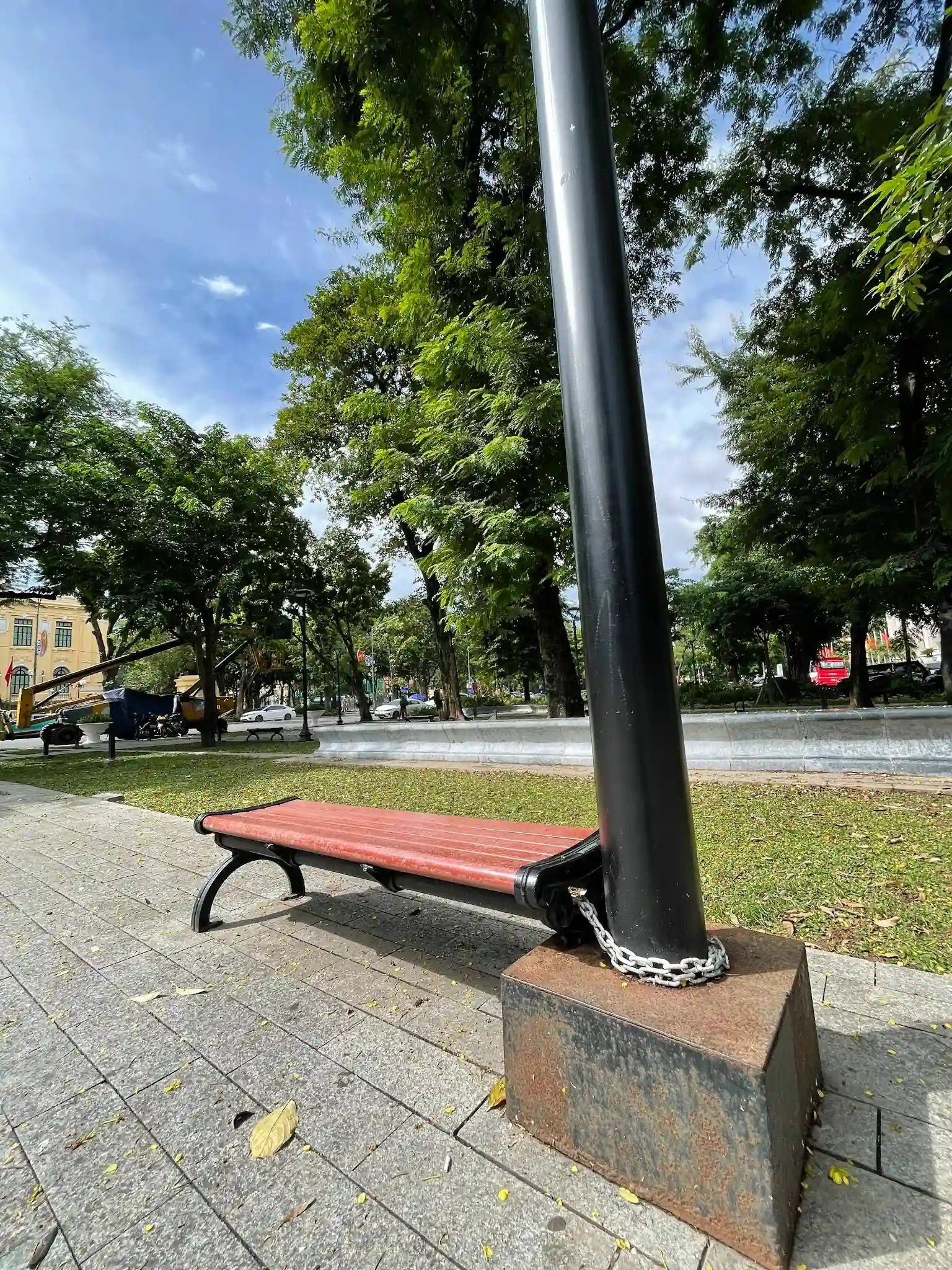
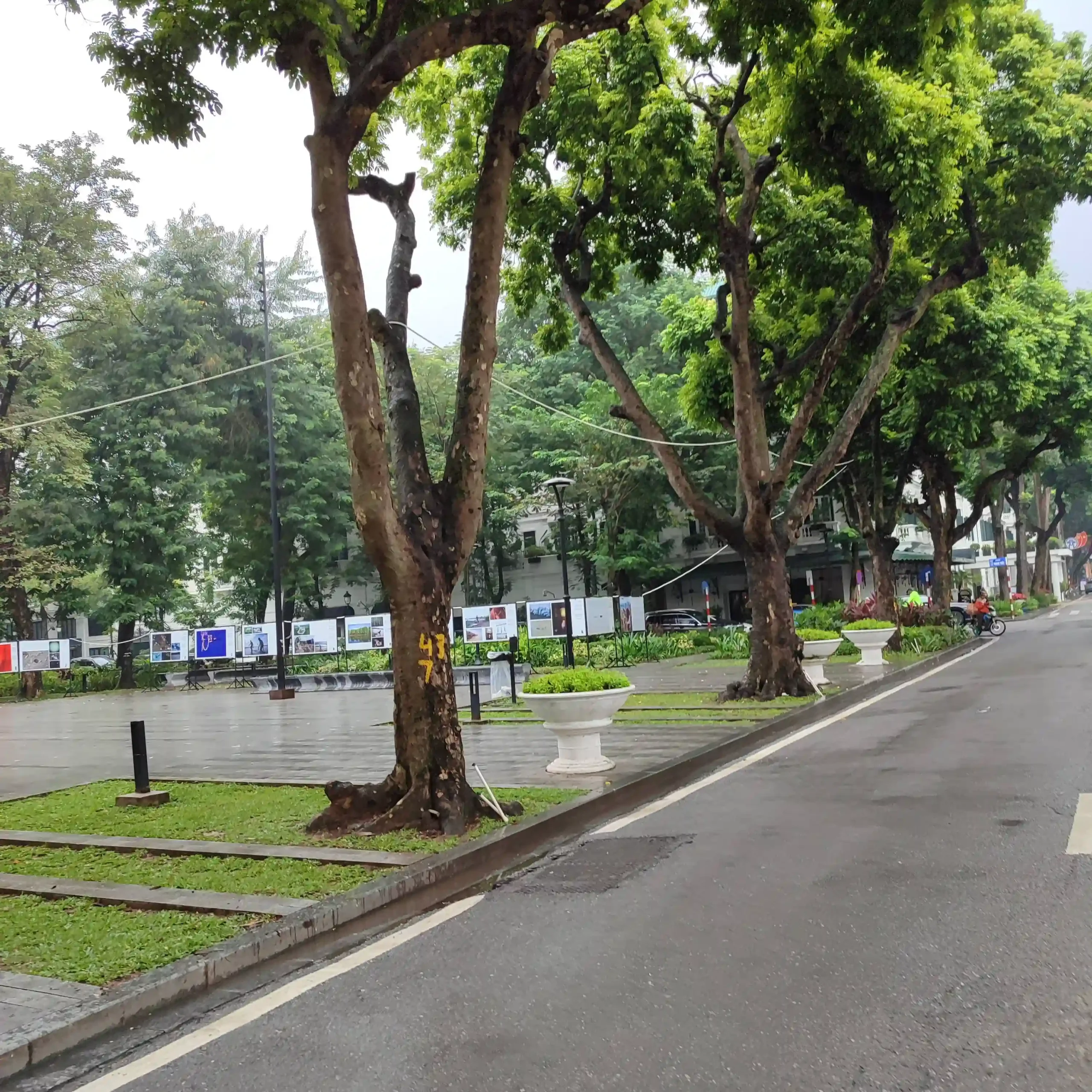
Follow the street until you arrive at the Sofitel Legend Metropole Hotel (located at 15 Ngo Quyen, but covering an entire city block).
Opened in 1901 by two French investors, the Metropole is the oldest luxury hotel in the city. The exterior is immaculately maintained with bright white plaster, dark green shutters, and ornate ironwork.
This hotel has hosted journalists, diplomats, and celebrities for over a century. Graham Greene wrote parts of his famous novel The Quiet American here, and Charlie Chaplin spent his honeymoon at the hotel in 1936.
During the war, the hotel built a concrete air-raid bunker underneath the courtyard bar to protect guests from American bombings; this bunker was rediscovered in 2011 and is now open for tours.
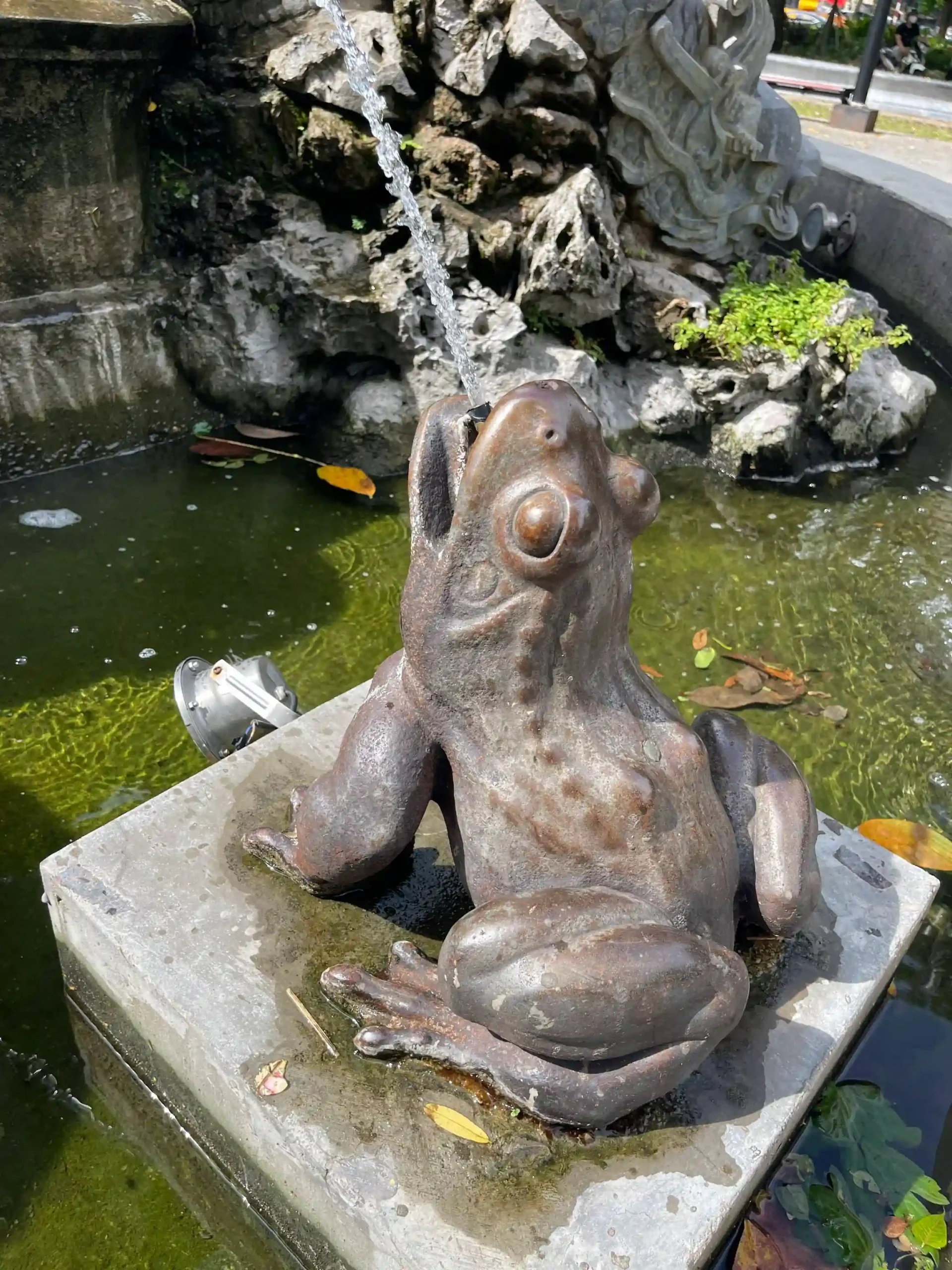
Right across the road from the hotel is Dien Hong Garden (often called Con Coc, or the Toad Flower Garden, by locals).
The park features a large stone fountain in the center, adorned with green copper sculptures of frogs spitting water toward an obelisk. Built by the French in 1901, it is the oldest public fountain in Hanoi.
The park is a very quiet, shaded space, often filled with older locals playing chess or wedding couples taking photos against the backdrop of the Metropole.
Stop D: Trang Tien Street down to the Opera House
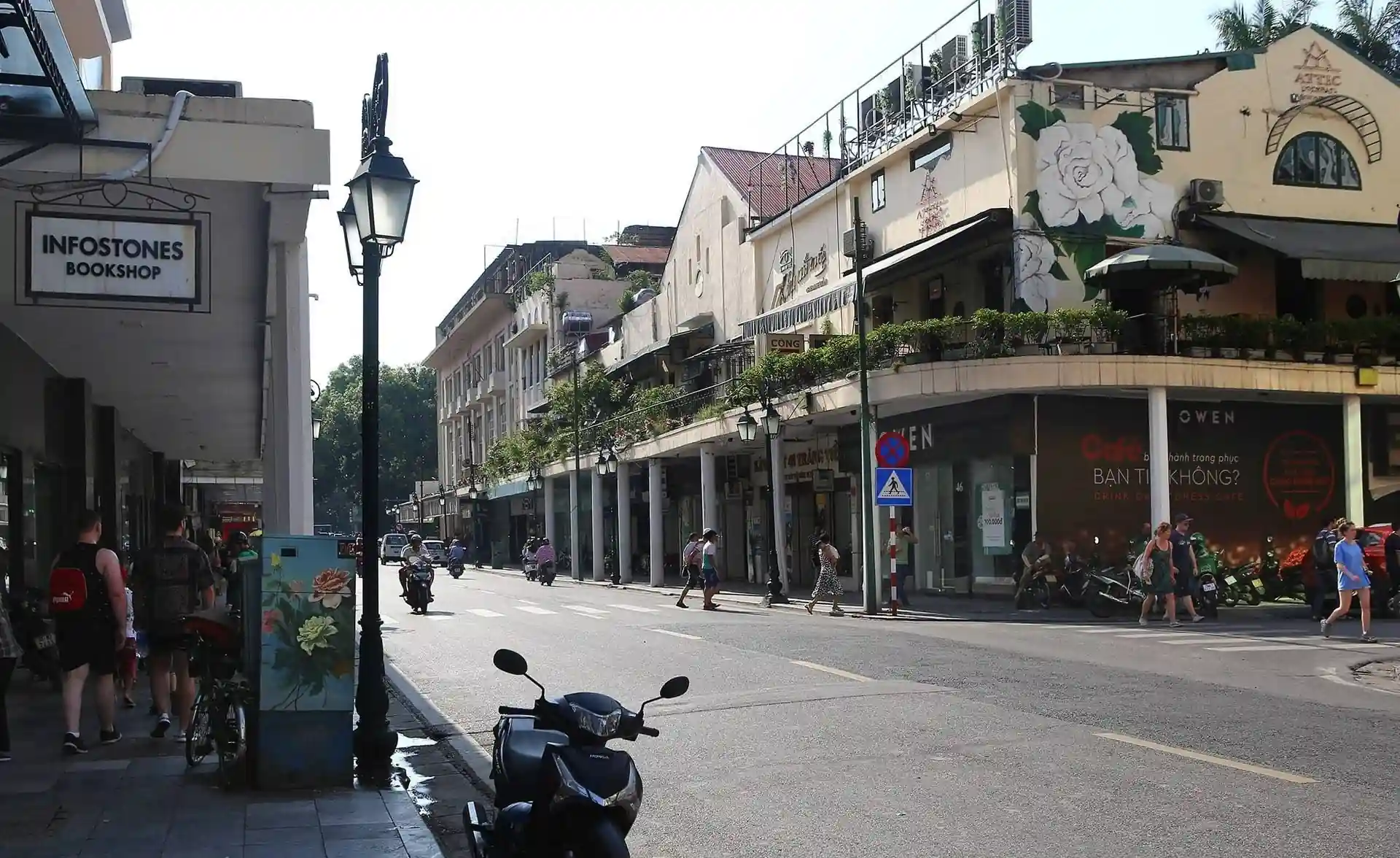
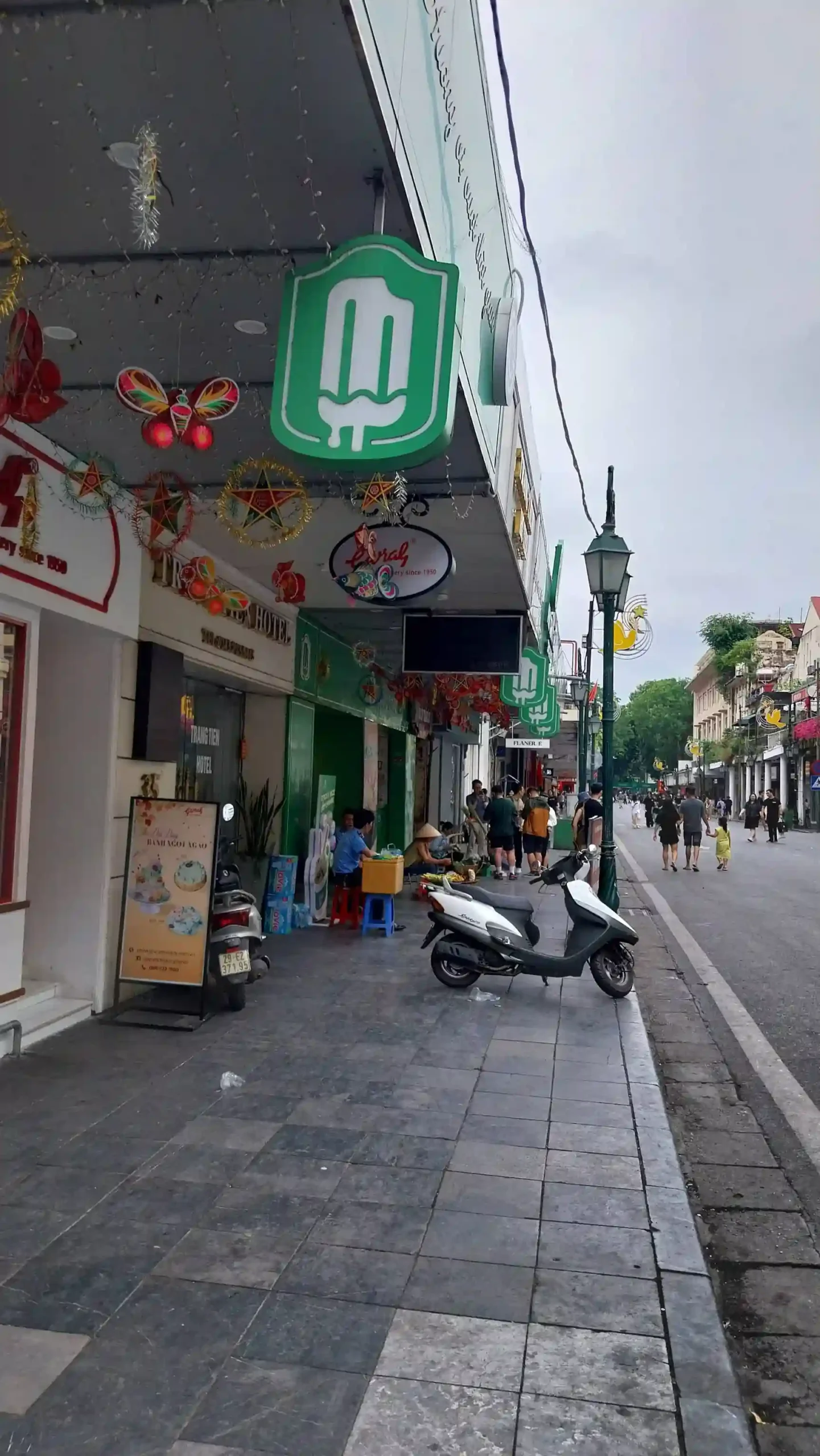
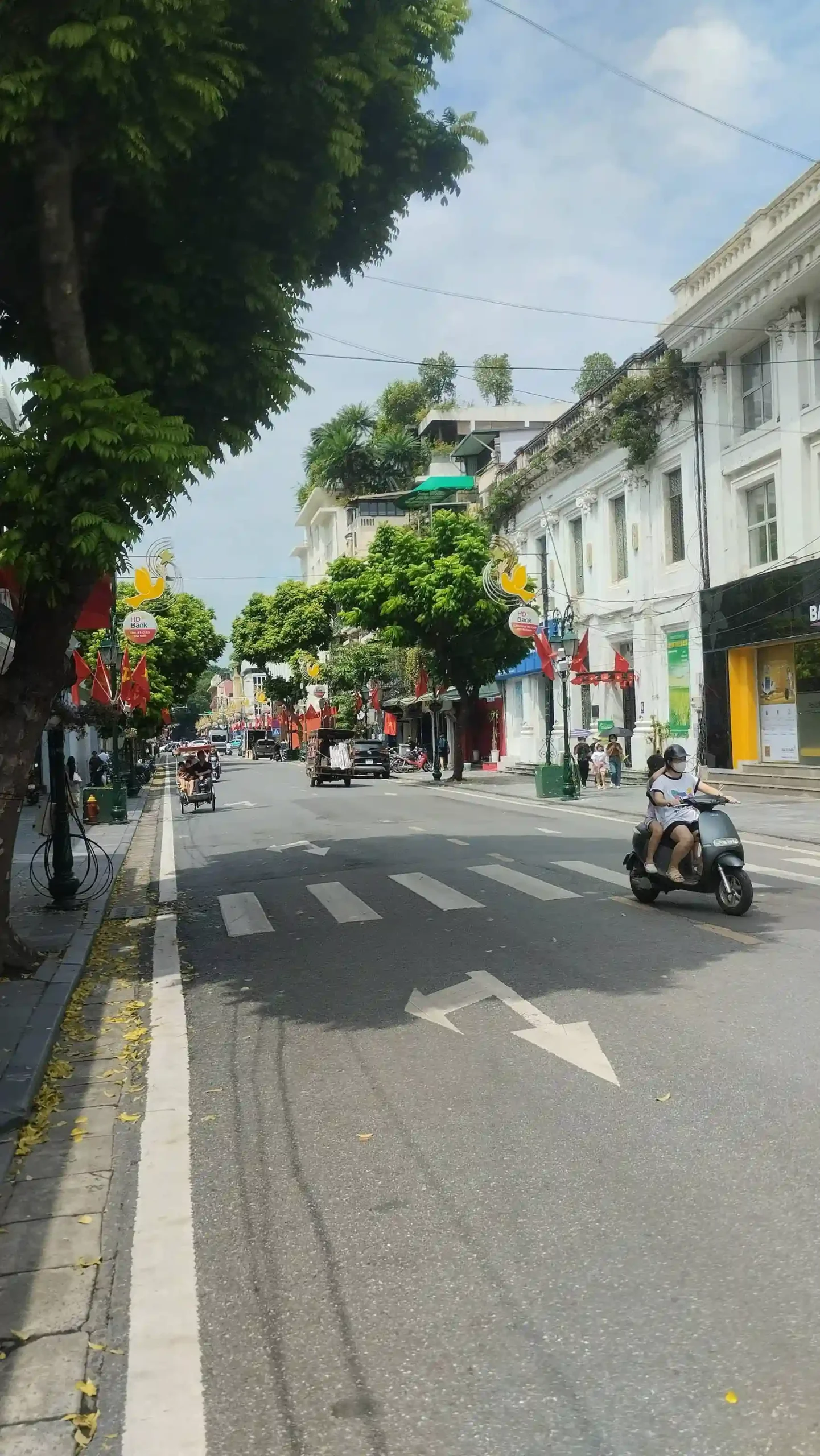
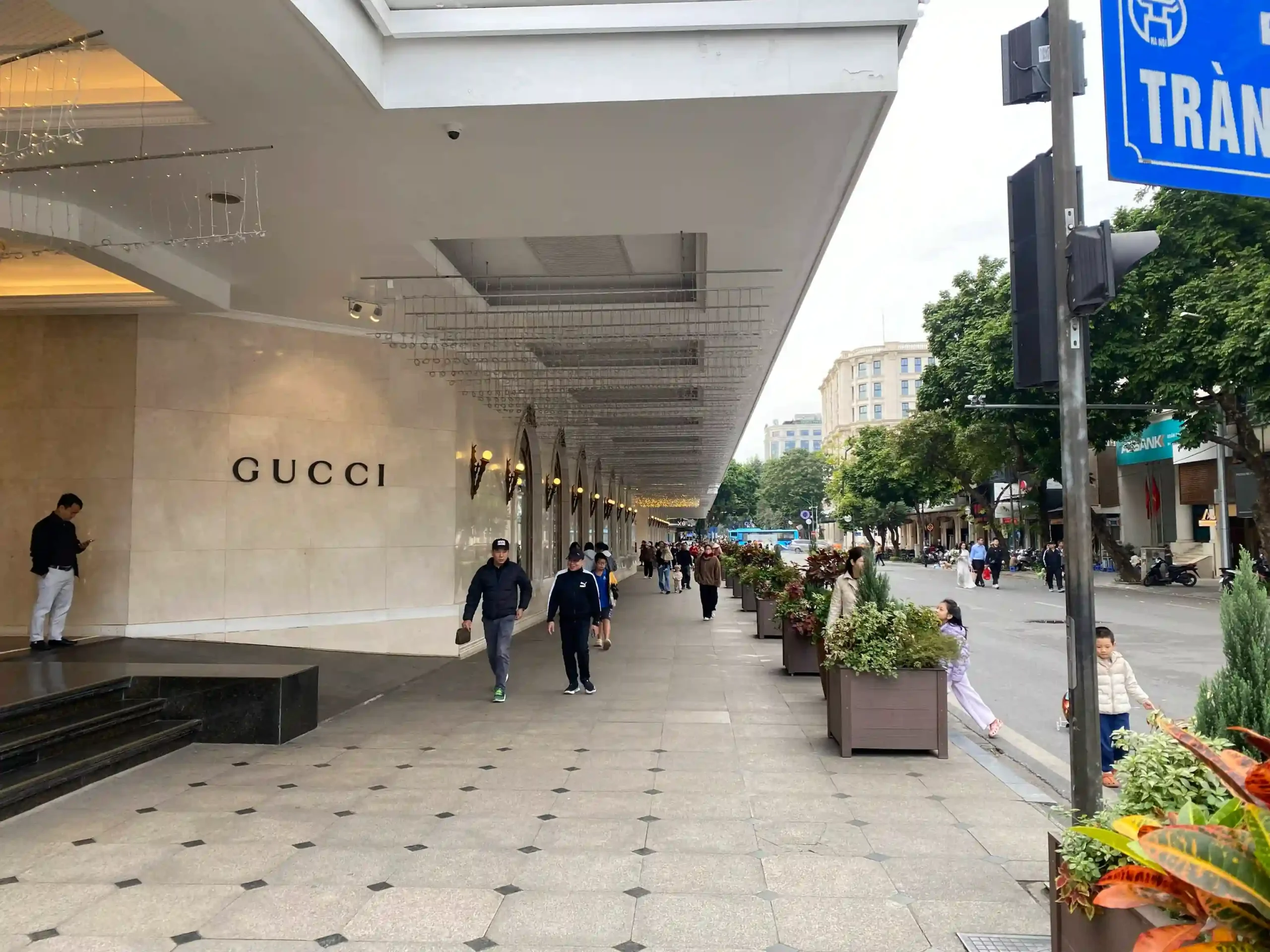
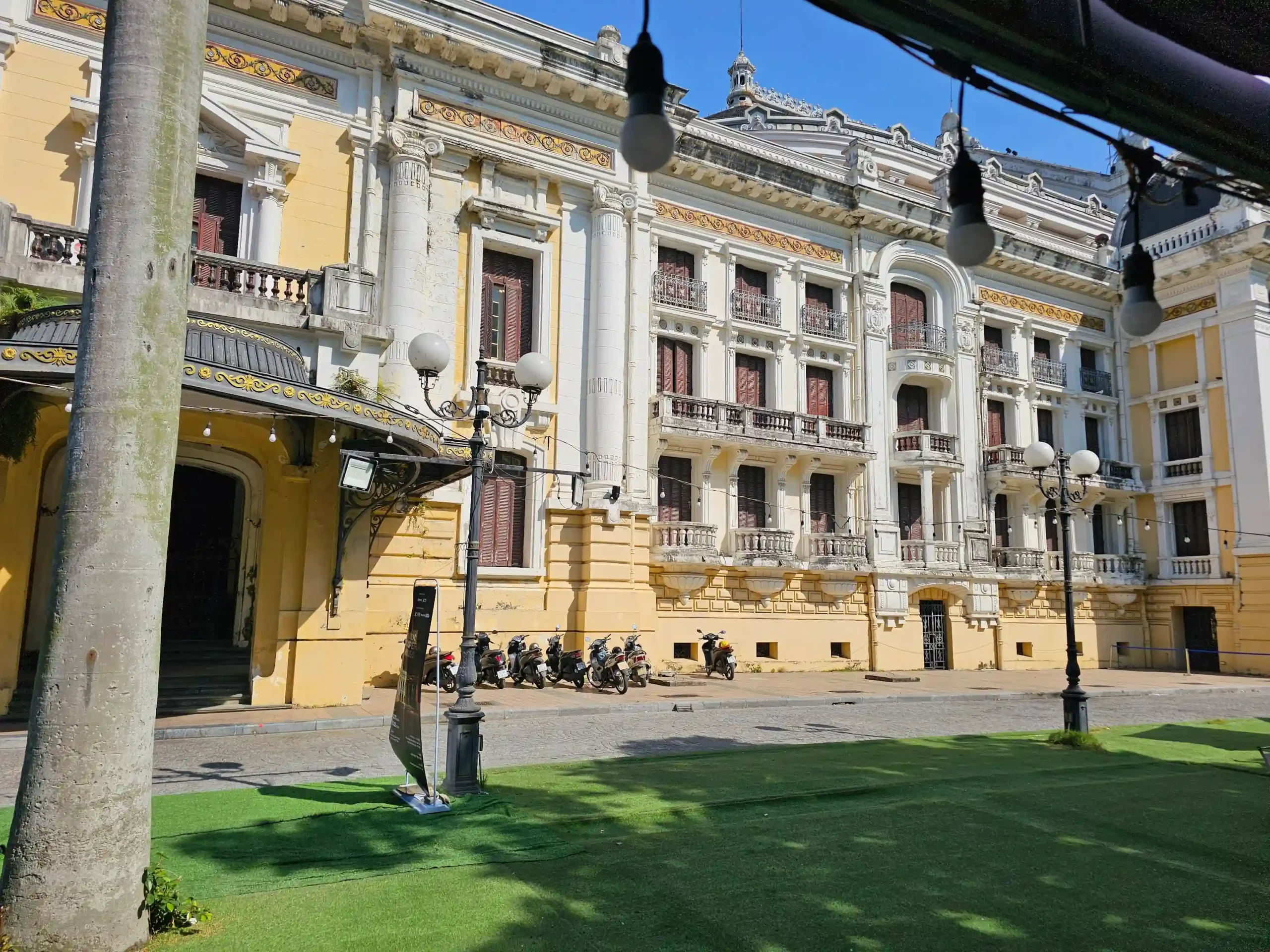
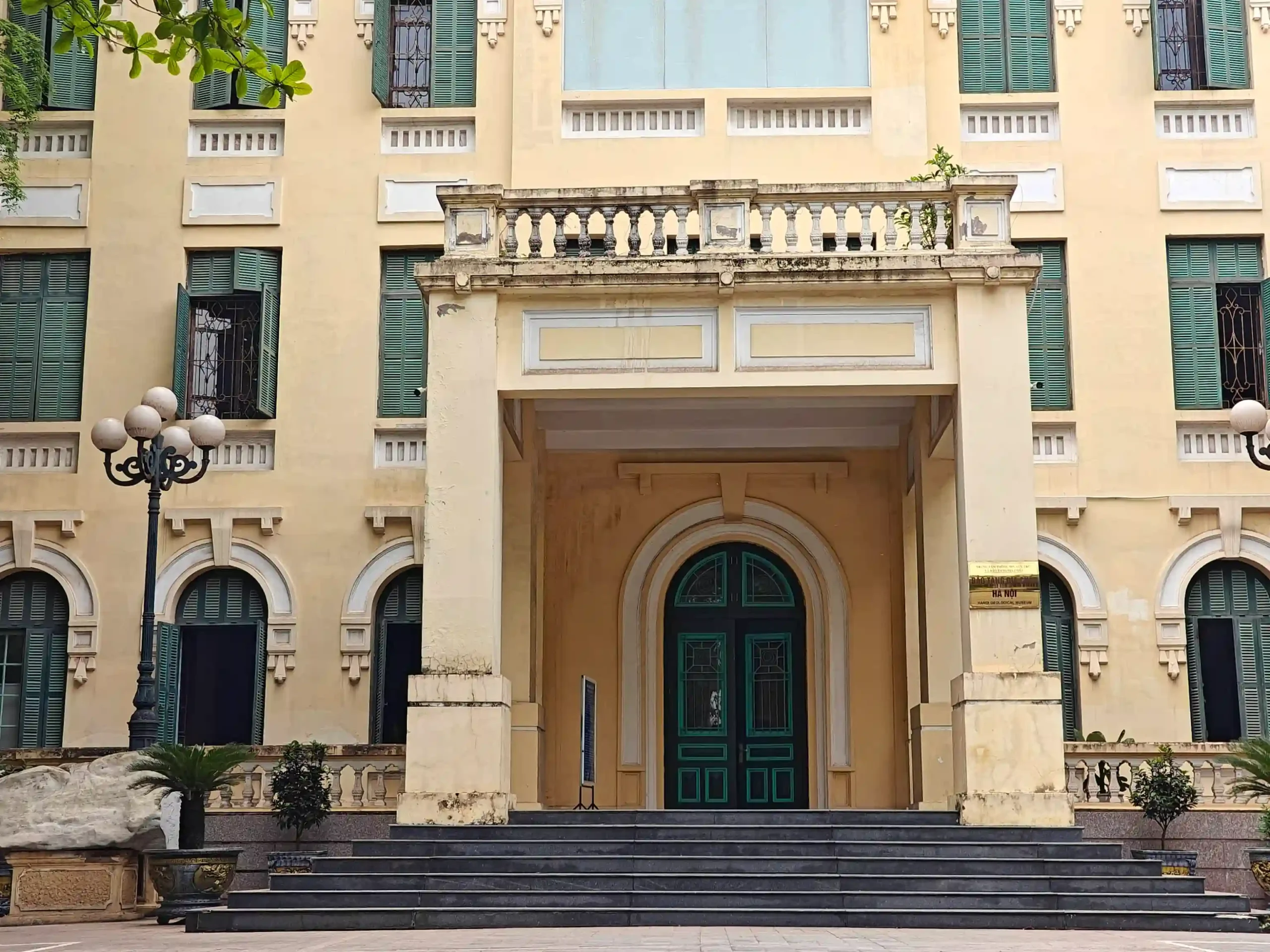
Walk one block over to Trang Tien street and turn east.
Trang Tien was designed by the French as “Rue Paul Bert,” the central shopping promenade of colonial Hanoi.
The architecture here is continuous, with covered arcade walkways supported by heavy square pillars lining the storefronts. This design allowed shoppers to stroll through high-end boutiques while remaining shielded from the intense summer sun or tropical rainstorms.
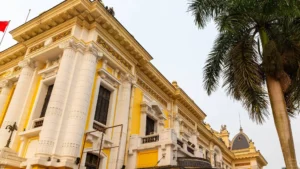
Keep walking east. At the end of the promenade, dominating a massive traffic roundabout, stands the Hanoi Opera House (1 Trang Tien).
Finished in 1911 after ten years of construction, the Opera House was modeled heavily after the Palais Garnier in Paris. It is a prime example of Beaux-Arts architecture, featuring yellow and white plaster walls, a dark grey slate roof imported from France, Italian marble floors, and massive brass chandeliers.
The French built it as a cultural haven for the colonial elite. Today, it still hosts classical concerts and national theater performances.
The building stands entirely alone in the center of the roundabout, with the chaotic traffic of modern Hanoi flowing smoothly around its colonial pillars.
| Route 2 Checkpoint Summary | Intersection / Street | What you are looking for |
|---|---|---|
| Start | 40 Nhà Chung | St. Joseph’s Cathedral’s weathered gray gothic towers. |
| Villas | Lý Thái Tổ Boulevard | Large faded yellow government villas set back from wide sidewalks. |
| Metropole | Ngô Quyền & Lý Thái Tổ | The white exterior of the Metropole Hotel & Dien Hong garden. |
| End | 1 Tràng Tiền | The Hanoi Opera House acting as a visual anchor at the roundabout. |
When it actually makes sense to pay for a guide
By providing the exact turn-by-turn directions above, the goal is to show you that checking off buildings, monuments, and streets on a map is entirely free. You just need to follow a path.
However, architecture is only one half of understanding a city.
A lot of people ask if they should combine their Hanoi walking tour with a food element?
I strongly suggest keeping these separate. Doing an architectural walking route during the day is great for photography. But navigating the reality of Hanoi’s food scene during a walk is where things get complicated.
Food stalls on the streets operate on very specific, undocumented schedules. A woman who serves phenomenal Bun Thang (chicken and egg noodle soup) might only sit on a specific corner of Hang Gai from 6 AM to 9 AM, and then she disappears.
The handwritten signs hanging over soup pots rarely feature English translations, making it difficult to understand exactly what cuts of meat are boiling in the broth.
This is the exact scenario where paying for an expert stops being a luxury and becomes an absolute necessity.
While doing your own historical walk by day is straightforward, booking an guided food walking tour completely opens up the city’s culinary side.
Instead of guessing at menus or just eating generic Phở, a guide leads your group through deep, unmarked alleys where there is no physical storefront.
They handle all the ordering, pay the vendors, ensure the ice is clean, and explain how certain local dishes are cooked using charcoal and fermented ingredients. Trying to replicate an intensive street food walk yourself will mostly result in frustration because the truly spectacular stalls are not found by scrolling Google Reviews.
If this appeals to you, taking an organized street food walk on your first or second day is a smart move.
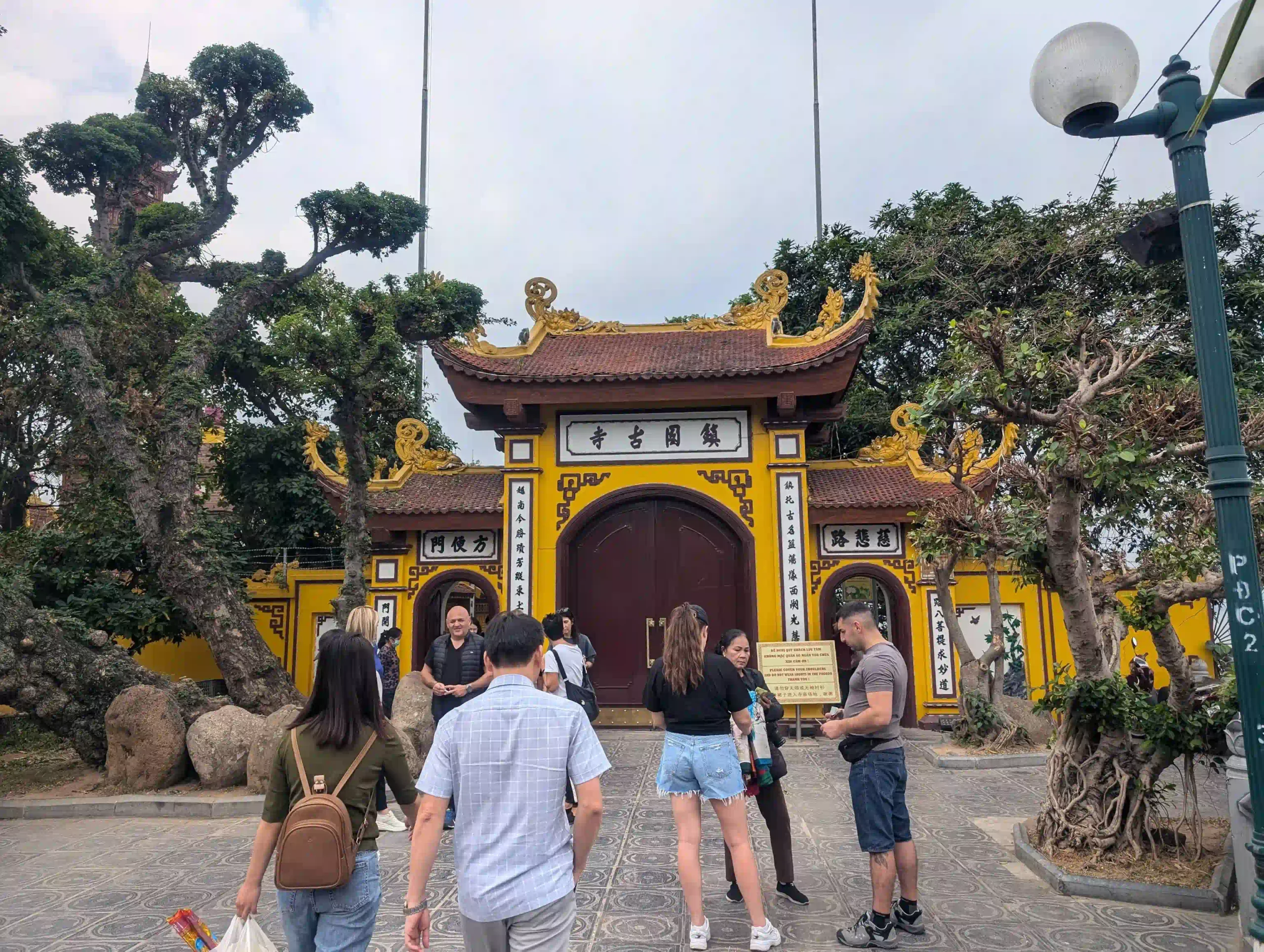
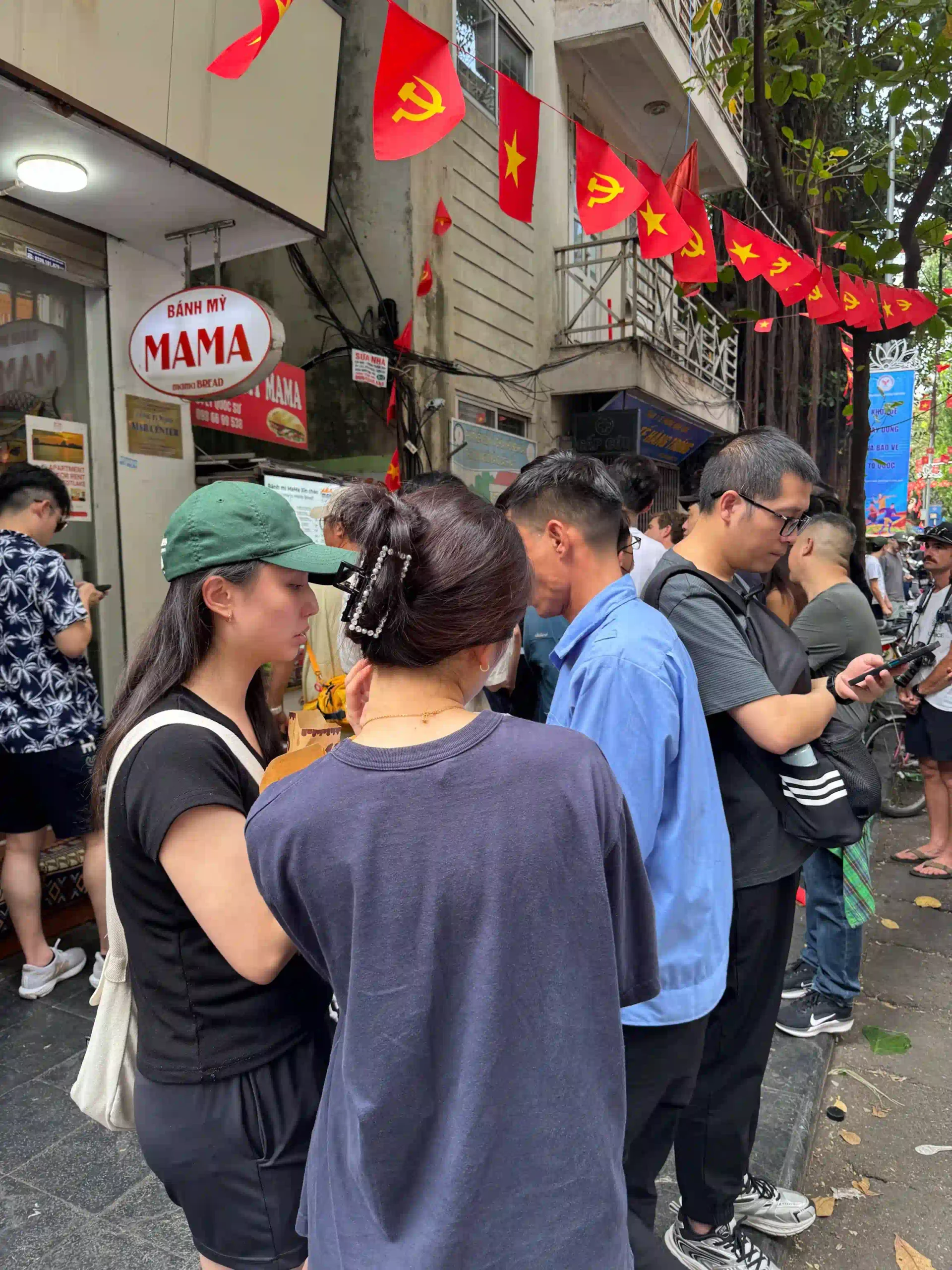
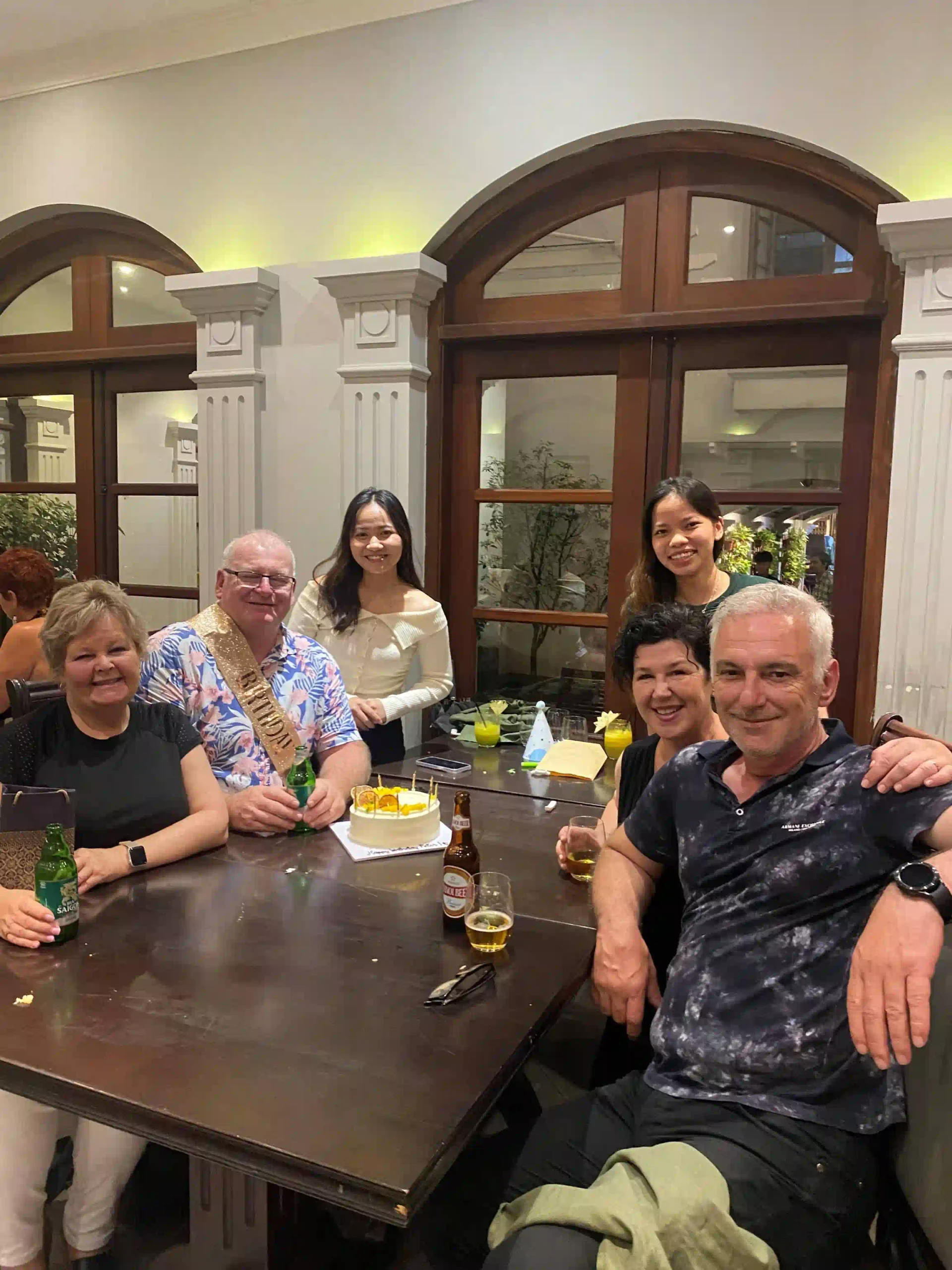
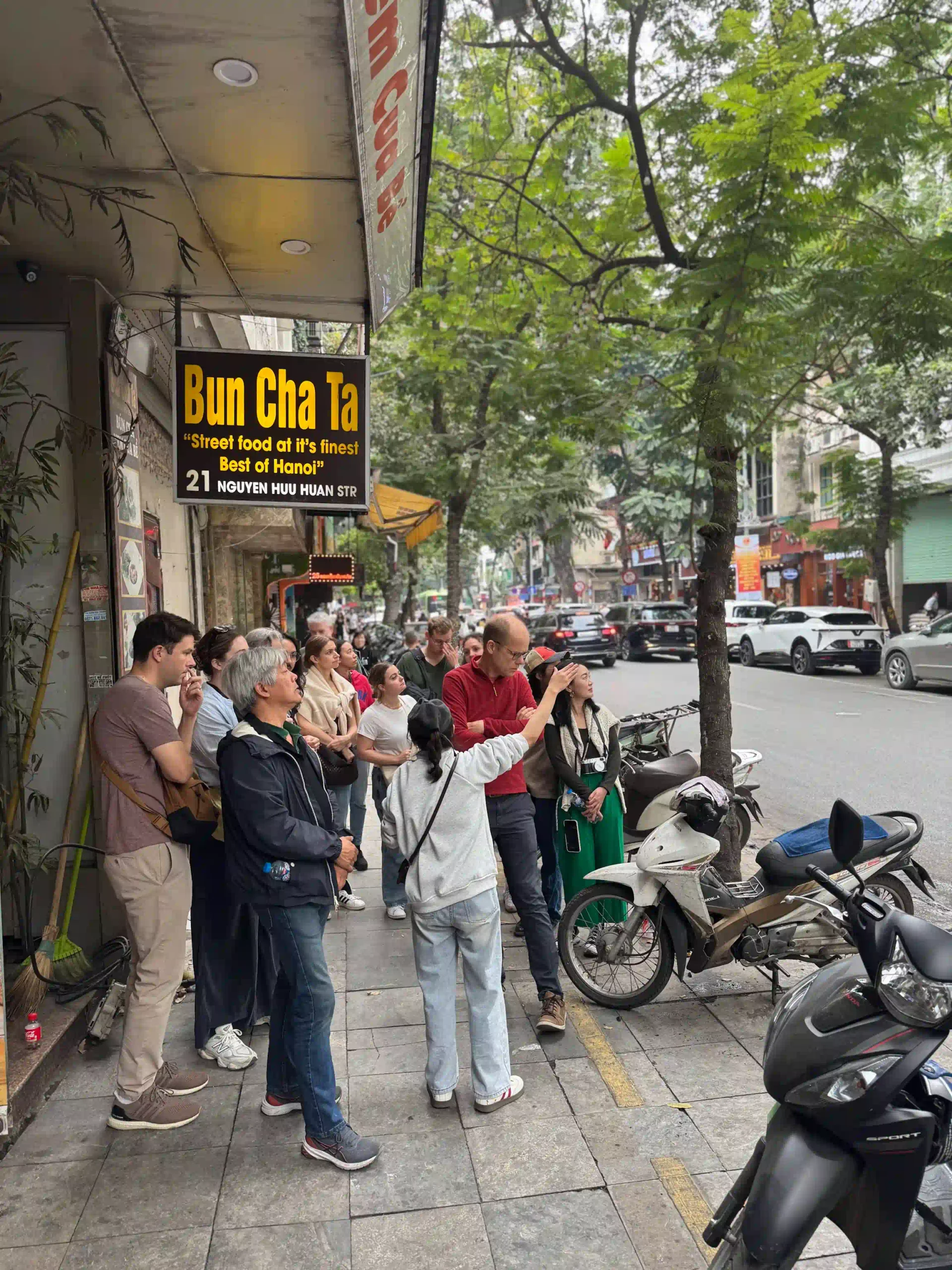
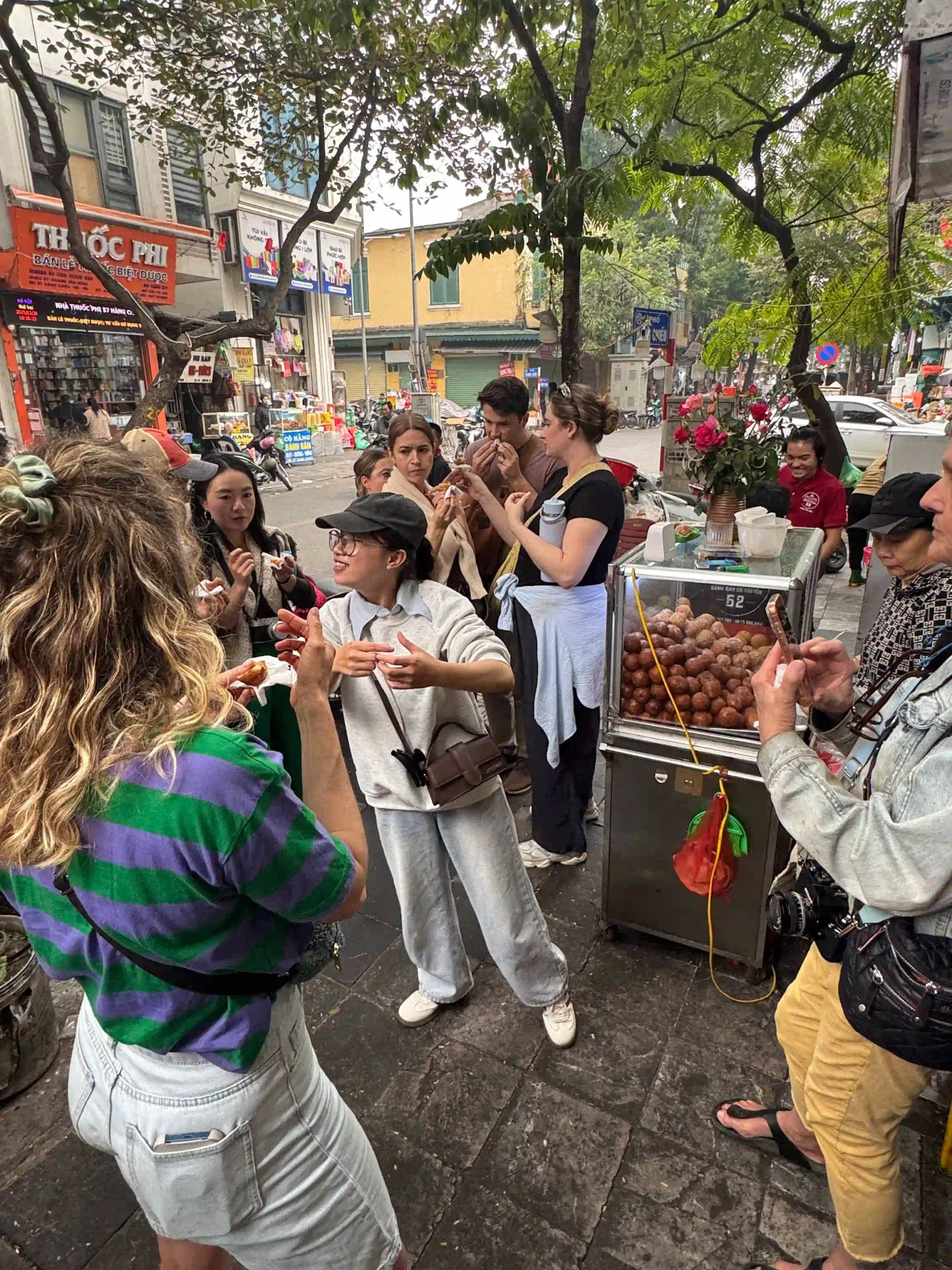
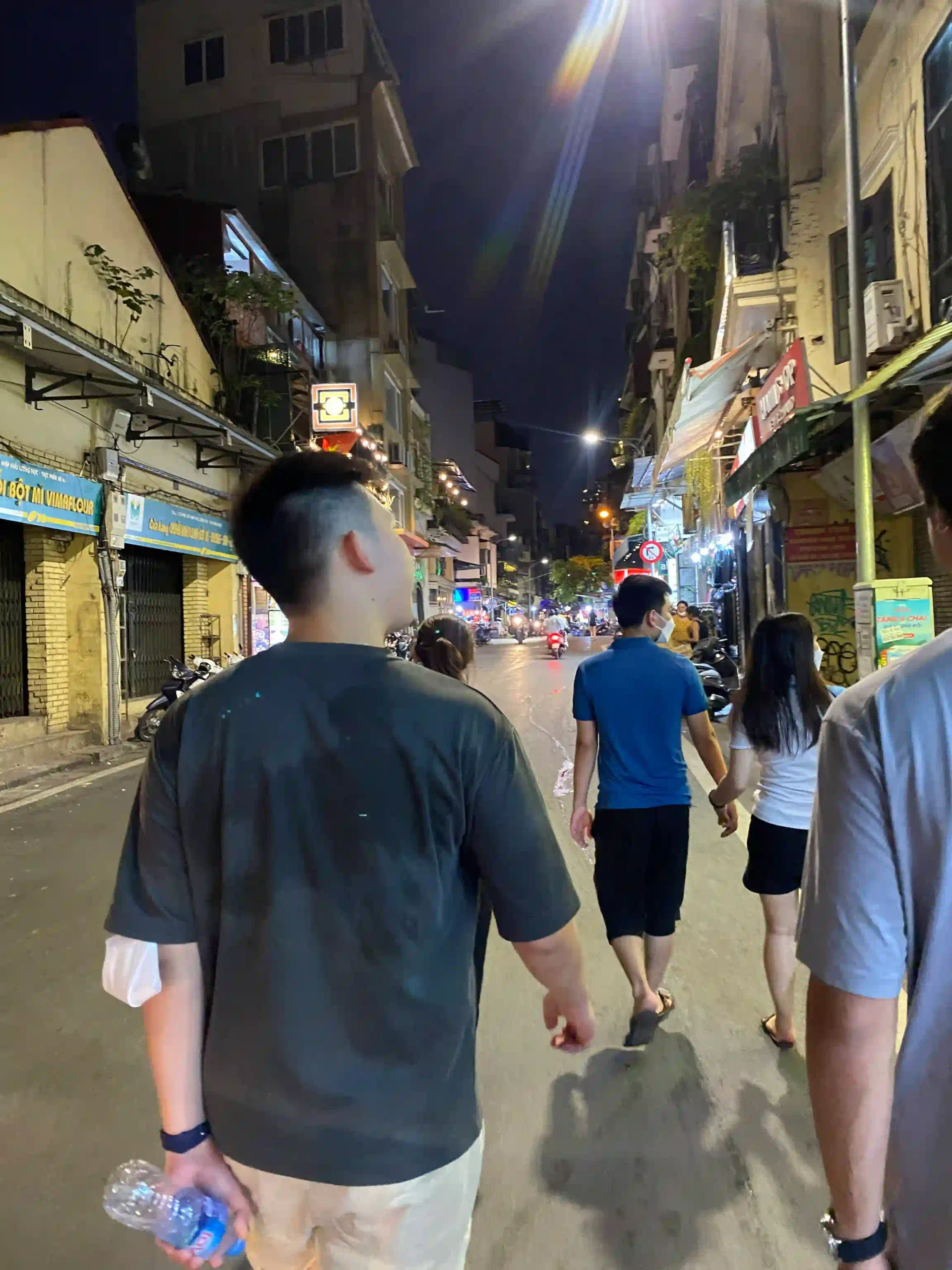
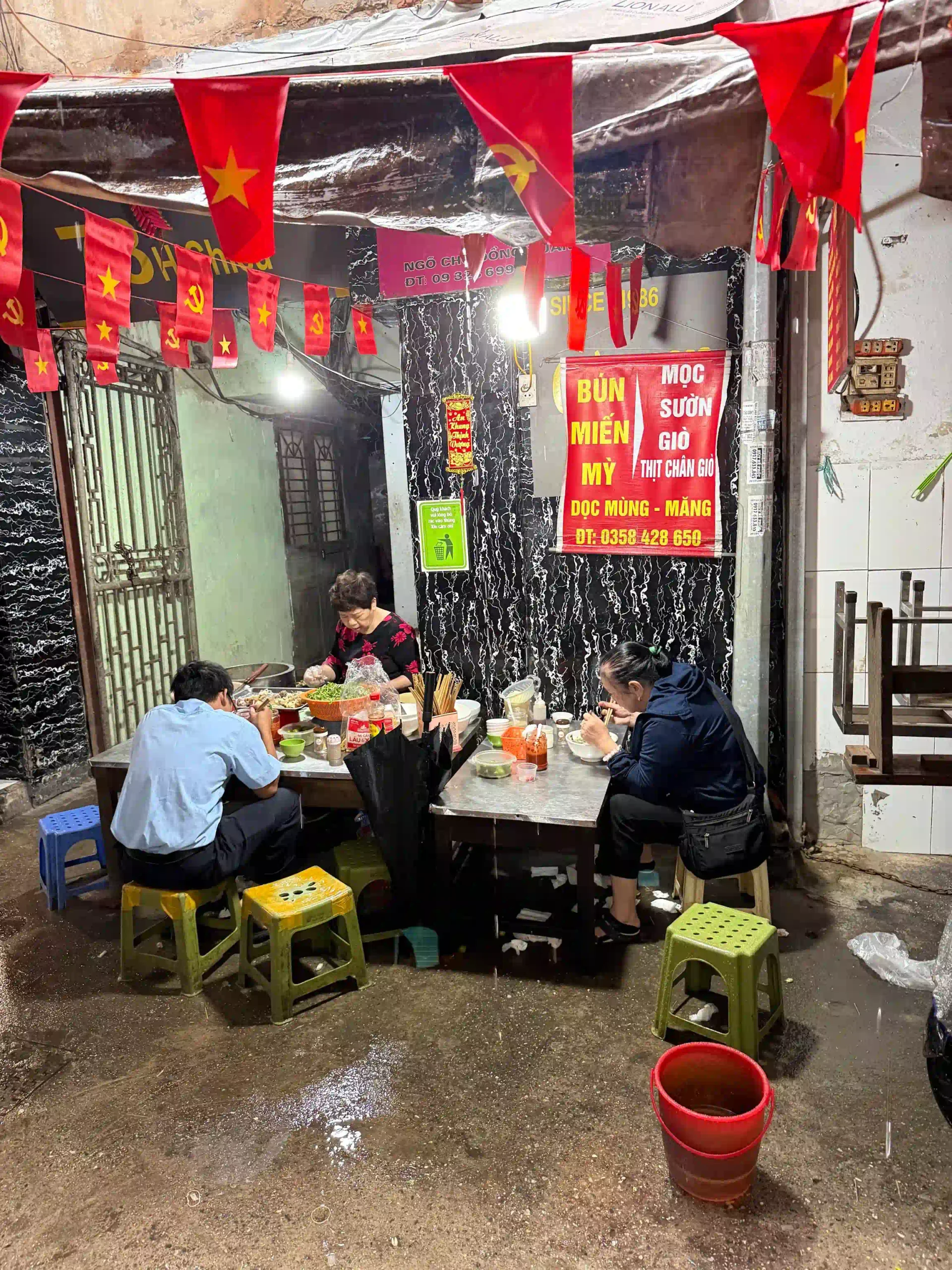
Services operating via local platforms consistently run small-group foodie walks that last about 3 hours, combining walks through the Old Quarter with five or six stops at highly specific vendor locations you would likely walk right past on a self-guided route.
You can check ticket prices and read recent participant feedback for highly rated Hanoi food walking tours here. Doing a guided walk specifically for the local meals complements your self-guided daytime building walks perfectly.
How to Read Hanoi’s Buildings
When you are doing a Hanoi walking tour self guided, you will see a lot of interesting architecture, but it helps to know how to read the visual clues on the facades. The buildings in the Old Quarter are a physical timeline of the city’s political and economic shifts.
Here is how to decipher the walls as you walk:
1. The Pre-Colonial Tube Houses (Nhà Ống)
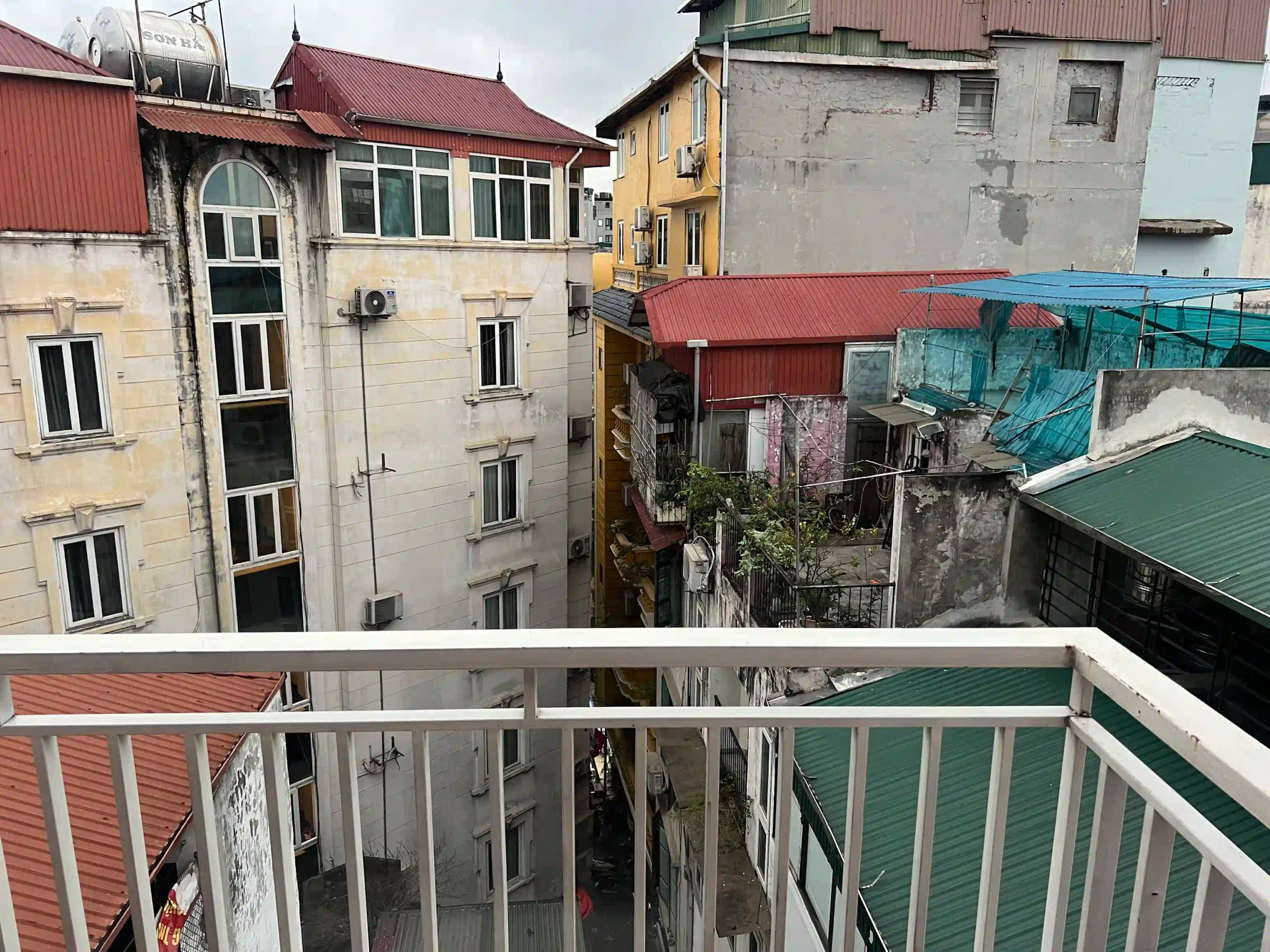
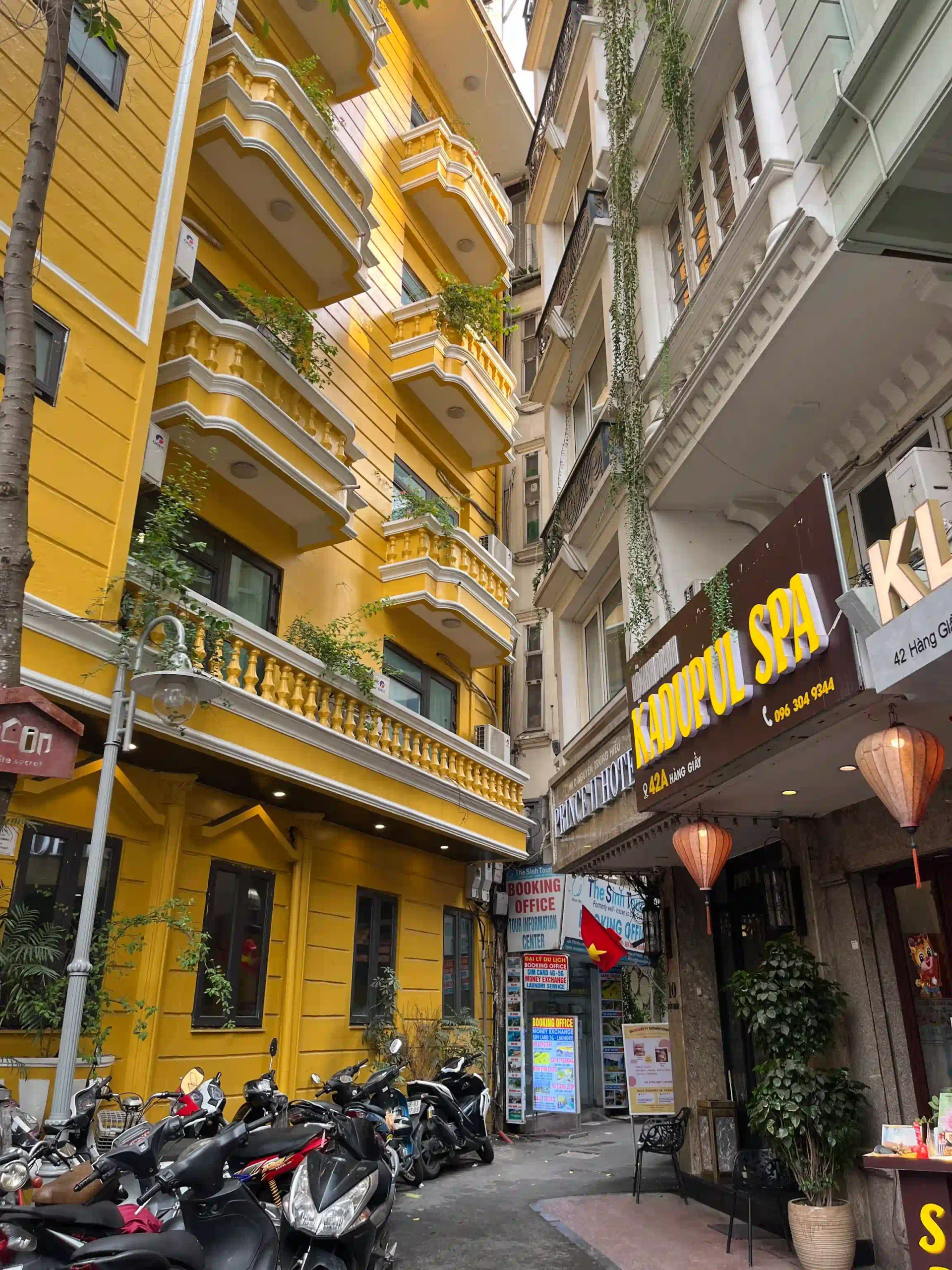
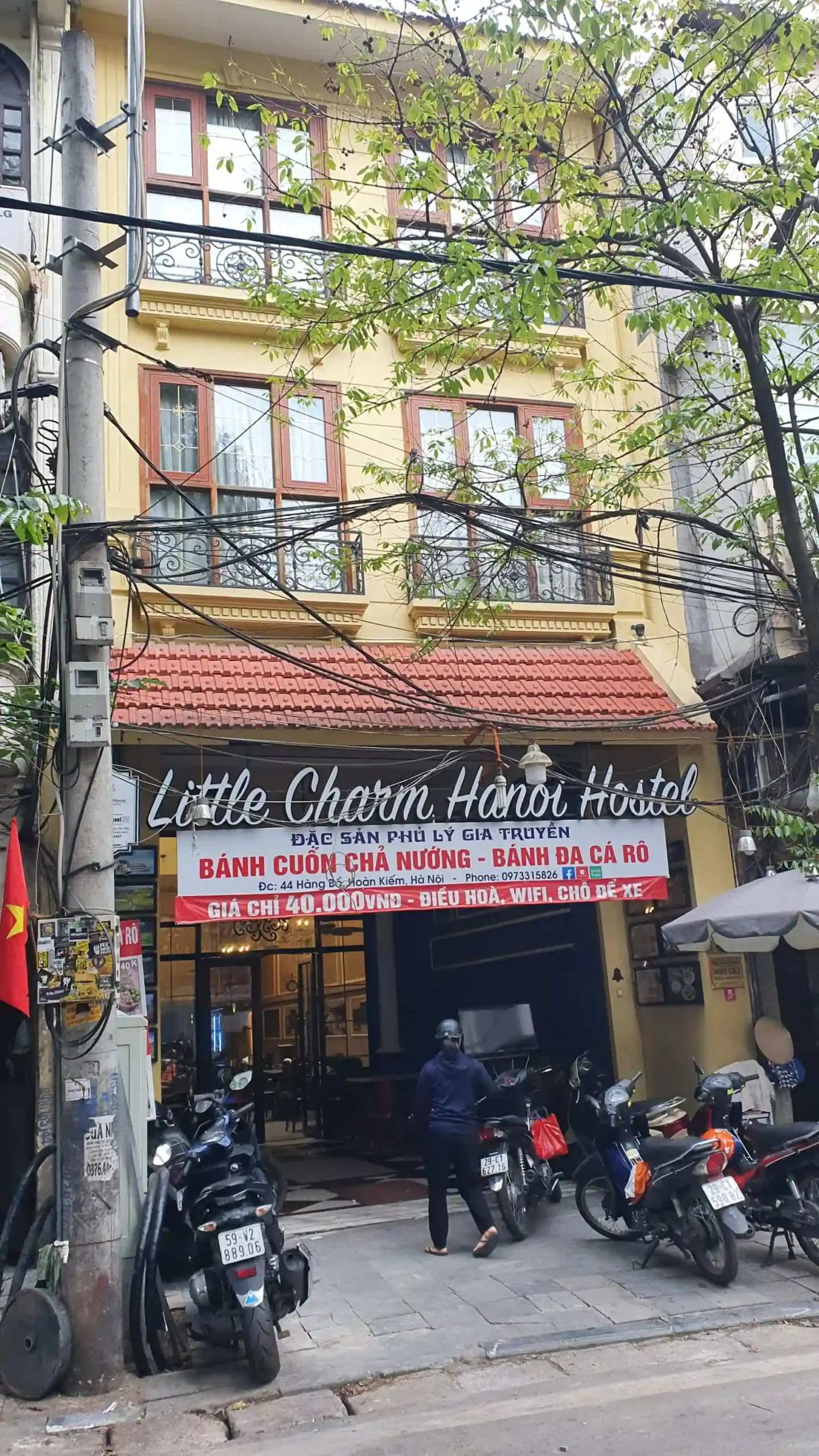
These are the original architectural styles of the merchant class.
- The Shape: Extremely narrow (3 to 4 meters) but very deep (up to 60 meters). This shape was designed to maximize the number of shops that could access the busy street.
- The Roof: Look for the “two-slope” tiled roofs that curve down toward the street, often looking like the scales of a dragon.
- The Facade: Most of these original houses had wooden partitions on the ground floor that could be completely removed during the day to open the shop to the sidewalk.
2. The French Colonial Hybrid (The Indochina Style)
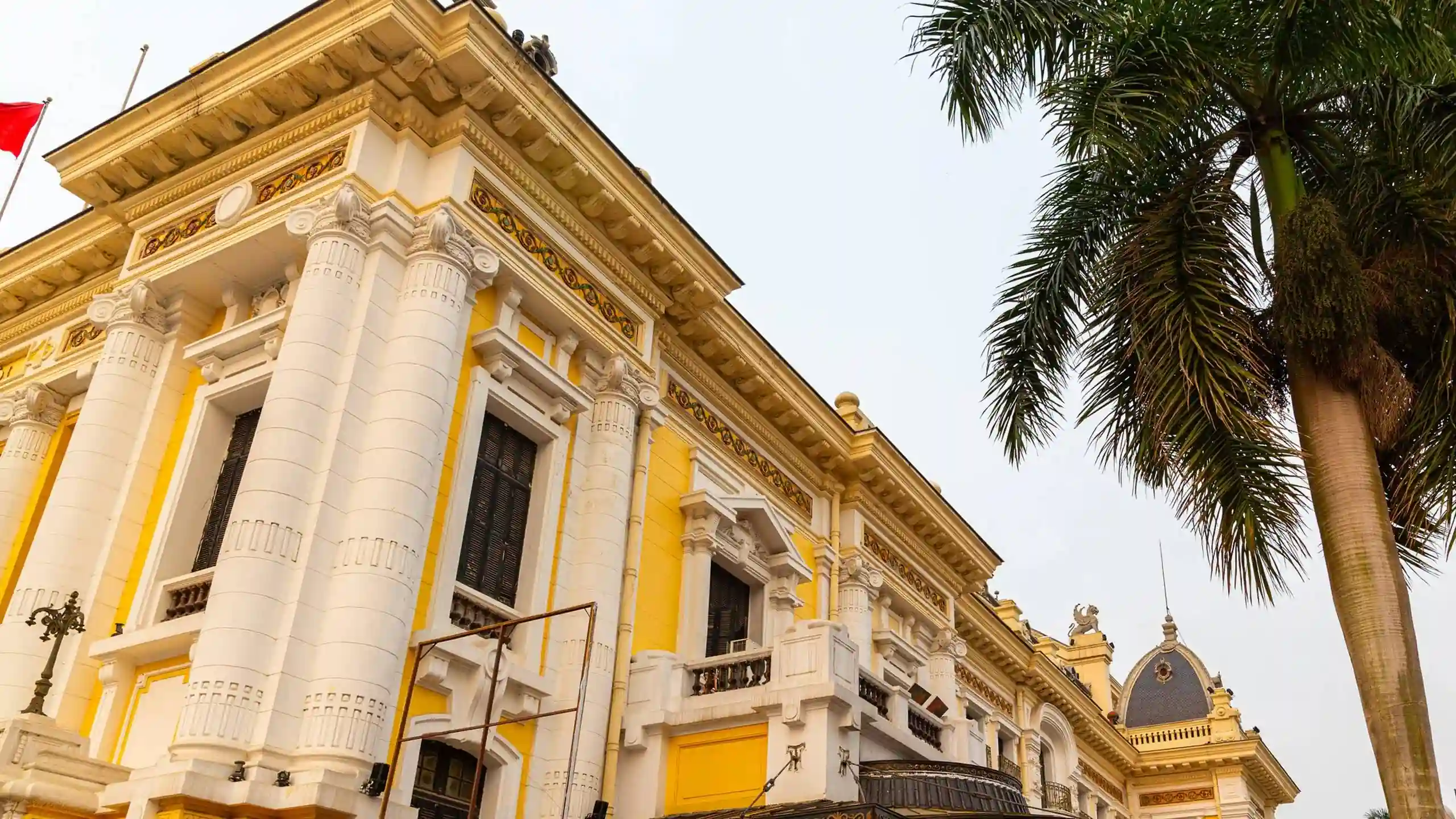
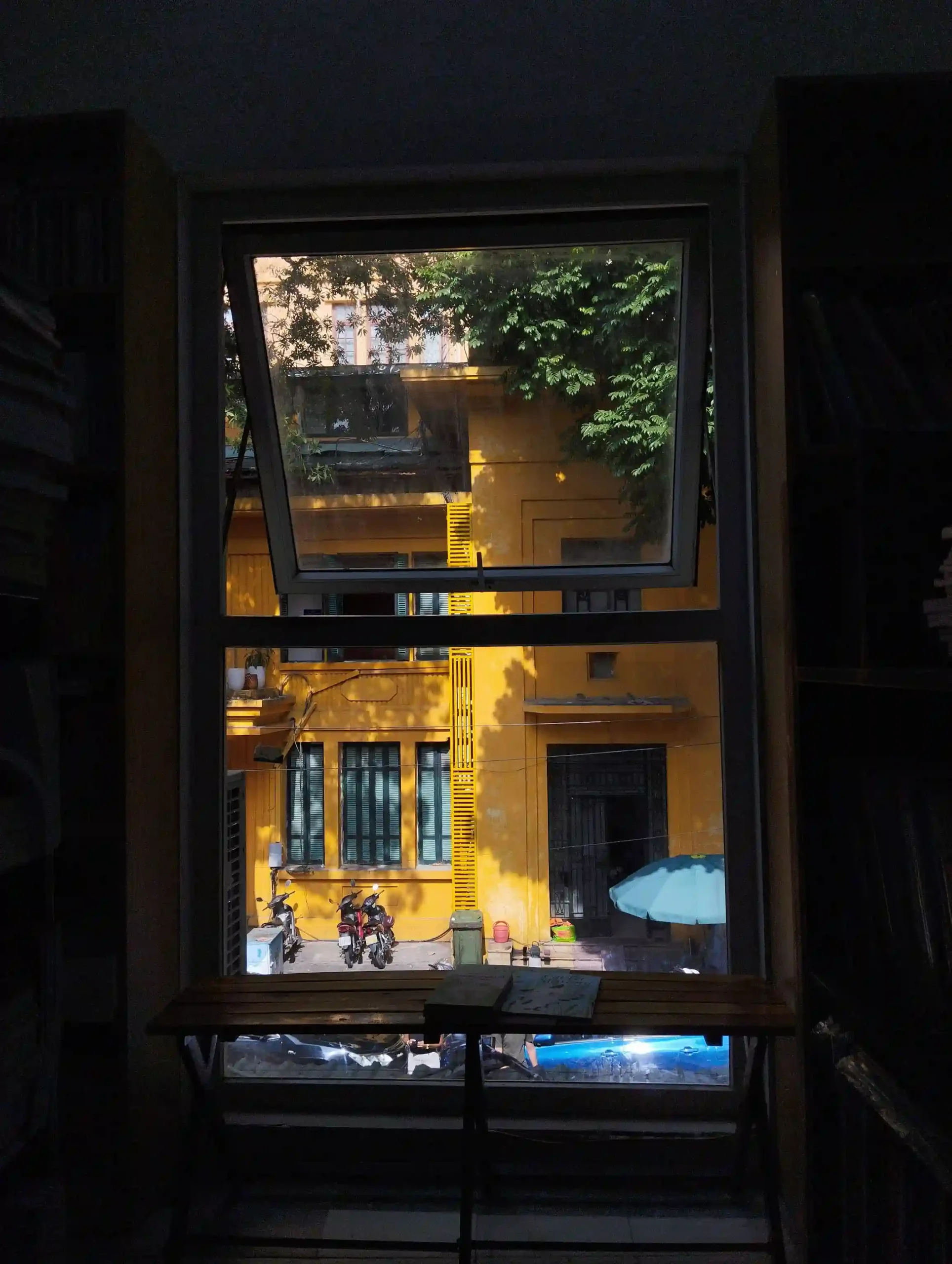
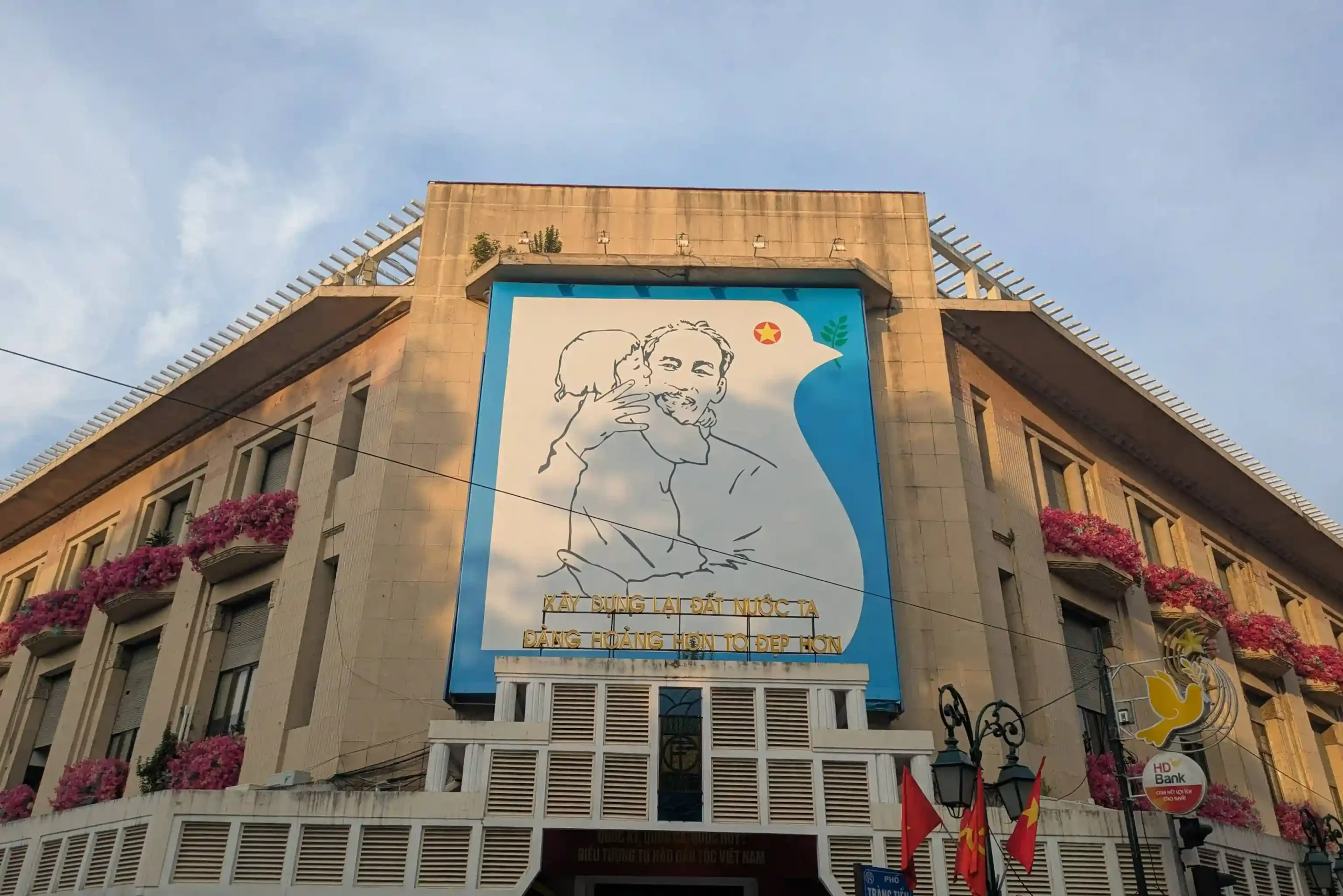
In the 1920s, a French architect named Ernest Hébrard realized that European-style buildings didn’t work well in the humid Vietnamese climate. They were too hot and trapped moisture. He created the “Indochina Style,” which mixed French design with local building techniques.
- The Ochre Paint: Almost all these buildings are painted a specific deep yellow. The French imported this color because it resists the dark mold stains caused by heavy tropical rains.
- The Louvered Shutters: Look at the windows. They feature two sets of shutters: a wooden louvered shutter on the outside to block the sun while letting the air circulate, and a glass window on the inside to seal the room during heavy storms.
- The High Ceilings: The rooms have incredibly high ceilings (often 4 meters) to allow hot air to rise, keeping the living spaces cool.
3. Post-War Soviet Style (Khu Tập Thể)
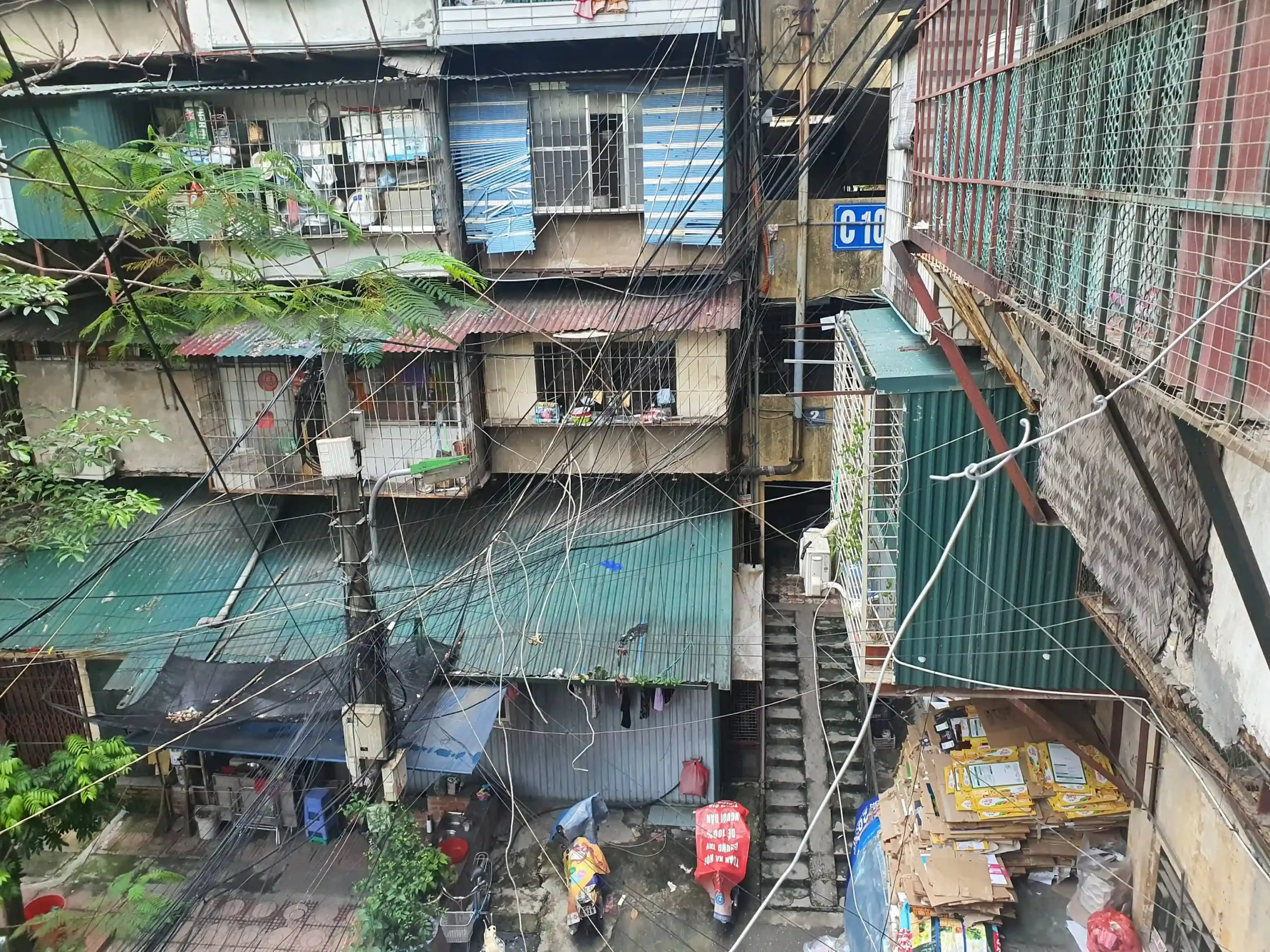
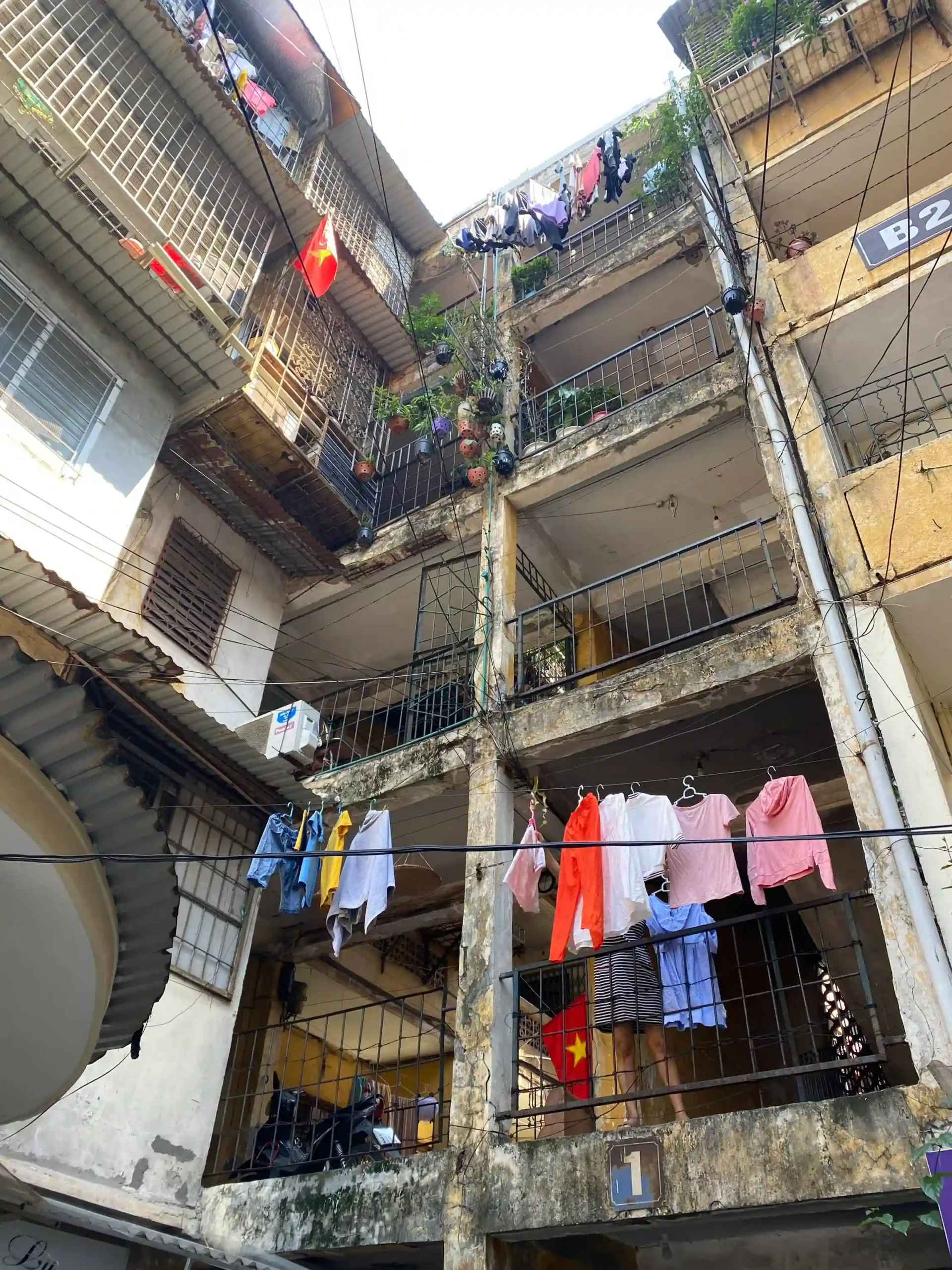
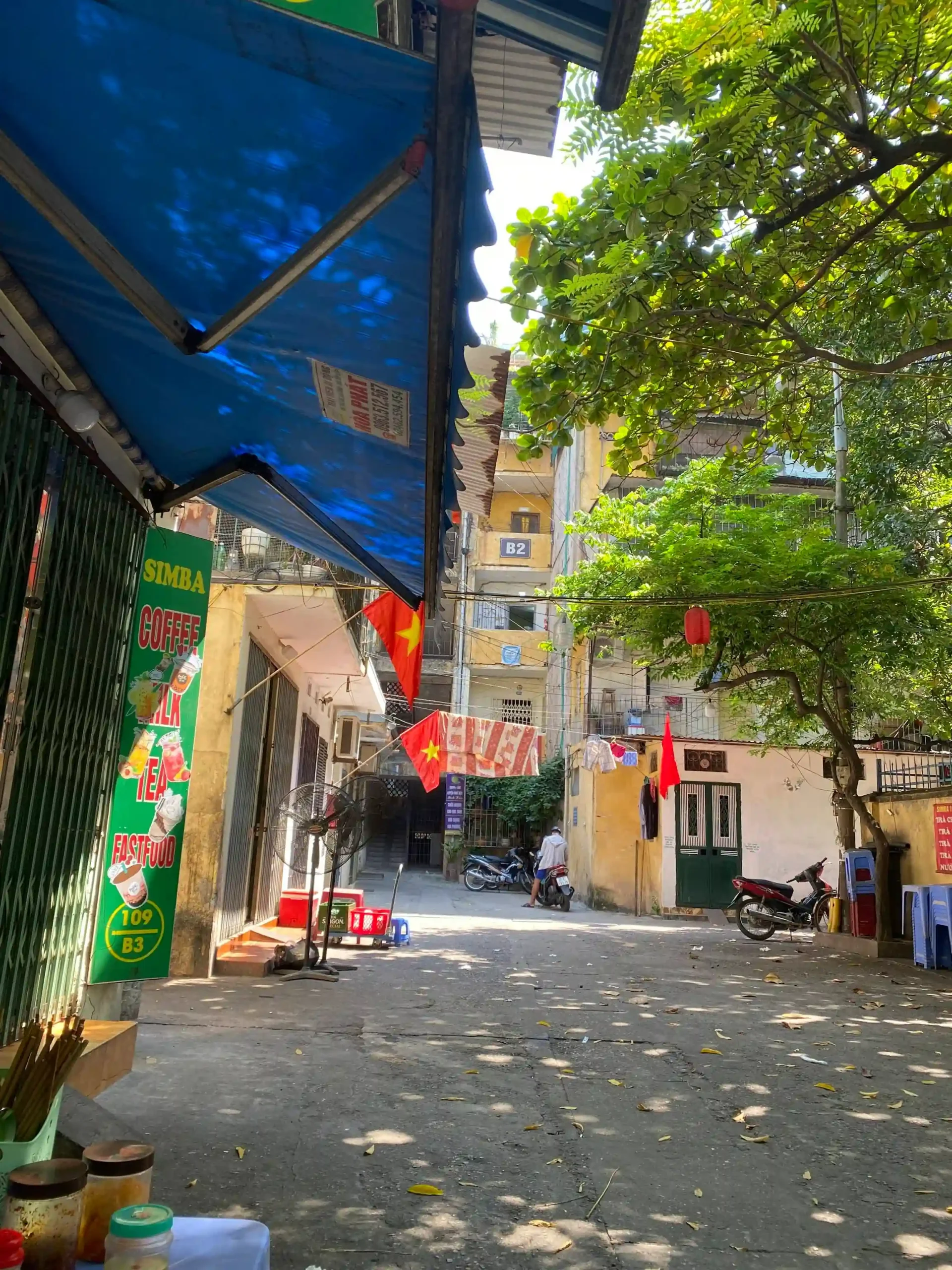
If you walk toward the edges of Ba Dinh or Dong Da, you will see massive concrete apartment blocks. These were built in the 1970s and 1980s with help from Soviet engineers to house workers.
- The Grey Concrete: These are blocky, highly functional apartment buildings.
- The “Tiger Cages” (Chuồng Cọp): Look up at the balconies. You will see rusty iron cages bolted onto the concrete structures, extending out over the street. Families built these cages to expand their living space or to create a safe place to dry clothes and grow plants.
Survival Realities for Pedestrians
Walking in Hanoi is not like walking in Tokyo or London. It requires a completely different set of physical habits. To complete these routes without getting exhausted or frustrated, keep these details in mind.
1. The Sidewalk Navigation Rule
Do not get angry when you realize the sidewalks are completely blocked by parked scooters, fruit vendors, and low plastic tables.
The sidewalk in Hanoi is a commercial space, not a walking path.
Accept that you will be walking on the asphalt of the road for about 50% of your tour. Walk on the very edge of the road, facing the oncoming traffic where possible, so you can see what is coming toward you. Keep your movements predictable.
2. Avoid the Midday Heat
The summer weather in Hanoi is incredibly heavy. The humidity traps the heat close to the asphalt, and the concrete buildings reflect the sun back onto the street.
If you try to walk Route 1 at 1:00 PM in July, you will get dehydrated very quickly. Split the walks. Walk the Old Quarter (Route 1) early in the morning when the shops open, and walk the French Quarter (Route 2) in the late afternoon when the tree canopy provides solid shade.
3. Use Clean Resting Points
Because public toilets are rare and often poorly maintained, do not try to search for one on the street.
When you need a restroom or a break from the heat, walk into a modern, air-conditioned cafe. Buy a bottle of water or a tea, sit down for fifteen minutes, use their clean facilities, and then resume your walk. It is a much more comfortable way to handle logistics.
4. Keep Your GPS Active
The narrow alleys of the Old Quarter can disrupt GPS signals occasionally, and the street names can be confusing because many start with the word “Hàng.”
Download an offline version of your map on your phone before you leave your hotel. Having active mobile data is incredibly helpful for tracking your location in real time as you navigate the tight intersections.
That is the entire route. Put the maps into your phone, take your time, and enjoy the walk.

Keep Exploring Hanoi
-
See & do UltimateReal things to do in Hanoi for travelers who hate big crowds ›
-
Route Must readDecide how many days in Hanoi with this ultimate guide! ›
-
RouteThe local way to a 2-day Hanoi weekend itinerary ›
-
RouteHow I’d spend 1 week in Hanoi on a Mid-Budget ›
-
RouteThe only Vietnam 2-week itinerary you’ll ever need !!! ›











 Tiếng Việt
 한국어
한국어 中文 (中国)
 日本語
日本語 ไทย
ไทย Deutsch
 Español
 Destinations
 Instagram
 Facebook
 X (Twitter)
 Threads
 Tiktok